
Confidential Computing in 2026: Protecting Sensitive Data in Use
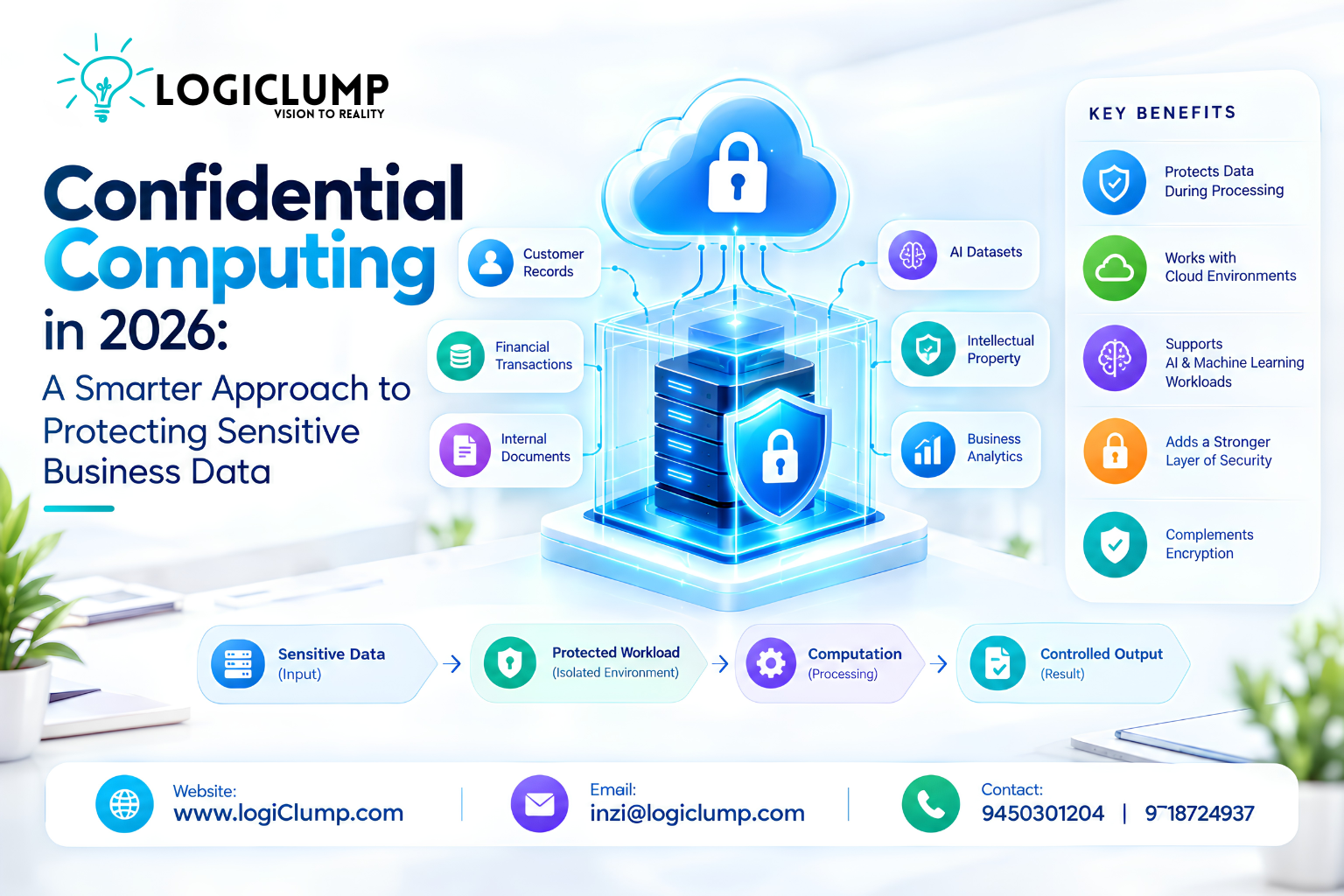
Businesses are processing more sensitive information than ever before. Customer records, financial transactions, internal documents, AI datasets, intellectual property, and business analytics are increasingly handled through cloud platforms and connected applications.
Most organizations already understand the importance of encrypting stored information and securing data as it travels between systems. But there is another stage that deserves equal attention: what happens to the data while software is actively using it?
This is the problem confidential computing is designed to address.
By creating protected environments for sensitive workloads, confidential computing can add another layer of security around information while it is being processed.
What Exactly Is Confidential Computing?
Confidential computing is a security approach focused on protecting data during computation.
A useful way to understand the data lifecycle is to divide it into three states:
- At rest: Data saved in databases, servers, storage systems, or backups
- In transit: Data moving between applications, devices, APIs, or servers
- In use: Data being actively processed by applications or computing systems
Traditional security strategies have become very effective at protecting stored and transmitted data. However, applications still need access to information to perform calculations, generate results, run analytics, or operate AI models.
Confidential computing introduces hardware-supported isolation mechanisms that can help protect these sensitive workloads while they are running.
Why Is Data in Use a Security Concern?
Imagine a business application processing confidential customer or financial information.
The database may be encrypted.
The connection between the application and database may also be encrypted.
But at some point, the application needs to read the information and process it.
That creates a different security requirement.
Confidential computing focuses on reducing the exposure of sensitive information during this processing stage by placing selected workloads inside protected execution environments.
The goal is not simply to encrypt information before processing it, but to create stronger protection around the computation itself.
How Confidential Computing Works
Confidential-computing implementations vary between hardware and cloud platforms, but the general concept is straightforward.
A sensitive application or workload runs inside a specially protected environment. The environment uses hardware-based security features to isolate the workload from unauthorized access.
A simplified workflow can be viewed as:
Sensitive Data → Protected Workload → Computation → Controlled Output
An important part of some confidential-computing architectures is attestation.
Attestation allows a system to verify that a workload is running in an expected protected environment before sensitive information is provided to it.
This can help establish trust between systems before confidential data is processed.
Confidential Computing Does Not Replace Encryption
One common misconception is that confidential computing is an alternative to encryption.
It is better understood as an additional security layer.
A modern application may need protection across all three stages:
Stored Data
Encryption protects databases, storage, backups, and other persistent information.
Moving Data
Encryption protects information travelling between applications, APIs, servers, and devices.
Processed Data
Confidential computing can help protect selected workloads while sensitive information is being processed.
Using these approaches together can provide a more comprehensive data-security strategy.
Why Cloud Computing Makes This More Relevant
Cloud infrastructure has become a standard part of modern software development.
Businesses use cloud services for application hosting, databases, analytics, AI processing, backups, and distributed workloads.
However, cloud environments can involve multiple layers of infrastructure and administrative access. Organizations therefore need to carefully consider how much trust is placed in the underlying computing environment.
Confidential computing can help strengthen the isolation of sensitive workloads in supported cloud environments.
This can be particularly useful when businesses need to process confidential information without unnecessarily exposing it to other infrastructure layers.
Confidential Computing and Artificial Intelligence
AI is creating new requirements for data protection.
An enterprise AI application might process:
- Private company documents
- Customer information
- Financial records
- Proprietary research
- Internal reports
- Confidential datasets
- Business intelligence
Companies want the benefits of AI without losing control over sensitive information.
Confidential computing can support certain AI workloads by providing protected environments for data processing and model execution.
This is especially relevant as businesses move beyond AI experiments and begin deploying AI systems into real operational workflows.
Protecting Machine-Learning Workloads
Machine learning depends heavily on data.
In many industries, the dataset itself may represent a valuable business asset. Organizations may also need to collaborate on analytics or machine-learning projects without giving every participant unrestricted access to the underlying information.
Protected computing environments can support some of these scenarios by restricting direct access to data while allowing approved computation to take place.
Potential applications include:
- Fraud analysis
- Financial modeling
- Healthcare research
- Risk assessment
- Customer analytics
- Business intelligence
- Collaborative AI projects
The exact architecture depends on the workload, hardware capabilities, and security requirements.
Confidential Computing in FinTech
Financial technology is one area where data protection is particularly important.
Modern FinTech systems can process enormous amounts of sensitive information, including transactions, account records, trading information, customer profiles, and risk data.
Confidential computing can complement existing security controls in areas such as:
- Financial analytics
- Fraud detection
- Risk calculations
- Sensitive customer-data processing
- Trading-related workloads
- Cloud-based financial applications
It should not be viewed as a standalone security solution. Instead, it can become part of a broader architecture involving encryption, identity management, access control, monitoring, and secure APIs.
Potential Applications in Healthcare
Healthcare organizations work with highly confidential information.
Patient records, medical research, diagnostic information, and health-related datasets require strict security controls.
As healthcare providers and technology companies increasingly use cloud computing and AI, protecting information during computation becomes another consideration.
Confidential computing can provide an additional mechanism for selected healthcare workloads where sensitive data needs to be processed in a controlled environment.
For example, organizations could explore protected environments for certain analytics, AI inference, or collaborative research workloads.
The Connection Between Confidential Computing and APIs
APIs are at the center of modern digital applications.
A typical system might look like:
Mobile App → API → Application Server → Database → AI Service
Every component introduces security considerations.
Secure communication and strong API authentication are essential, but they address only part of the overall security problem.
After an API request is authorized, the application still needs to process the associated information.
Confidential computing can complement API security by adding protection around sensitive workloads that process the data.
This creates a layered security model rather than relying on a single defensive mechanism.
Confidential Computing and Zero-Trust Architecture
Zero Trust has become an important security approach for modern organizations.
Instead of automatically trusting users, devices, applications, or networks, Zero Trust requires access to be verified and restricted according to defined policies.
Confidential computing can complement this philosophy by adding protection at the workload level.
A mature security architecture might therefore combine:
- Strong identity verification
- Least-privilege access
- Encrypted communication
- Protected workloads
- Continuous monitoring
- Detailed audit records
- Controlled data access
Each layer addresses a different part of the security problem.
What Is a Trusted Execution Environment?
A Trusted Execution Environment (TEE) is a protected area of a computing system designed to isolate specific code and data.
The objective is to provide stronger guarantees around sensitive computation.
The technical implementation can differ depending on the processor, cloud provider, and platform being used.
For businesses, the important idea is simple:
Sensitive workloads can be processed inside an environment designed to provide additional isolation and protection.
TEEs are therefore an important foundation for many confidential-computing implementations.
Understanding Remote Attestation
Protecting a workload is only part of the challenge.
A system may also need to determine whether the workload is actually running in the expected environment.
This is where remote attestation can become useful.
Before providing sensitive information, one system can request evidence about the identity or configuration of the protected environment.
If the environment satisfies the required conditions, the system can proceed according to its security policy.
This creates a more measurable trust relationship between systems.
Key Benefits for Businesses
Confidential computing can provide several potential advantages when appropriately implemented.
Stronger Protection During Processing
It addresses a part of the data lifecycle that traditional encryption does not fully cover.
Additional Cloud Security
Protected execution can add another security layer to selected cloud workloads.
Better Protection for Sensitive AI
Organizations can explore ways to process confidential datasets and AI workloads within protected environments.
Reduced Infrastructure Exposure
It can reduce the amount of trust placed in certain underlying infrastructure components.
Support for Data Collaboration
Some collaborative workloads can potentially be designed so that data can be processed without unnecessarily exposing the raw information.
Defense in Depth
Confidential computing can work alongside encryption, identity controls, API security, monitoring, and other security technologies.
Is Confidential Computing Necessary for Every Application?
No.
Not every business application handles information that requires this level of protection.
A better strategy is to identify workloads where the security benefits justify the additional architectural complexity.
Examples could include:
- Highly sensitive financial processing
- Confidential AI workloads
- Proprietary algorithms
- Sensitive analytics
- Private customer information
- Collaborative data processing
Businesses should evaluate the sensitivity of the data, threat model, compliance requirements, infrastructure, performance needs, and implementation cost before deciding where confidential computing makes sense.
Challenges to Consider
Like any emerging technology, confidential computing comes with practical considerations.
Application Compatibility
Existing software may need changes to work effectively within protected environments.
Performance
Security mechanisms can introduce technical trade-offs depending on the workload and implementation.
Infrastructure Support
The chosen hardware and cloud platform must support the required confidential-computing capabilities.
Key Management
Encryption keys, credentials, identities, and access policies remain critical.
Operational Complexity
Teams need appropriate monitoring, testing, deployment processes, and incident-response procedures.
Not a Complete Security Solution
Confidential computing cannot compensate for weak authentication, poor API security, insecure application code, or excessive permissions.
It works best as part of a broader security architecture.
How Businesses Can Start Adopting Confidential Computing
Organizations do not need to redesign their entire infrastructure immediately.
A practical approach can begin with a small assessment.
1. Find Your Most Sensitive Workloads
Identify applications that process valuable or highly confidential information.
2. Understand the Data Lifecycle
Map how information moves from storage to applications, APIs, analytics systems, and AI services.
3. Review Existing Security
Look at encryption, identity management, access controls, API security, logging, monitoring, and key management.
4. Select a Suitable Use Case
Choose one workload where stronger protection during computation could provide measurable value.
5. Build a Proof of Concept
Test the technology in a controlled environment before introducing it into critical production systems.
6. Expand Gradually
If the initial implementation delivers the expected security and performance benefits, consider applying the approach to additional workloads.
Confidential Computing and the Future of Business Software
The way businesses use technology is changing rapidly.
Cloud platforms, AI systems, connected APIs, distributed applications, and data-intensive services are becoming part of everyday business operations.
As this transformation continues, protecting information only when it is stored or transmitted may not be sufficient for every sensitive workload.
Businesses will increasingly need to think about the entire data lifecycle—including what happens while information is being processed.
Confidential computing provides one possible answer to this challenge.
It can help organizations create stronger boundaries around sensitive computation while supporting modern cloud and AI architectures.
Final Thoughts
Confidential computing is an important development in the broader field of data security.
Its main purpose is straightforward: provide stronger protection for sensitive data while it is being processed.
For businesses working with AI, cloud infrastructure, financial systems, healthcare information, proprietary data, or sensitive analytics, this additional security layer may become increasingly valuable.
However, technology alone does not create a secure application.
A strong implementation still requires secure software architecture, proper identity management, encryption, API protection, least-privilege access, monitoring, testing, and well-defined security policies.
The future of business security is likely to involve multiple layers working together.
Confidential computing is one of those layers—and as sensitive workloads continue moving into cloud and AI environments, protecting data in use will become an increasingly important part of the conversation.
How LogiClump Can Help
Modern software security should be considered from the beginning of the development process.
LogiClump Technologies works on custom digital solutions involving web and mobile applications, APIs, AI integrations, cloud-ready software, FinTech platforms, and scalable business systems.
For organizations exploring secure cloud applications, AI solutions, financial software, or other data-sensitive platforms, choosing the right architecture early can help create a stronger foundation for future growth.
Website: www.logiclump.com
Email: inzi@logiclump.com
Contact: 9450301204 | 9718724937
Build. Innovate. Empower
Discover how confidential computing protects sensitive data during processing and strengthens security for AI, cloud, FinTech, APIs, and modern business applications.
Tom Cruise