
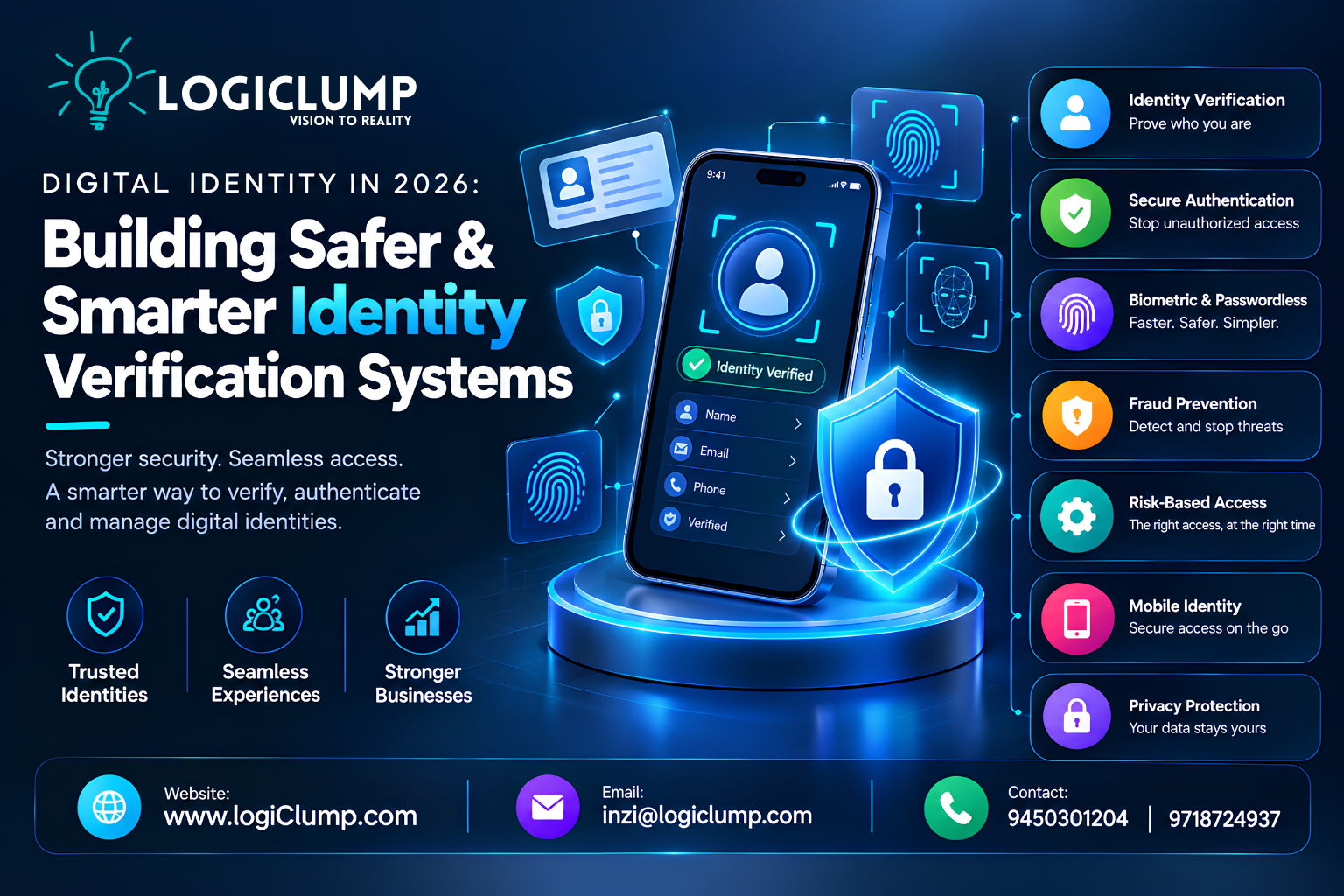
Digital Identity in 2026: Building Safer & Smarter Identity Verification Systems
The digital world is becoming increasingly dependent on identity.
Whether someone is opening an online bank account, purchasing a product, using a business application, accessing a SaaS platform, or interacting with a mobile app, the system needs to know who is behind the activity.
At the same time, identity-related attacks are becoming more sophisticated. Stolen credentials, fake accounts, account takeovers, automated fraud, and manipulated identity information can create serious problems for businesses.
This has made digital identity much more than a login feature.
In 2026, businesses are looking for identity systems that can verify users, manage permissions, identify suspicious activity, protect personal information, and provide a convenient digital experience.
Understanding Digital Identity
A digital identity is the collection of information and credentials associated with a person, organization, device, or digital service.
Depending on the application, it can contain information such as:
- Name and contact information
- Login credentials
- Verified identity attributes
- Digital credentials
- Biometric information
- Device details
- Authentication history
- Account activity
- Security-related signals
This information helps software recognize a digital user and determine what that user or system can access.
For example, an online financial application needs to establish the identity of a customer before allowing access to sensitive account information.
Identity Verification: What Does It Actually Mean?
Identity verification is the process of establishing that an individual is genuinely the person they claim to be.
The verification process can use different techniques depending on the application's risk level.
These may include:
- Government-issued identity documents
- Phone or email verification
- Facial matching
- Biometric checks
- Address verification
- Database validation
- Device verification
- Additional security factors
There is no single verification method suitable for every business.
A social platform and a financial application, for example, have very different identity requirements.
Why Digital Identity Has Become a Business Priority
Modern applications are no longer isolated systems.
A single platform can communicate with payment gateways, cloud services, CRM software, databases, AI systems, third-party APIs, and mobile applications.
Every connection creates another point where identity needs to be managed.
Businesses therefore need to answer questions such as:
- Is this a legitimate user?
- Is the account being accessed by its real owner?
- Does this person have permission to perform the requested action?
- Is the current activity unusual?
- Should additional verification be requested?
A modern identity platform needs to address these questions without making the user experience unnecessarily complicated.
Authentication and Identity Verification Are Different
These two terms are often used interchangeably, but they describe different processes.
Identity verification generally takes place when a business needs to establish that a person is who they claim to be.
Authentication is used when a known user attempts to access an existing account.
Consider a new customer joining a financial platform.
During registration, the business may verify the customer's identity using documents and other checks. Later, the customer may authenticate using a passkey, biometric method, or another approved credential.
The two processes work together but serve different purposes.
The Move Toward Risk-Based Verification
One of the biggest changes in modern identity systems is the move away from treating every login in exactly the same way.
Consider two situations.
A customer signs in from their usual phone and follows their normal behavior.
Another person attempts to access the same account from an unfamiliar device after several failed login attempts.
Treating these two events identically would not make much sense.
Risk-based identity systems can evaluate contextual signals and increase security requirements when something appears unusual.
Depending on the situation, the system could:
- Allow access normally
- Request another authentication factor
- Require identity verification
- Block a high-risk action
- Temporarily restrict the account
This approach can improve security without adding unnecessary friction to every interaction.
Passwordless Authentication Is Gaining Attention
Passwords have been a fundamental part of online security for decades, but they also create problems.
Users forget them, reuse them, share them, or accidentally provide them to attackers through phishing.
Businesses are therefore exploring passwordless approaches such as:
- Passkeys
- Biometrics
- Security keys
- Device-based credentials
- Cryptographic authentication
The goal is to make account access both more secure and easier for legitimate users.
Passwordless authentication can also reduce some of the operational costs associated with password resets and account recovery.
Digital Identity in Mobile Applications
For many businesses, the smartphone is now the primary way customers interact with their services.
A mobile identity architecture may connect several components:
Mobile Application → Identity Service → API Layer → Business Backend
Security cannot stop at the application's login screen.
The backend should independently validate authentication and authorization before processing sensitive requests.
A mobile identity solution might incorporate:
- Secure tokens
- Biometric authentication
- Device recognition
- Session controls
- Multi-factor authentication
- API authorization
- Risk assessment
This creates a stronger relationship between the user's identity and the actions performed inside the application.
Digital Identity in Financial Technology
FinTech is one of the industries where identity management can have a particularly significant role.
Financial platforms may need to establish customer identity before providing services involving accounts, payments, investments, trading, or other financial activities.
Identity technologies can support workflows such as:
- Customer onboarding
- KYC processes
- Account registration
- Transaction verification
- Fraud screening
- Account recovery
- Risk assessment
The challenge is finding the right balance between strong verification and a smooth onboarding experience.
If verification is unnecessarily complicated, customers may abandon the process. If it is too weak, the platform may become easier to abuse.
Identity Verification in E-Commerce
Digital identity is not limited to banking and financial services.
Online retailers also need to protect customer accounts and sensitive information.
A compromised shopping account could expose:
- Personal details
- Saved addresses
- Order history
- Loyalty points
- Payment information
- Refund activity
Businesses can use identity and risk controls to identify unusual account behavior and apply stronger verification when sensitive actions are requested.
For example, a normal login might require standard authentication, while an unusual high-value transaction could trigger an additional security check.
The New Identity Challenge: AI Systems
Artificial intelligence is introducing another dimension to digital identity.
Traditional identity systems primarily focus on people.
But modern software may also interact with:
- AI agents
- Automated services
- Applications
- Devices
- APIs
- Machine-to-machine processes
This creates a new question:
Who—or what—is actually performing an action?
An AI system accessing a CRM database should not necessarily have the same identity or permissions as a human employee.
Organizations can create separate identities for automated systems and control what actions they are allowed to perform.
Identity for AI Agents
AI agents can potentially perform multi-step tasks across business applications.
For example, an authorized agent could potentially retrieve information from a CRM, prepare a report, and update a business record.
Each action needs appropriate controls.
A better architecture can look like:
Agent Identity → Authentication → Authorization → Approved Tool/API → Business Action
This makes it possible to identify the agent responsible for an activity and restrict its permissions.
It also improves auditing because businesses can distinguish actions performed by AI systems from actions performed by human users.
Protecting Personal Identity Information
Identity verification often requires sensitive personal information.
This could include identity documents, addresses, biometric information, financial information, and other private attributes.
Businesses need to think carefully about how this information is collected, processed, stored, and eventually removed.
Important security practices include:
- Encrypting sensitive information
- Limiting internal access
- Protecting identity APIs
- Maintaining audit records
- Defining retention policies
- Collecting only necessary information
- Monitoring unusual access
A strong identity system should protect the information it uses—not simply verify it.
The Role of APIs in Digital Identity
Identity systems are heavily dependent on APIs.
A typical workflow could involve:
User → Application → Identity API → Verification Service → Business Platform
This makes API security an important part of identity architecture.
Organizations should consider controls such as:
- Strong authentication
- Fine-grained authorization
- Secure token handling
- Input validation
- Encryption
- Rate limiting
- Monitoring
- Audit logging
If the identity API is poorly protected, weaknesses in that layer can affect the security of the entire platform.
Identity as a Fraud-Prevention Tool
Fraudsters continuously look for weaknesses in digital onboarding and account systems.
Common attacks can include:
- Creating synthetic or fake accounts
- Taking control of legitimate accounts
- Using stolen credentials
- Automating registrations
- Manipulating identity information
- Abusing promotions
- Performing unauthorized transactions
Modern identity platforms can combine verification with behavioral and contextual signals.
This allows organizations to evaluate not just who a user claims to be, but also whether their activity appears consistent with legitimate behavior.
Continuous Identity Monitoring
Identity verification does not always have to happen only during registration.
For higher-risk applications, businesses can continuously monitor activity throughout an authenticated session.
Signals might include:
- New device usage
- Unusual login behavior
- Unexpected API activity
- Sudden changes in account behavior
- Unusual transaction patterns
- Repeated authentication failures
If the risk changes significantly, the application can request additional verification before allowing a sensitive operation.
This creates a more dynamic approach to identity security.
Digital Identity and Privacy Must Work Together
A smarter identity system should not mean collecting unlimited personal information.
In fact, collecting unnecessary information can increase the potential impact of a security breach.
Businesses should consider privacy principles such as:
Data Minimization
Collect only what is genuinely required.
Purpose Limitation
Use identity information for clearly defined purposes.
Controlled Access
Only authorized systems and employees should be able to access sensitive information.
Secure Storage
Sensitive identity information should receive appropriate technical protection.
Responsible Retention
Data should not be retained indefinitely without a valid reason.
Security and privacy should therefore be designed together.
Common Digital Identity Mistakes
Even sophisticated organizations can make mistakes when designing identity systems.
1. Depending Entirely on Passwords
Passwords alone may not provide enough protection for sensitive applications.
2. Giving Excessive Permissions
A verified user does not automatically need access to every feature or dataset.
3. Ignoring Account Recovery
Account recovery can become a target for attackers if it is weaker than normal authentication.
4. Neglecting API Security
Identity systems frequently depend on APIs, making the API layer part of the security boundary.
5. Keeping Sensitive Data for Too Long
Unnecessary identity information creates additional security and privacy exposure.
6. Treating Every User the Same
High-risk and low-risk activities may require different security responses.
7. Failing to Monitor Identity Activity
Without useful logs and monitoring, suspicious activity can remain unnoticed.
Building a Modern Identity Verification Architecture
A business planning a new identity system can approach development in stages.
Step 1: Understand the Business Risk
Determine what needs protection and which activities present the highest risk.
Step 2: Define the Identity Model
Decide which identities the platform needs to support—customers, employees, administrators, devices, applications, or AI agents.
Step 3: Select Verification Methods
Choose appropriate methods based on the sensitivity of the service.
Step 4: Secure Authentication
Implement appropriate authentication factors and secure session management.
Step 5: Design Authorization
Define exactly what each identity can access or perform.
Step 6: Protect the API Layer
Secure communication between identity services and the rest of the application.
Step 7: Introduce Risk Detection
Use contextual information to identify unusual activity.
Step 8: Protect Personal Data
Apply encryption, access controls, monitoring, and suitable retention policies.
Step 9: Monitor and Improve
Identity security should continuously evolve as applications, users, and threats change.
Where Digital Identity Is Heading
The concept of digital identity is expanding beyond traditional usernames and passwords.
Future identity systems are likely to combine several technologies and signals, including:
- Passkeys
- Biometrics
- Verifiable credentials
- Device identity
- Behavioral analysis
- AI-assisted risk assessment
- Human identities
- Machine identities
- Privacy-focused technologies
- Continuous authentication
The objective is not simply to make verification harder.
The goal is to make digital trust more reliable, intelligent, and convenient.
Why Businesses Should Think About Identity Early
Identity is deeply connected to the rest of a digital platform.
It affects:
- Application architecture
- APIs
- Databases
- Mobile applications
- Customer onboarding
- Security monitoring
- Fraud prevention
- AI integrations
- User experience
Adding identity controls after an application has already been built can be more difficult than designing them into the architecture from the beginning.
Businesses planning new digital products should therefore treat identity as a core architectural consideration.
Final Thoughts
Digital identity is becoming one of the foundations of modern digital services.
As businesses adopt mobile applications, cloud platforms, FinTech solutions, SaaS products, AI systems, and connected APIs, the traditional idea of simply logging in with a password is becoming less sufficient for many use cases.
Modern identity systems need to establish trust while also controlling access, detecting suspicious activity, protecting personal information, and keeping legitimate users moving through the application smoothly.
The strongest approach is not necessarily the one with the most verification steps.
It is the one that applies appropriate verification, access control, and risk management at the right point in the user journey.
For businesses building digital platforms in 2026 and beyond, smarter identity architecture can become an important foundation for security, customer trust, and sustainable growth.
How LogiClump Can Help
A secure digital platform requires identity management to work together with application architecture, APIs, access controls, and data protection.
LogiClump Technologies can help businesses develop custom digital solutions across web applications, mobile apps, APIs, AI integrations, FinTech systems, and business software.
Whether you are planning a customer portal, SaaS product, financial platform, AI-powered application, or another custom digital solution, considering identity and security during the architecture stage can help create a stronger foundation.
Website: www.logiclump.com
Email: inzi@logiclump.com
Contact: 9450301204 | 9718724937
Build. Innovate. Empower.
Learn how smarter digital identity and verification systems help businesses strengthen security, prevent fraud, protect personal data, and improve user access in 2026.
Tom Cruise