
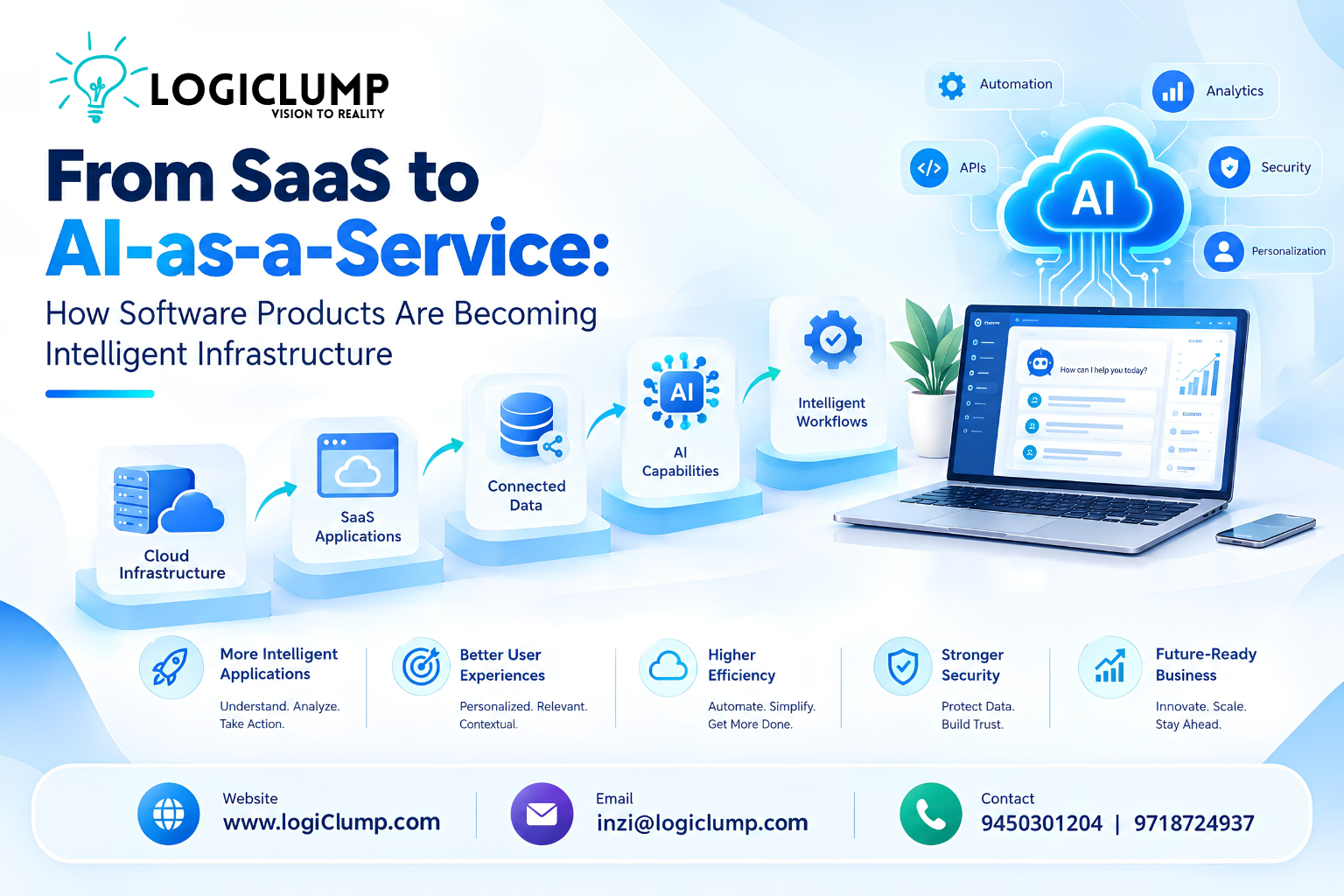
From SaaS to AI-as-a-Service: The Future of Intelligent Software
The software industry has gone through several major transformations. Businesses moved from locally installed applications to cloud-based platforms, and Software-as-a-Service (SaaS) became a standard way to deliver and consume business software.
Today, another shift is underway.
Artificial intelligence is becoming deeply integrated into software products, creating a growing market for AI-as-a-Service (AIaaS). Instead of software simply helping users complete predefined tasks, modern applications can increasingly analyze information, understand patterns, generate content, provide recommendations, and assist with complex workflows.
This evolution is changing the role of software within businesses. Applications are no longer just digital tools; they are increasingly becoming part of an organization's intelligent infrastructure.
Understanding the Shift From SaaS to AI-as-a-Service
SaaS made software available through the internet instead of requiring organizations to install and maintain applications locally.
AIaaS takes this concept further by making artificial intelligence capabilities available through cloud platforms, APIs, managed services, and software products.
Depending on the implementation, AIaaS can provide capabilities such as:
- Natural language processing
- Intelligent search
- Document and image analysis
- Speech recognition
- Predictive analysis
- Content generation
- Recommendation engines
- Data classification
- AI assistants
- Workflow automation
This means businesses can introduce AI-powered functionality without necessarily developing an entire artificial intelligence platform from the ground up.
SaaS Established the Foundation
The growth of SaaS changed the traditional software business model.
Instead of purchasing software once and installing it on individual computers or company servers, organizations could subscribe to cloud-based platforms and access them through web browsers or applications.
This model introduced several practical benefits.
Centralized Software Management
Updates, maintenance, infrastructure, and many technical operations can be managed centrally by the service provider.
Flexible Usage
Businesses can select software plans according to their current requirements and adjust them as those requirements change.
Continuous Development
Cloud software can be updated regularly, allowing new functionality and improvements to reach users without traditional installation processes.
Cloud Scalability
Cloud infrastructure can help software providers accommodate changing workloads and growing numbers of users.
AIaaS builds on this established model by introducing intelligent capabilities into the same software ecosystem.
Software Is Moving Beyond Rule-Based Automation
Traditional business software generally works according to predefined logic.
A simple workflow might look like:
User Input → Business Rule → System Action → Result
AI can introduce another layer of interpretation:
Data → AI Analysis → Context → Recommendation or Action
This does not mean conventional programming is disappearing. Instead, AI can complement existing application logic where interpretation, prediction, or natural-language interaction is useful.
For example, customer-support software could use predefined rules to assign tickets to departments. An AI-enabled version could additionally analyze the customer's message, identify the subject, summarize the problem, detect relevant context, and help prepare a response.
The software becomes more capable of understanding the information it processes.
AI Is Becoming Part of Application Architecture
AI is increasingly being integrated directly into software architecture rather than being treated as a separate experimental technology.
A modern business application may include:
- Front-end interface
- Backend services
- Databases
- APIs
- Authentication systems
- Analytics
- Automation workflows
- AI services
The AI component can interact with other parts of the application within defined permissions.
For instance, an AI assistant inside an enterprise platform could retrieve approved information from customer records, product databases, reports, or internal documentation and use that information to assist employees.
This creates a more connected form of software infrastructure.
Why Companies Are Adding AI to Their Products
The reasons for adopting AI vary from one organization to another, but several use cases are becoming increasingly common.
Faster Information Processing
Businesses produce large volumes of documents, messages, transactions, reports, and other data. AI can help organize and analyze this information more efficiently.
More Personalized User Experiences
Applications can use available behavioral and contextual information to provide more relevant recommendations or interactions.
This can be particularly useful in:
- E-commerce
- Financial technology
- Education platforms
- Customer service
- Enterprise applications
- Marketing systems
Reduction of Repetitive Work
AI can assist with tasks such as summarizing documents, categorizing requests, extracting information, and preparing routine responses.
Enhanced Customer Assistance
AI-powered assistants can handle common questions and help support teams find relevant information more quickly.
Decision Support
AI can identify patterns within large datasets and present information that may help employees evaluate business situations.
The purpose should be to support business processes rather than simply add an AI feature for marketing purposes.
The Growing Role of AI Agents
A major development within AI-powered applications is the emergence of AI agents.
A conventional AI feature may perform one specific operation after receiving a request. An AI agent can be designed to manage a sequence of tasks toward a defined objective, subject to the permissions and controls built into the application.
For example, within an appropriately configured business system, an AI agent could potentially:
- Understand a customer request.
- Identify the relevant information.
- Retrieve authorized records.
- Check available options.
- Prepare an appropriate response.
- Create a follow-up task.
- Record the interaction.
This approach could change how employees interact with business software.
Instead of manually moving between multiple screens, users may increasingly be able to describe what they need and allow the application to coordinate the relevant workflow.
APIs Are Accelerating AI Adoption
Another important factor behind AIaaS growth is the availability of AI APIs.
Developers can connect applications with external AI capabilities instead of creating every machine-learning component internally.
Depending on the provider and use case, APIs can support functions such as:
- Text processing
- Speech recognition
- Image analysis
- Semantic search
- Text generation
- Document understanding
- Conversational interfaces
This lowers the entry barrier for businesses that want to experiment with AI.
However, API integration still requires careful planning. Development teams need to consider response time, reliability, usage costs, data security, provider dependencies, and how the application will behave if an AI service becomes unavailable.
Data Is the Foundation of Intelligent Software
AI cannot be considered separately from the data that supports it.
A software product may contain sophisticated AI capabilities, but poor-quality, incomplete, outdated, or inaccessible data can limit their usefulness.
Businesses should therefore pay attention to:
- Data accuracy
- Data organization
- Data governance
- Access permissions
- Privacy requirements
- Data retention
- Integration quality
- Monitoring
The quality of the surrounding data architecture can be just as important as the AI technology itself.
Security Must Evolve Alongside AI
As applications become more intelligent, they may gain access to larger amounts of business information.
Depending on the application, that information could include customer records, financial data, internal documents, transaction details, or confidential business information.
AI implementation should therefore include appropriate security measures such as:
- Strong authentication
- Role-based permissions
- Encryption
- Secure API connections
- Audit trails
- Access controls
- Data minimization
- Monitoring
- Appropriate human oversight
AI systems should only access information that they are authorized to use.
AI Can Also Increase Technical Complexity
AI can make software more capable, but it can also introduce additional engineering challenges.
Development teams may need to manage:
- Model selection
- AI provider integrations
- Infrastructure requirements
- API consumption
- Latency
- AI output evaluation
- Monitoring
- Security
- Data pipelines
- Failure handling
- Ongoing maintenance
For this reason, businesses should first identify the problem they want to solve and then determine whether AI is an appropriate solution.
SaaS Applications Are Becoming More Context-Aware
Traditional SaaS applications primarily provide users with information and tools.
AI-enabled applications can potentially add another layer of understanding.
Imagine a project-management platform showing several overdue tasks. A conventional application may simply display those tasks.
An intelligent version could potentially analyze the available project information and help identify recurring delays, summarize outstanding issues, highlight dependencies, and prepare a project-status summary.
The difference lies in how application data is transformed into useful context.
AIaaS and the Next Generation of Business Software
The combination of cloud computing, SaaS, APIs, automation, data infrastructure, and artificial intelligence is creating a new generation of software products.
A simplified view of this evolution is:
Cloud Infrastructure → SaaS Applications → Connected Data → AI Capabilities → Intelligent Workflows
This does not mean every application will become fully autonomous. Instead, many products are likely to become more capable of assisting users with information-heavy and repetitive tasks.
Natural-language interfaces may also become increasingly common.
For example, instead of manually searching through multiple reports, an employee could ask an application:
“Summarize the unresolved customer issues from this month and identify the most common categories.”
If the system has the required data, permissions, integrations, and AI capabilities, it could transform that request into a structured analysis.
What Businesses Should Evaluate Before Adding AI
AI adoption should begin with a clear business objective.
Before integrating AI into an application, businesses should consider several questions.
What Problem Are We Solving?
The AI feature should address a genuine operational, customer, or business requirement.
Do We Have Suitable Data?
The application needs access to appropriate and reliable information for many AI use cases.
How Will Data Be Protected?
Sensitive information requires appropriate security, privacy, and access controls.
How Will AI Connect With Existing Systems?
AI often needs to work with databases, APIs, business applications, and internal workflows.
What Will It Cost?
The total cost may include development, infrastructure, API usage, monitoring, maintenance, and ongoing optimization.
What Happens When AI Is Wrong?
AI outputs can require validation. Businesses should establish appropriate fallback procedures and human review for higher-impact processes.
These considerations can help organizations adopt AI in a controlled and practical way.
How LogiClump Can Help Build Intelligent Software Solutions
The transition from conventional SaaS products to AI-enabled platforms requires more than simply connecting an application to an AI API.
The underlying architecture, database structure, integrations, security model, user experience, and business workflow all need to work together.
LogiClump can help businesses develop customized software solutions based on their specific operational requirements.
From web applications and custom software to automation-focused platforms and AI-enabled solutions, development can be planned around factors such as scalability, security, integrations, data requirements, user experience, and long-term maintenance.
AI can be incorporated where it provides meaningful value rather than being treated as an isolated feature.
What the Future of Software May Look Like
The transition from SaaS to AIaaS is changing how organizations think about software.
Earlier generations of applications primarily provided tools for employees to operate. Modern intelligent applications can increasingly help users interpret information, discover patterns, automate routine processes, and interact with complex systems through natural language.
This does not eliminate the importance of conventional software engineering. Instead, AI becomes another layer within the technology stack.
The organizations that approach this transition strategically can focus on practical use cases, responsible data management, security, measurable outcomes, and sustainable architecture.
Conclusion
The journey from SaaS to AI-as-a-Service represents a broader evolution in the role of software.
SaaS changed how applications were delivered and managed. AIaaS is changing what those applications can potentially do with data and user requests.
As AI becomes more accessible through APIs, cloud platforms, and integrated software services, applications are increasingly capable of moving beyond fixed workflows toward more adaptive and intelligent experiences.
The next generation of software will not simply be defined by whether it contains AI. Its value will depend on how effectively that intelligence is connected to real business needs, reliable data, secure infrastructure, and useful workflows.
For businesses, the goal is not to add AI everywhere. It is to identify the right opportunities where intelligent technology can make software more useful, efficient, and responsive.
Contact LogiClump
🌐 Website: www.logiclump.com
📧 Email: inzi@logiclump.com
📞 Contact: 9450301204 | 9718724937
Discover how SaaS is evolving into AI-as-a-Service, transforming software into intelligent infrastructure through AI, automation, APIs, data, and smarter business workflows.
Tom Cruise