
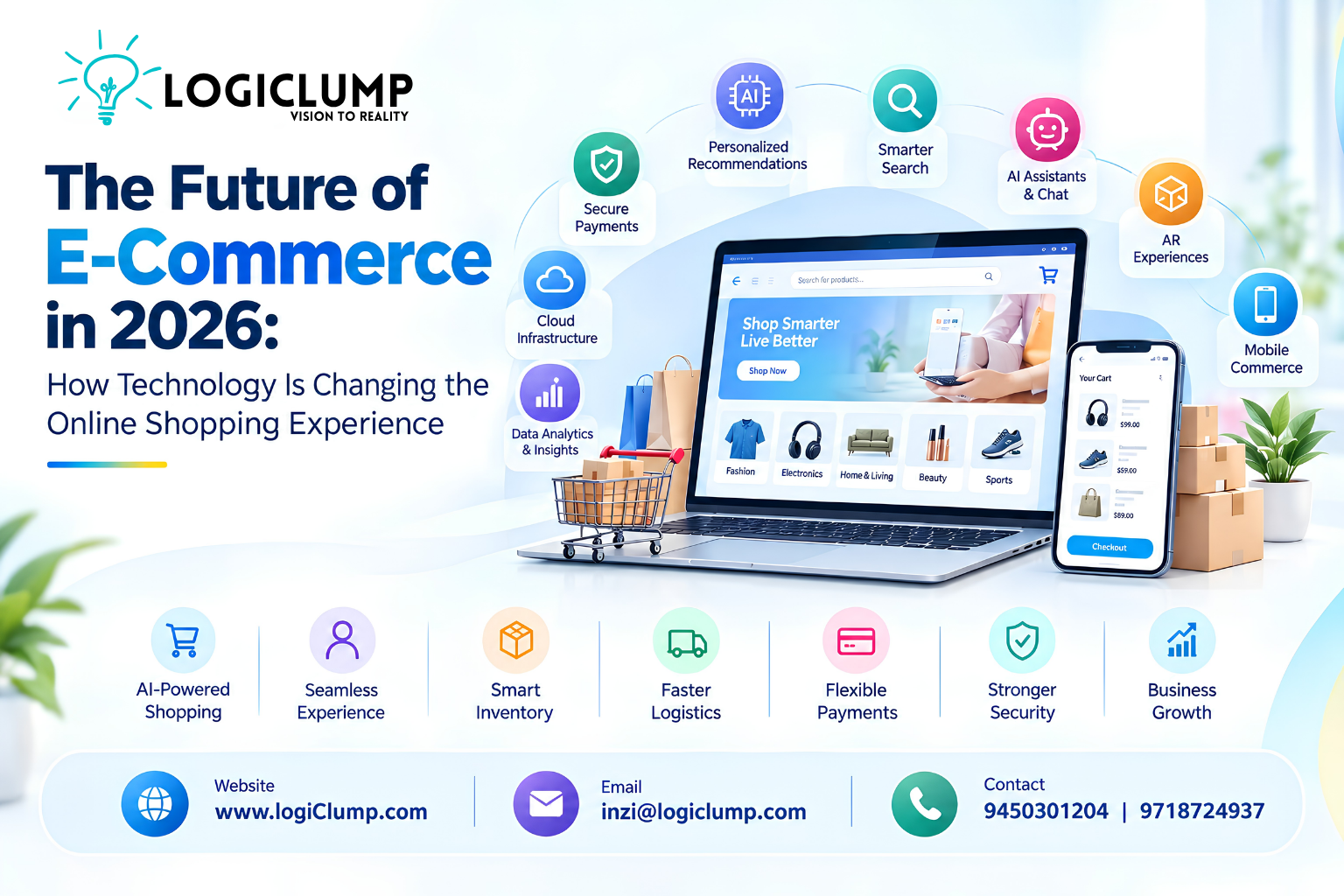
The Future of E-Commerce in 2026
E-commerce has moved well beyond the basic idea of putting a product catalog on a website. Today, technology influences almost every part of digital retail, from how shoppers discover products to how businesses manage inventory, process orders, communicate with customers, and build long-term relationships.
In 2026, technologies such as artificial intelligence, automation, advanced analytics, mobile commerce, augmented reality, conversational tools, cloud computing, and API-based systems are creating new possibilities for online retailers.
The modern online store is becoming more than a digital storefront. It is increasingly becoming an intelligent platform that connects customers, products, data, payments, logistics, and business operations.
The Changing Nature of Online Shopping
Earlier e-commerce websites were primarily designed around three basic functions: showing products, accepting orders, and processing payments.
Modern platforms are expected to do much more.
Customers want relevant product suggestions, quick answers, flexible payment options, accurate delivery information, easy returns, and a smooth experience across different devices.
At the same time, businesses need technology that can help them manage growing product catalogs, customer information, inventory, orders, marketing, and logistics.
This has made technology an important competitive factor in e-commerce.
Artificial Intelligence Is Transforming Digital Retail
Artificial intelligence is becoming increasingly useful across online retail.
Rather than relying entirely on fixed rules, AI-based systems can analyze large amounts of information and identify patterns that may be useful for customers or businesses.
E-commerce companies can use AI for:
- Product recommendations
- Intelligent search
- Customer-service assistance
- Product-content generation
- Customer segmentation
- Demand analysis
- Review analysis
- Fraud monitoring
- Marketing personalization
- Business insights
For example, an online fashion retailer can use customer interactions and product information to present more relevant items to shoppers.
The important consideration is not whether a store uses AI, but whether the technology actually improves a specific part of the shopping experience or business operation.
Personalized E-Commerce Experiences
Online shoppers increasingly expect experiences that feel relevant to their individual needs.
A basic website might display identical products and content to every visitor. A more advanced platform can use permitted customer and behavioral information to personalize parts of the experience.
Personalization can influence:
- Recommended products
- Homepage content
- Search results
- Promotional messages
- Product suggestions
- Follow-up communication
For example, a customer who frequently explores sports products may receive recommendations related to that interest instead of seeing completely unrelated items.
However, personalization should be implemented with appropriate privacy practices and transparent data handling.
Smarter Product Recommendations
Recommendation engines have become an important part of modern online retail.
Instead of presenting products randomly, recommendation systems can identify relationships between products, customer behavior, browsing activity, and purchase history.
Imagine a shopper purchasing a new camera.
The platform could potentially suggest:
- Compatible lenses
- Memory cards
- Camera bags
- Batteries
- Tripods
This can help customers discover useful products without manually searching through an entire catalog.
For retailers, intelligent recommendations can also create more opportunities to introduce customers to products that match their interests.
Search Is Becoming More Intelligent
Product search has traditionally depended heavily on keywords.
However, customers do not always search using exact product names.
Someone might type:
“comfortable shoes for a formal office”
instead of searching for a specific product category.
AI-powered search can attempt to understand the meaning behind a query and connect it with relevant products.
Natural-language and conversational search can make this interaction even more flexible, particularly when customers are unsure about the exact product terminology.
Conversational Shopping Assistants
AI assistants are creating another way for customers to interact with online stores.
Instead of navigating through multiple filters, shoppers may be able to describe what they are looking for in everyday language.
For example:
“I need a lightweight laptop for office work with good battery life.”
A shopping assistant could ask follow-up questions, compare available products, explain specifications, and present relevant options from the store's catalog.
Such systems need access to reliable product information so that recommendations and answers remain accurate.
Augmented Reality Is Making Products More Interactive
One of the biggest limitations of online shopping is the inability to physically examine a product before purchasing it.
Augmented reality can help bridge part of this gap.
Depending on the industry, shoppers can use AR to visualize products in a real-world setting.
Potential applications include:
- Placing furniture inside a room
- Previewing home décor
- Trying virtual eyewear
- Visualizing makeup
- Exploring product colors
- Customizing certain products
These experiences can make online product discovery more engaging and give customers additional information before making a purchase.
Visual Search Simplifies Product Discovery
Sometimes customers know what a product looks like but do not know its name.
Visual search allows an image to become the starting point for product discovery.
For example, a shopper could upload a picture of a particular chair, dress, accessory, or home décor item and search for visually similar products.
This technology can be particularly useful for industries where appearance plays a major role in purchasing decisions.
Mobile Commerce Continues to Grow
Smartphones have become an important part of the online shopping journey.
Customers may discover a product, compare prices, read reviews, place an order, and track delivery using the same device.
A strong mobile-commerce strategy should therefore focus on:
- Fast page loading
- Responsive design
- Easy navigation
- Clear product information
- Simple checkout
- Secure authentication
- Convenient payment options
- Mobile-friendly customer support
For businesses with dedicated applications, mobile technology can also support notifications, loyalty programs, personalized experiences, and order updates.
Payment Technology and Easier Checkout
Checkout is one of the most important stages of an online purchase.
Even when customers find the right product, a complicated payment process can create unnecessary friction.
Modern e-commerce platforms can integrate multiple payment options, depending on the target market and applicable regulations.
These may include:
- Debit and credit cards
- Digital wallets
- Bank-based payment methods
- Buy-now-pay-later services where appropriate
- Regional payment solutions
Convenience must be balanced with security. Strong authentication, secure payment integrations, and fraud-prevention mechanisms remain essential.
Automation Behind the E-Commerce Experience
The customer-facing website represents only one part of an e-commerce business.
A large amount of work happens in the background.
Automation can assist with processes such as:
- Order confirmation
- Invoice creation
- Inventory synchronization
- Shipping notifications
- Customer emails
- Product updates
- Return workflows
- Internal task assignment
Automating repetitive operations can reduce manual effort and help businesses handle larger volumes without increasing administrative work at the same rate.
Smarter Inventory and Demand Planning
Inventory problems can directly affect customer satisfaction.
If a website displays an item as available when it is actually out of stock, the result may be delayed orders, cancellations, or frustrated customers.
Modern e-commerce systems can connect inventory data across relevant sales channels and help businesses maintain a clearer view of product availability.
Analytics and AI-based forecasting can also help identify patterns in historical sales, seasonal demand, and product performance.
Forecasting cannot eliminate uncertainty, but it can give businesses additional information for inventory planning.
Customer Service Is Becoming More Intelligent
Customer support is another area where technology is changing rapidly.
AI-powered tools can help answer routine questions about:
- Order status
- Delivery
- Returns
- Product specifications
- Account information
- Payment-related issues
When a situation requires human judgment or more detailed assistance, the conversation can be transferred to a support representative.
This combination of automation and human support can help businesses manage routine requests while keeping people involved in more complex cases.
Social Media and E-Commerce Are Converging
Product discovery increasingly happens outside traditional online stores.
Customers may first encounter a product through social content, online communities, creators, videos, or digital campaigns.
This has contributed to the growth of social commerce, where discovery and purchasing can become closely connected.
For businesses, this creates a need for consistency across different channels.
Product details, prices, availability, customer information, and order data should remain synchronized wherever possible.
Analytics Is Helping Retailers Understand Customers
Every online store generates valuable operational data.
Businesses can analyze information such as:
- Product views
- Search activity
- Cart abandonment
- Purchase patterns
- Customer retention
- Marketing performance
- Frequently purchased products
- Website navigation
- Delivery performance
These insights can help identify where customers face friction and which areas of the business require improvement.
AI can further assist by identifying relationships and patterns within large datasets, although businesses still need appropriate data quality and governance.
E-Commerce Security and Customer Privacy
Technology has improved online shopping, but it has also increased the importance of cybersecurity.
E-commerce platforms may handle sensitive information involving customers, addresses, accounts, orders, and payment processes.
Businesses should therefore consider security measures such as:
- Secure authentication
- Encryption
- Access management
- Secure payment integrations
- Fraud monitoring
- Activity logging
- Data protection controls
- Regular security reviews
Privacy should also be considered when collecting and using customer data for personalization, analytics, or AI-based services.
Customer trust depends heavily on how responsibly businesses handle information.
Headless Commerce and API-Based Systems
E-commerce architecture is also changing.
In a traditional setup, the customer-facing website and commerce backend may be closely connected.
Headless commerce separates the presentation layer from the core commerce functionality, allowing businesses to create different customer experiences while using shared backend services.
This approach can support experiences across:
- Websites
- Mobile apps
- Marketplaces
- Social platforms
- Digital displays
- Other connected interfaces
API-driven architecture can also make it easier to integrate e-commerce platforms with payment providers, CRM systems, inventory software, logistics services, analytics tools, and AI technologies.
The Growth of Omnichannel Shopping
Customers often move between multiple channels before and after making a purchase.
For example, a shopper might:
- Discover a product on social media.
- Visit the company's website.
- Compare products on a smartphone.
- Complete the purchase online.
- Receive delivery updates through an app or message.
- Contact support through another channel.
Omnichannel technology aims to connect these interactions so that customers receive a more consistent experience.
For businesses, this requires coordinated systems for customer data, product information, inventory, orders, and communication.
Cloud Technology Is Supporting E-Commerce Growth
Cloud infrastructure has become an important foundation for modern e-commerce.
Online stores can experience significant variations in traffic during festivals, sales campaigns, product launches, and seasonal events.
Cloud-based infrastructure can help businesses respond to changing workloads and support distributed applications.
Cloud technology can also make it easier to connect different services, APIs, databases, analytics systems, and application components.
What Could the E-Commerce Experience Look Like in the Future?
The future of online shopping is unlikely to depend on one individual technology.
Instead, multiple technologies will work together.
A modern e-commerce ecosystem may combine:
AI + Automation + Cloud + Analytics + Mobile Commerce + AR + APIs + Secure Payments
This combination can create shopping experiences that are more interactive, personalized, and connected.
Customers may increasingly expect online stores to understand what they are looking for and help them reach a decision without requiring them to search through hundreds of products manually.
Challenges Businesses Should Not Ignore
Technology can create new opportunities, but implementation also brings challenges.
Businesses need to consider:
Technology Costs
AI services, cloud infrastructure, integrations, development, and maintenance all contribute to the overall cost of an e-commerce platform.
Data Quality
Poor or outdated data can reduce the usefulness of analytics, recommendations, and AI-powered features.
Integration Complexity
Connecting payment systems, inventory software, CRM platforms, logistics providers, analytics tools, and AI services requires careful technical planning.
Cybersecurity
As the number of connected systems increases, businesses need appropriate security controls and monitoring.
User Experience
Adding too many features can make a shopping platform confusing. Technology should simplify the customer journey rather than make it unnecessarily complicated.
How LogiClump Can Help Businesses Build Modern E-Commerce Platforms
A successful e-commerce platform requires more than an attractive interface.
The technology behind the store needs to support products, customers, orders, payments, inventory, integrations, analytics, security, and future expansion.
LogiClump can help businesses develop customized e-commerce and software solutions based on their specific requirements.
Whether a business needs a responsive online store, custom e-commerce functionality, third-party integrations, automated workflows, API connectivity, or intelligent features, the development approach can be structured around factors such as performance, scalability, security, user experience, and long-term maintenance.
The objective is to build technology that solves real business problems while providing a foundation for future growth.
The Future Is About Connected Shopping Experiences
E-commerce is moving from simple online catalogs toward interconnected digital ecosystems.
AI can help customers discover relevant products. Automation can streamline operations. Analytics can provide business insights. AR and visual search can make product discovery more interactive. Mobile technology can keep shopping accessible, while APIs and cloud infrastructure connect the different systems operating behind the scenes.
The most effective e-commerce strategies will not necessarily involve adopting every new technology.
Instead, businesses need to identify which technologies solve meaningful customer and operational problems and implement them in a practical way.
Conclusion
The e-commerce industry is entering a technology-driven phase in which online shopping is becoming increasingly intelligent, personalized, automated, and connected.
In 2026, technology is influencing far more than the storefront. It is shaping product discovery, search, recommendations, payments, customer support, inventory management, analytics, security, and the overall relationship between businesses and their customers.
For businesses, the opportunity lies in combining technology with a clear understanding of customer expectations.
The future of e-commerce will not simply be about putting more products online. It will be about creating digital shopping experiences that are faster, easier, more relevant, secure, and genuinely useful.
Contact LogiClump
🌐 Website: www.logiclump.com
📧 Email: inzi@logiclump.com
📞 Contact: 9450301204 | 9718724937
Explore how AI, automation, AR, and smart technology are transforming e-commerce in 2026.
Tom Cruise