
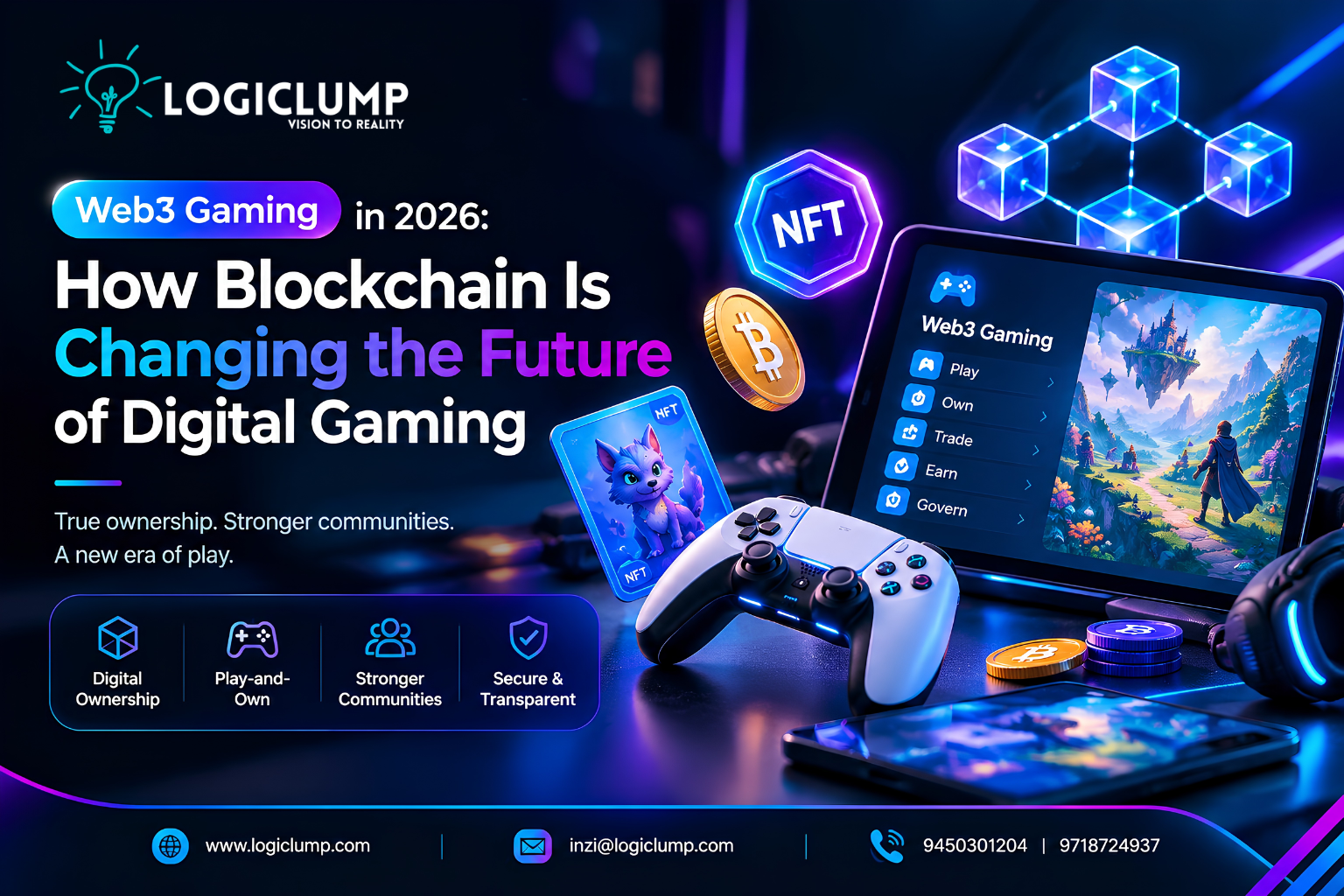
Web3 Gaming in 2026: How Blockchain Is Changing the Future of Digital Gaming
Gaming is no longer limited to a screen, a controller, and a closed digital world.
Modern games are becoming connected ecosystems where players can compete, create content, interact with communities, purchase digital items, and participate in virtual economies.
At the same time, blockchain technology has introduced a new concept to gaming: digital assets that can be recorded and owned on a decentralized network.
This combination has created what is commonly known as Web3 gaming.
However, the Web3 gaming industry has changed considerably over the past few years. Early projects often focused heavily on tokens, NFTs, and play-to-earn rewards. While those ideas attracted considerable attention, they also exposed problems around unsustainable economies, speculation, bots, complicated wallets, and weak gameplay.
In 2026, the conversation is becoming more practical.
Developers are increasingly asking where blockchain can provide genuine value instead of putting blockchain into every part of a game.
The future of Web3 gaming may therefore be less about making games “crypto-focused” and more about using blockchain where it can improve ownership, marketplaces, identity, creator economies, and digital interactions.
What Makes a Game Web3?
A Web3 game uses blockchain technology as part of its underlying ecosystem.
The blockchain component can serve different purposes depending on the product.
For example, a game may use blockchain for:
- Player-owned digital assets
- Collectible items
- Marketplace transactions
- Token-based ecosystems
- Smart contracts
- Digital memberships
- Community governance
- Player identity
- Creator rewards
This does not mean the entire game has to operate on a blockchain.
In fact, most game functions are generally better suited to conventional servers or specialized gaming infrastructure.
Real-time gameplay requires speed.
Blockchain is more useful when the system needs a verifiable record of ownership, transactions, or other digital rights.
That leads to an important architectural principle:
Use blockchain where it adds value—not simply because it is available.
Traditional Gaming vs Web3 Gaming
The difference becomes clearer when looking at digital assets.
In a conventional game, a player might purchase a special character skin.
The game database records that the player has access to it.
If the publisher changes the rules, closes the game, or removes the marketplace, the player's relationship with that asset can change significantly.
Web3 introduces another possibility.
A selected game asset can be represented by a blockchain token, allowing ownership information to exist independently of the game's internal database.
This does not automatically guarantee that the asset will work in other games.
It does, however, create a different technical model for recording ownership.
Digital Ownership Is the Core Idea
One of the most important concepts behind Web3 gaming is ownership of digital assets.
Players can spend significant amounts of time collecting:
- Characters
- Skins
- Weapons
- Vehicles
- Equipment
- Collectibles
- Virtual land
- Cosmetic items
Blockchain can allow selected assets to have independently verifiable ownership records.
This changes the relationship between the player and the game.
Instead of every digital item being purely an entry inside a company's database, some assets can become portable blockchain-based objects.
The practical value of this depends on how developers design the ecosystem.
NFTs Beyond the Hype
Non-fungible tokens, or NFTs, became one of the most recognizable technologies associated with Web3 gaming.
An NFT can represent a unique digital asset.
In gaming, possible applications include:
- Limited-edition items
- Characters
- Collectibles
- Game passes
- Creator content
- Virtual property
- Special achievements
But modern game design does not require every object to be an NFT.
A game could use traditional databases for common items while reserving blockchain assets for objects where ownership, scarcity, or transferability actually matters.
This can make the system simpler for both developers and players.
Why Play-to-Earn Lost Some of Its Appeal
The first major wave of blockchain gaming frequently promoted the idea of play-to-earn.
Players could theoretically play a game and receive tokens or digital assets as rewards.
The model created significant interest, but it also produced an uncomfortable question:
What happens when the financial reward becomes more important than the game?
If players participate primarily for financial incentives, the game can become dependent on:
- New users
- Token demand
- Asset prices
- Reward emissions
- Marketplace activity
When those conditions weaken, the economy can become difficult to maintain.
This is one reason newer Web3 game concepts increasingly emphasize gameplay first and blockchain second.
From Play-to-Earn to Player Ownership
A more sustainable concept is to separate gaming enjoyment from financial speculation.
The player should have a reason to play because the game itself is entertaining.
Blockchain can then provide additional functionality.
For example:
Play → Progress → Collect → Own → Use → Trade if desired
The player is not necessarily promised a financial return simply for playing.
Instead, the player receives control over selected digital items.
This model allows developers to focus on game design while treating blockchain as supporting infrastructure.
Hybrid Game Architecture
A Web3 game does not need to put every action on-chain.
A practical architecture might look like:
Game Client
↓
Game Servers
↓
Gameplay & Matchmaking
↓
Blockchain Integration Layer
↓
Smart Contracts
↓
Wallet / Marketplace
This separation allows high-speed game operations to remain off-chain while ownership and selected transactions can use blockchain networks.
Off-chain operations may include:
- Character movement
- Combat
- Physics
- Matchmaking
- Voice communication
- Graphics
- Real-time scoring
- Temporary game state
On-chain operations may include:
- Asset ownership
- Token transfers
- Marketplace transactions
- Selected achievements
- Digital collectibles
- Governance
This approach can reduce unnecessary blockchain transactions while preserving the benefits of decentralized infrastructure.
Smart Contracts Can Automate Game Economies
Smart contracts are programmable blockchain components that execute predefined rules.
Gaming platforms can potentially use them for:
- Marketplace settlements
- Asset transfers
- Tournament rewards
- Creator payments
- Digital memberships
- Community voting
- Token distribution
For example, a tournament platform could automatically distribute a reward according to predefined rules after the required competition conditions are verified.
The benefit is automation.
The challenge is security.
A mistake in a smart contract can potentially affect digital assets or funds, so smart-contract development requires extensive testing and security review.
Blockchain Marketplaces
A game can have its own marketplace where players exchange selected digital assets.
A typical transaction might involve:
- A player lists an eligible asset.
- Another player purchases it.
- The transaction is authorized.
- The ownership record changes.
- The applicable payment and fees are processed.
Smart contracts can automate portions of this process.
However, a marketplace also needs protection against:
- Fraud
- Fake assets
- Price manipulation
- Stolen accounts
- Wash trading
- Malicious contracts
- Unauthorized transactions
Therefore, a blockchain marketplace is not simply a technical feature.
It is a complete security and economic system.
Creator Economies
Web3 gaming can also change the role of players.
Instead of being only consumers, players could become creators.
A platform might allow users to produce:
- Skins
- Characters
- Maps
- Accessories
- Virtual spaces
- Digital collectibles
- Custom experiences
Blockchain can provide a mechanism for recording ownership and transactions associated with selected creator assets.
This can create a marketplace where developers provide the infrastructure while the community contributes additional content.
The challenge is maintaining quality, moderation, intellectual-property protection, and economic fairness.
Interoperability: What Is Actually Possible?
One of the most frequently discussed Web3 gaming ideas is interoperability.
The concept is simple:
Own an asset in one game → use it somewhere else.
The technical reality is considerably more complicated.
An asset's blockchain ownership record does not automatically tell another game:
- How it should look
- What abilities it should have
- How powerful it should be
- Which animations to use
- Whether it is licensed for another game
- How it should interact with that game's rules
For genuine interoperability, developers need shared standards and agreements.
Blockchain can help with ownership.
It cannot automatically solve game compatibility.
Portable Player Identity
Blockchain could also contribute to more portable gaming identities.
A player might maintain a digital identity containing selected:
- Achievements
- Collectibles
- Memberships
- Credentials
- Community affiliations
This could eventually allow certain aspects of a player's gaming history to move between compatible ecosystems.
Privacy remains important.
Players should have meaningful control over what information is publicly visible and what remains private.
Web3 Gaming on Smartphones
Mobile gaming has enormous reach, but mobile users generally expect simple experiences.
A complicated onboarding process involving:
- Seed phrases
- Gas fees
- Multiple networks
- Wallet extensions
- Transaction signing
can discourage ordinary players.
This means successful Web3 gaming products may need to hide much of the underlying blockchain complexity.
Technologies such as embedded wallets and simplified account systems can help create a smoother experience.
Ideally, a player should be able to start the game without needing to become a blockchain expert.
AI Could Transform Web3 Games
Blockchain is not the only technology changing gaming.
Artificial intelligence is becoming increasingly relevant as well.
AI can support:
- Intelligent NPCs
- Dynamic conversations
- Personalized game content
- Automated game testing
- Player behavior analysis
- Anti-cheat systems
- Procedural environments
- Game moderation
Blockchain and AI solve different problems.
AI can make the game more intelligent.
Blockchain can provide selected ownership and transaction infrastructure.
Together, they could create new types of interactive digital worlds.
For example, an AI-driven character could respond differently to individual players while certain character attributes or collectibles are recorded through blockchain infrastructure.
AI-Powered Anti-Cheat Systems
Competitive games face a constant battle against cheating.
Traditional anti-cheat systems can monitor suspicious behavior, but AI can add another layer of analysis.
A system could examine:
- Movement patterns
- Input behavior
- Match statistics
- Account activity
- Unusual transaction patterns
and identify behavior that differs significantly from normal players.
Blockchain can complement this by providing verifiable records for selected transactions and asset ownership.
The result could be a broader security architecture combining behavioral intelligence with transaction transparency.
The Importance of Scalable Infrastructure
Gaming applications need high performance.
Players expect:
- Fast loading
- Low latency
- Reliable servers
- Smooth multiplayer sessions
- Rapid transactions
A blockchain network cannot necessarily handle every real-time game event efficiently.
That is why developers may use:
- Layer-2 networks
- Sidechains
- Specialized gaming chains
- Off-chain databases
- Caching systems
- Cloud infrastructure
The objective is to create a system where blockchain provides useful capabilities without slowing down the actual game.
Web3 Gaming Economies Need Better Design
Every game economy needs balance.
Developers must carefully consider:
- How assets enter the ecosystem
- How assets leave it
- How rewards are distributed
- How scarcity works
- How marketplaces operate
- How inflation is controlled
- How bots are handled
Adding a token does not automatically create a healthy economy.
A sustainable ecosystem should be designed around the game's actual user behavior.
The Problem of Speculation
Digital assets can become speculative.
Players may purchase an item because they believe its price will increase rather than because they want to use it in the game.
This can create volatility.
Prices can rise quickly and fall just as quickly.
For game developers, excessive speculation can distract from the gaming experience and create expectations that the product cannot realistically satisfy.
A strong game economy therefore needs to distinguish between:
Gameplay utility
and
financial speculation
They are not the same thing.
Security Must Cover the Entire Ecosystem
Web3 gaming creates a larger attack surface because several technologies are connected.
A complete ecosystem might include:
Game → Account → Wallet → Smart Contract → Marketplace → Blockchain
A weakness anywhere in this chain can affect users.
Potential threats include:
- Account takeover
- Wallet theft
- Phishing
- Fake NFT collections
- Smart-contract exploits
- Marketplace manipulation
- Private-key theft
- Malicious links
- Bridge vulnerabilities
Security therefore needs to be designed from the beginning rather than added after launch.
Smart Contract Security
Developers working with valuable blockchain assets should use a strong security process.
This can include:
- Secure coding practices
- Automated tests
- Static analysis
- Fuzz testing
- Independent code review
- Smart-contract audits
- Penetration testing
- Deployment monitoring
- Emergency controls
The objective is to reduce the chance that a programming mistake becomes a financial or operational incident.
User Protection Matters Too
A technically secure blockchain game can still be difficult for users.
Players need clear information about:
- What they are purchasing
- What they actually own
- Transaction fees
- Marketplace rules
- Wallet permissions
- Asset limitations
- Refund policies
Clear interfaces are therefore part of security.
A player should not have to approve a transaction without understanding what it does.
Regulation Is Another Consideration
Web3 gaming operates across multiple markets, and digital assets can be treated differently depending on jurisdiction.
Game developers may need to consider rules related to:
- Virtual assets
- Tokens
- Digital marketplaces
- Consumer protection
- Gambling
- Taxation
- Data privacy
- Financial activities
The legal classification of a gaming asset can depend on how the product is structured and how it is used.
Businesses should therefore evaluate regulatory requirements before launching blockchain-based economies.
Blockchain Does Not Need to Be Visible
One of the most important directions for Web3 gaming may be invisible blockchain technology.
Players may not care about:
- Which chain is being used
- Which smart contract stores an asset
- How the transaction is technically processed
They may simply want:
Fast gameplay.
Simple accounts.
Secure ownership.
Easy transactions.
This could lead to a future where blockchain works behind the scenes.
The technology becomes infrastructure rather than the user experience.
What the Web3 Game of the Future Could Look Like
Imagine downloading a new game.
You create an account and immediately begin playing.
There is no complicated wallet setup.
As you progress, certain achievements unlock unique digital items.
Some are purely cosmetic.
Others may have utility inside the game.
You can keep them, trade supported items through the game's marketplace, or simply continue playing without interacting with the economy.
Behind the scenes, different technologies perform different jobs:
AI handles dynamic characters and personalized experiences.
Cloud infrastructure handles gameplay and multiplayer services.
Blockchain records selected ownership and transactions.
Smart contracts automate specific rules.
APIs connect the ecosystem.
Security systems protect accounts and assets.
For the player, it simply feels like a game.
That may be the most practical vision for Web3 gaming.
What Developers Should Ask Before Adding Blockchain
Before implementing blockchain functionality, developers should answer several questions.
Does blockchain solve a real problem?
If a normal database can handle the requirement, blockchain may not be necessary.
What needs to be on-chain?
Only functions that benefit from blockchain should use it.
How will users access their assets?
Wallet and account recovery need careful planning.
How will the economy work?
Token and marketplace mechanics should be sustainable.
How will fraud be prevented?
Security needs to cover both game accounts and blockchain assets.
What happens if the game changes?
Players need to understand how digital assets are affected by future updates.
What regulations apply?
Legal requirements should be considered before launching the economy.
These questions can help prevent blockchain from becoming an unnecessary layer of complexity.
Opportunities for Businesses
Web3 gaming creates opportunities beyond game development itself.
Companies can build:
- Blockchain gaming platforms
- NFT marketplaces
- Gaming wallets
- Smart-contract infrastructure
- Player management systems
- Creator platforms
- Gaming analytics
- AI-powered gaming tools
- Tournament systems
- Digital asset management platforms
This creates an expanding technology ecosystem around blockchain-powered entertainment.
How LogiClump Can Help
Developing a Web3 gaming platform requires a combination of software engineering, blockchain development, user experience, security, and scalable infrastructure.
At LogiClump, businesses can develop custom technology solutions involving:
- Web3 game development
- Mobile game applications
- Blockchain integration
- Smart contracts
- NFT systems
- Digital marketplaces
- Wallet integration
- Token-based ecosystems
- AI-powered gaming features
- API development
- Admin dashboards
- Cloud infrastructure
- Security implementation
The objective is to build technology around the actual product requirement rather than adding blockchain simply for marketing purposes.
Where Web3 Gaming Is Heading
The next generation of Web3 gaming is likely to be more practical than the first.
Developers have learned that players ultimately care about the quality of the game.
Blockchain can add meaningful functionality when used for the right problems.
AI can make game worlds more responsive.
Cloud infrastructure can provide the performance required for large multiplayer environments.
Smart contracts can automate selected transactions.
Marketplaces can give players ways to exchange eligible digital assets.
Creator systems can allow communities to contribute to the ecosystem.
Together, these technologies can create a more connected gaming environment.
The Future of Digital Gaming
Gaming has always been about creating experiences.
Blockchain introduces another dimension: ownership and verifiable digital assets.
AI introduces intelligence.
Cloud technology provides scale.
APIs connect services.
Modern security protects the entire ecosystem.
The future of Web3 gaming may therefore not be about turning every game mechanic into a blockchain transaction.
Instead, it may be about carefully combining technologies to create games that are:
- More interactive
- More connected
- More creator-driven
- Easier to access
- More secure
- More flexible
- More personalized
The most useful blockchain gaming experiences may eventually be the ones where players enjoy the game first and only notice the blockchain when it provides a genuine benefit.
Conclusion
Web3 gaming is entering a more mature phase.
The early focus on tokens and play-to-earn models demonstrated the possibilities of blockchain, but it also revealed the importance of sustainable economics, strong gameplay, simple onboarding, and robust security.
In 2026, the opportunity is broader.
Blockchain can provide verifiable ownership.
Smart contracts can automate selected game-economy rules.
Marketplaces can connect players and creators.
AI can create more dynamic experiences.
Cloud infrastructure can support scale.
And secure APIs can connect the different parts of the ecosystem.
The future of gaming is unlikely to be defined by blockchain alone.
Instead, blockchain can become one component of a much larger technology stack.
The goal is simple:
Build better games.
Give players meaningful digital ownership.
Create sustainable virtual economies.
Keep the technology secure and easy to use.
That is where Web3 gaming can move beyond the hype and become a practical part of the next generation of digital entertainment.
Contact LogiClump
🌐 Website: www.logiclump.com
📧 Email: inzi@logiclump.com
📞 Contact: 9450301204 | 9718724937
Build. Innovate. Empower.
Discover how Web3 gaming is evolving in 2026 through blockchain, digital ownership, NFTs, smart contracts, AI, secure marketplaces, and decentralized technology.
Tom Cruise