
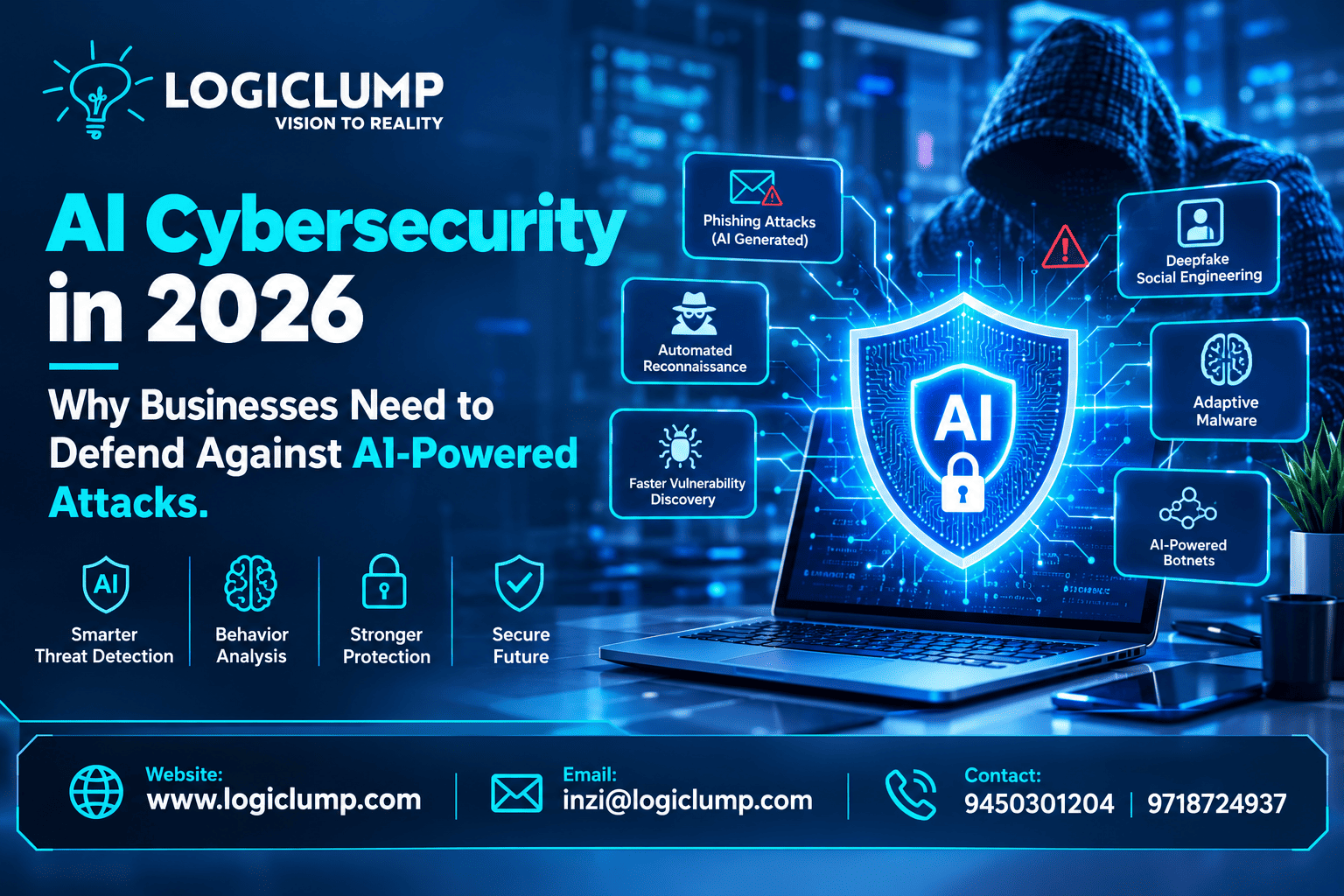
AI Cybersecurity in 2026: Defending Against AI-Powered Threats
Artificial Intelligence is becoming deeply connected to modern business technology. Companies are using AI to automate operations, analyze information, improve customer experiences, and create smarter applications.
But there is another side to this transformation.
Cybercriminals can also use AI to improve the speed, scale, and sophistication of their activities. Attacks that once required significant manual effort can increasingly be supported by automated analysis, personalized communication, and intelligent tools.
This is creating a new cybersecurity landscape where businesses need to prepare for threats that are not only faster, but potentially more adaptive.
At the same time, AI can become a powerful defensive technology.
In 2026, cybersecurity is increasingly becoming a competition between intelligent attack techniques and intelligent defense systems.
What Is AI Cybersecurity?
AI cybersecurity refers to the use of artificial intelligence and machine learning to identify, analyze, prevent, and respond to digital security threats.
Instead of depending entirely on predefined security rules, intelligent security systems can examine patterns across large amounts of activity.
They can assist with:
- Detecting unusual account behavior
- Identifying suspicious network activity
- Analyzing security events
- Finding potential vulnerabilities
- Detecting abnormal transactions
- Prioritizing security alerts
- Supporting incident investigations
- Automating selected response actions
AI does not replace the basic foundations of cybersecurity. Instead, it adds another layer of analysis and automation to existing security practices.
How AI Is Changing the Threat Landscape
AI can be used for legitimate purposes, but attackers can also take advantage of the technology.
The biggest concern is not necessarily that AI creates completely new categories of attacks. In many cases, it can make existing attack methods easier to scale and personalize.
More Sophisticated Phishing
Phishing attacks depend on convincing people to click, respond, or share information.
AI can help attackers create messages that are more polished and tailored to specific targets.
This makes it harder for employees to identify suspicious communication based only on obvious grammar mistakes or generic wording.
Businesses therefore need both technical email protection and continuous employee security awareness.
Automated Target Research
Before attempting an attack, criminals may gather information about a company, its employees, technologies, and publicly exposed systems.
AI can help process large amounts of information more efficiently.
This makes external exposure management increasingly important.
Businesses should regularly review publicly accessible information, application endpoints, cloud resources, and other exposed assets.
Faster Identification of Weaknesses
Modern applications can contain APIs, third-party libraries, cloud services, databases, authentication systems, and thousands of lines of code.
Finding security weaknesses manually can be difficult.
AI-assisted security tools can help developers and security teams examine these environments and highlight areas that deserve further investigation.
Used defensively, this can help organizations discover weaknesses before they become serious incidents.
Why Businesses Need More Than Traditional Security
Firewalls, encryption, antivirus solutions, authentication, vulnerability management, and access controls remain essential.
However, modern businesses operate across increasingly complex environments.
A single organization may have:
- Cloud applications
- Mobile apps
- Web platforms
- APIs
- Remote employees
- SaaS services
- Databases
- IoT devices
- Third-party integrations
Each component can produce security events.
The amount of information generated can become difficult for human teams to analyze manually.
AI can help by processing large volumes of security data and highlighting patterns that require attention.
AI as a Security Detection Layer
Imagine an employee normally accesses a business platform during working hours from a familiar device.
One day, the same account:
- Connects from an unusual location
- Attempts to access restricted information
- Downloads an unusually large amount of data
- Performs unfamiliar administrative actions
Individually, some of these events might not immediately indicate an attack.
Together, however, they could represent suspicious behavior.
An intelligent security system can correlate these signals and raise an alert for further investigation.
This ability to connect multiple events is one of the important advantages of AI-assisted security monitoring.
Intelligent Threat Detection
Security teams often have to deal with large numbers of alerts.
If every alert receives the same priority, important incidents can become difficult to identify quickly.
AI can help categorize and prioritize security events based on multiple signals.
It can analyze information from:
- Login systems
- Endpoints
- Applications
- Cloud environments
- Network activity
- Databases
- Identity systems
- Security logs
The objective is not simply to generate more alerts.
The objective is to help security teams find the alerts that matter most.
AI and Zero-Trust Security
Cloud computing, remote work, APIs, and distributed applications have changed the traditional idea of a secure network boundary.
This has increased interest in Zero Trust security models.
The basic principle is straightforward:
Do not automatically trust. Verify access continuously.
AI can complement this approach by examining factors such as:
- User behavior
- Device activity
- Access patterns
- Login history
- Resource usage
- Geographic anomalies
If behavior suddenly changes, additional verification or investigation may be appropriate.
AI therefore has the potential to make access decisions more context-aware, while established identity and security controls remain essential.
The AI System Itself Must Be Protected
There is an important point that businesses sometimes overlook.
Organizations are increasingly using AI inside their own applications.
An AI system might be connected to:
- Internal documents
- Customer records
- Databases
- APIs
- CRM systems
- Cloud platforms
- Business workflows
That means the AI layer becomes another component that needs protection.
Businesses should consider:
Controlled Access
AI systems should receive only the permissions necessary to perform their assigned tasks.
Data Protection
Sensitive information should be appropriately protected when it is processed by AI-enabled applications.
Input Security
Applications should be designed to handle malicious or manipulative inputs safely.
Activity Monitoring
Important AI actions should be logged and monitored, especially when AI can interact with external tools.
Human Approval
High-risk operations may require human confirmation before execution.
AI Governance and Cybersecurity Are Becoming Connected
As organizations deploy more AI, cybersecurity cannot be separated from AI governance.
Companies should establish clear policies around:
- AI usage
- Data access
- Model permissions
- Security monitoring
- Human oversight
- Auditability
- Incident response
- Sensitive information
A secure AI implementation is therefore not just an engineering project.
It involves technology, people, processes, and organizational policies working together.
AI Can Improve Incident Response
Detecting suspicious activity is only the beginning.
Security teams must also understand what happened and determine what action should be taken.
AI can assist by helping analysts:
- Summarize security events
- Group related alerts
- Identify potentially affected systems
- Analyze large log datasets
- Investigate unusual behavior
- Support response workflows
For example, hundreds of related alerts may actually be connected to one underlying incident.
AI can help security professionals recognize those relationships and reduce unnecessary investigation effort.
AI Cybersecurity in FinTech and Trading
Security is especially important in financial technology.
FinTech and trading platforms may process sensitive information involving:
- Customer accounts
- Financial transactions
- Trading activity
- Payment systems
- APIs
- Business data
A security incident in such an environment can have serious financial and operational consequences.
Intelligent monitoring can help identify unusual transactions, abnormal account activity, suspicious access patterns, and other indicators that require investigation.
For this reason, security should be considered during the architecture and development stages, rather than treated as something to add after the product is finished.
Security Should Begin During Development
Modern cybersecurity should be integrated into the software development lifecycle.
A stronger approach looks like:
Secure Architecture → Secure Development → Security Testing → Vulnerability Assessment → Protected Deployment → Continuous Monitoring
AI can support several stages of this process.
Development teams can use intelligent tools to:
- Review source code
- Identify potentially risky patterns
- Examine dependencies
- Generate security test cases
- Analyze application behavior
- Assist with vulnerability investigation
This helps move organizations toward a security-by-design mindset.
How Businesses Can Strengthen Security in 2026
Organizations do not need to wait for a major security incident before improving their defenses.
A practical strategy can begin with several areas.
1. Improve Identity Protection
Use strong authentication, appropriate permissions, and careful management of privileged accounts.
2. Monitor Behavior
Look beyond individual events and analyze changes in normal user and system activity.
3. Secure APIs
Modern applications depend heavily on APIs, making authentication, authorization, validation, and monitoring important.
4. Review Cloud Security
Regularly examine cloud permissions, configurations, exposed services, and workloads.
5. Educate Employees
Employees should understand modern phishing, social engineering, and AI-assisted scams.
6. Protect AI Applications
Limit what AI systems can access and what actions they are permitted to perform.
7. Establish Incident Response Procedures
Teams should have a clear plan for detecting, containing, investigating, and recovering from security incidents.
The Future of Cybersecurity: AI vs. AI
The cybersecurity landscape is becoming increasingly intelligent.
Attackers can use AI to improve the efficiency and personalization of their methods.
Defenders can use AI to analyze enormous amounts of information, identify suspicious patterns, and accelerate security operations.
This does not mean AI will replace cybersecurity professionals.
Instead, AI can become a powerful tool that allows security teams to spend less time dealing with repetitive analysis and more time making important security decisions.
The strongest security strategy will combine:
AI + Skilled Security Teams + Strong Architecture + Access Controls + Continuous Monitoring + Good Governance
Why AI Cybersecurity Matters for Businesses
AI is becoming part of websites, mobile applications, SaaS platforms, cloud infrastructure, financial systems, and internal business tools.
As software becomes more intelligent, the security strategy surrounding that software must evolve as well.
Businesses should think about cybersecurity not only as protection against today's threats, but as preparation for an environment where attacks and defenses can both become increasingly automated.
The goal is not simply to adopt more security technology.
It is to build secure, resilient, and intelligently monitored digital systems from the beginning.
Build Secure and Intelligent Solutions With LogiClump
Developing a secure AI-powered application requires more than integrating an AI model.
It requires the right combination of software architecture, secure APIs, data protection, cloud infrastructure, application development, monitoring, and business logic.
LogiClump helps businesses transform technology ideas into digital solutions across AI, custom software, web and mobile development, FinTech, trading technology, blockchain, cloud, and SaaS platforms.
Whether you are planning an AI-enabled application, a secure business platform, an intelligent automation solution, or a technology product that needs scalable infrastructure, LogiClump can help turn the concept into a practical digital solution.
LogiClump — Vision to Reality
🌐 Website: www.logiclump.com
📧 Email: inzi@logiclump.com
📞 Contact: 9450301204 | 9718724937
Discover how AI-powered threats are changing cybersecurity in 2026 and how businesses can build smarter, stronger digital defenses.
Tom Cruise