
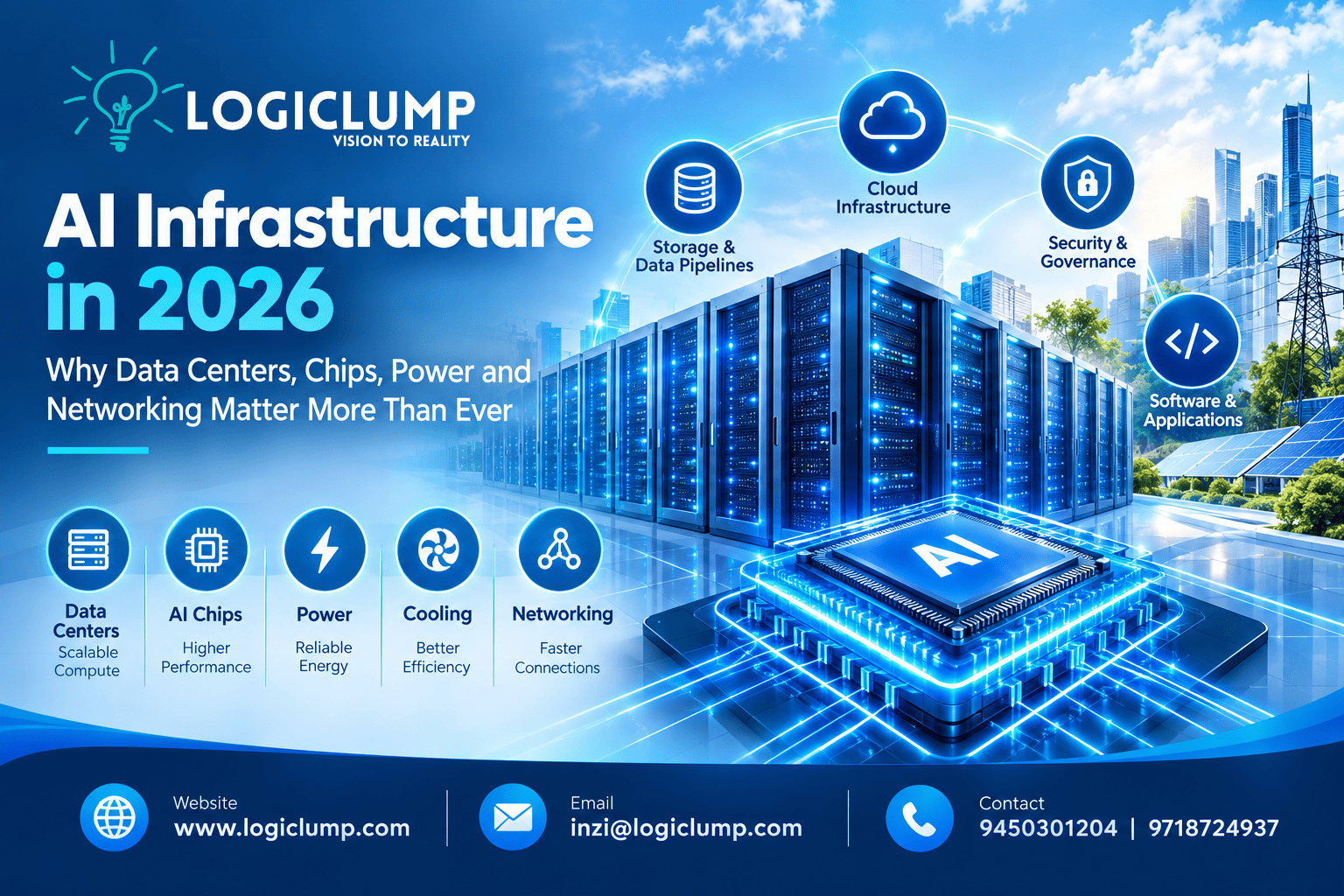
AI Infrastructure in 2026: Why Data Centers, Chips, Power & Networking Matter
Artificial intelligence is entering a new phase of adoption. Businesses are moving beyond basic chatbots and experimental AI tools to develop intelligent applications, automate complex workflows, analyze large volumes of information, and improve everyday decision-making.
But there is a less visible side to this transformation: the technology infrastructure that allows AI systems to function.
Every AI-powered application depends on computing resources, data storage, electricity, network connectivity, and software systems working together. As organizations introduce AI into more business processes, these underlying requirements are becoming increasingly important.
The next stage of AI development will depend not only on smarter models, but also on the infrastructure that makes those models practical, affordable, and reliable.
In 2026, data center capacity, specialized processors, energy availability, cooling technologies, and high-speed networking are central considerations for companies building and deploying AI solutions.
For businesses investing in digital transformation, understanding these components can help them choose appropriate technologies, manage operating expenses, and prepare their applications for future growth.
Understanding the AI Infrastructure Ecosystem
AI infrastructure is the combination of physical equipment, computing resources, software platforms, and operational systems used to develop and run artificial intelligence applications.
Unlike a conventional website or business application, an AI workload may require specialized processors, substantial memory, rapid data transfers, and repeated communication between different computing services.
The infrastructure supporting these workloads generally includes several interconnected layers.
- Computing hardware: CPUs, GPUs, and specialized AI accelerators that process information and execute model operations.
- Data center facilities: Buildings and technical environments that accommodate servers, storage, networking, and supporting equipment.
- Power systems: Electrical connections, distribution equipment, backup supplies, and energy management solutions.
- Cooling technology: Systems that control the heat generated by processors and other electronic equipment.
- Networking infrastructure: Connections that transfer information between servers, databases, AI accelerators, and end users.
- Storage and data pipelines: Systems that collect, organize, protect, and deliver information to AI applications.
- Cloud and software platforms: Services used to deploy models, manage workloads, monitor performance, and scale computing resources.
- Security and reliability controls: Technologies and procedures that protect data, manage access, and maintain service availability.
These elements are closely connected. Increasing processor capacity alone may not improve performance if networking is slow, data retrieval is inefficient, or the system cannot provide sufficient power and cooling.
The effectiveness of an AI deployment therefore depends on how well its entire technology stack is designed.
Why AI Infrastructure Is Becoming a Business Priority in 2026
AI adoption is expanding across industries, including finance, healthcare, retail, education, manufacturing, and professional services. Businesses are incorporating intelligent features into existing applications while developing new products around generative AI and automated agents.
This expansion creates infrastructure demands that vary according to the application.
An internal knowledge assistant might process a relatively small number of requests. An AI-powered customer service platform, by comparison, could handle thousands of simultaneous interactions. A system that analyzes video or operates across multiple business workflows may have different computing and storage requirements again.
The International Energy Agency has highlighted the growing electricity requirements associated with data centers and AI. Its analysis projects that worldwide data center electricity consumption could reach approximately 950 terawatt-hours annually by 2030, reflecting the importance of energy supply and efficiency as digital infrastructure expands. Source: IEA
Several factors are contributing to the growing importance of infrastructure planning:
- Wider deployment of AI across business applications.
- Increased demand for computing capacity and faster processing.
- Greater expectations for responsive, continuously available services.
- Higher power and cooling requirements for certain AI hardware configurations.
- The need to manage computing expenses as usage increases.
- Growing attention to security, reliability, and data governance.
For businesses, this means AI planning should include infrastructure decisions from the beginning rather than treating them as an afterthought.
1. Data Centers: Where AI Computing Happens
Data centers provide the physical environment in which servers, storage systems, processors, and networking equipment operate.
They support many digital services, from websites and databases to enterprise platforms and AI applications. However, large AI workloads can place different demands on these facilities compared with conventional computing environments.
Designing Facilities for AI Workloads
AI systems may require groups of specialized processors to operate together while exchanging large amounts of information. Supporting these workloads can require substantial electrical capacity, advanced thermal management, and high-performance internal networking.
Important considerations include:
- Computing density and rack configuration.
- Electrical distribution and backup systems.
- Cooling capacity and temperature management.
- High-speed connections between servers.
- Hardware monitoring and maintenance.
- Physical security and operational resilience.
Not every AI application requires a specialized facility. Smaller deployments can often operate using standard cloud services or existing enterprise infrastructure. The requirements depend on the workload's size, performance targets, and operational needs.
Why Cloud Infrastructure Matters
Cloud computing gives organizations access to servers, databases, storage, and AI services without requiring them to purchase and maintain all the underlying hardware.
This model allows businesses to experiment with AI, launch new applications, and increase capacity as demand changes.
For startups and growing companies, it can reduce the initial investment required to introduce AI-powered products.
However, cloud services still rely on physical infrastructure. Resource availability, service configuration, pricing, and geographic deployment can influence application performance and cost.
Businesses should evaluate cloud resources according to their actual requirements rather than assuming that more computing capacity will automatically produce better results.
2. AI Chips: Matching Computing Power to the Task
Artificial intelligence relies on mathematical operations that can become extremely demanding when models contain large numbers of parameters or process substantial amounts of data.
Specialized processors help execute these operations efficiently, making AI chips a central part of modern computing infrastructure.
The Role of GPUs and AI Accelerators
Graphics processing units, or GPUs, are widely used in AI because they can perform many calculations in parallel.
Other options include application-specific integrated circuits (ASICs) and specialized AI accelerators designed for particular workloads.
Each hardware category offers different capabilities. Performance, memory, energy consumption, software support, availability, and cost can all affect the suitability of a processor.
The right choice depends on what the system needs to accomplish. Training a large model, running an AI assistant, processing images, and analyzing business documents may require different computing configurations.
Training and Inference Have Different Requirements
AI infrastructure supports two major activities: model training and inference.
Training is the process of developing a model or adapting it using data. Large training projects may distribute computation across many processors, requiring substantial computing resources and fast communication between machines.
Inference occurs when a trained model receives input and produces an output. Examples include answering customer questions, extracting information from documents, generating code, and summarizing reports.
Inference deserves particular attention from businesses because it continues throughout the application's operational life.
For instance, an AI assistant integrated into a company's website may process requests throughout the day. The business must consider response speed, usage patterns, computing expenses, and the quality of the generated answers.
Why Hardware Selection Requires Careful Planning
The most powerful available processor is not necessarily the most appropriate option for every application.
A business should evaluate its workload, expected usage, model requirements, and budget before selecting its computing environment.
In some cases, an optimized smaller model may meet the business requirement without the expense of a larger model. Other applications may justify specialized hardware because of their performance or processing needs.
The objective is to find a practical balance between capability, efficiency, and cost.
3. Electricity: An Essential Resource for AI Growth
AI infrastructure requires a dependable supply of electricity to operate processors, networking equipment, storage systems, and cooling technologies.
As computing facilities become more demanding, access to sufficient power is increasingly important when planning new infrastructure.
Why Power Availability Matters
Large AI deployments can contain many processors running at high utilization for extended periods. Their electricity requirements must be considered alongside the needs of the facility's cooling and supporting equipment.
Data center operators must plan for:
- Adequate electrical supply.
- Reliable power distribution.
- Backup systems for interruptions.
- Power quality and equipment protection.
- Energy monitoring and reporting.
- Long-term operating expenses.
In some locations, electrical grid capacity and the time required to establish new connections can influence data center development.
The IEA's research on energy and AI discusses the relationship between growing digital workloads, electricity demand, and the infrastructure needed to support them. Source: IEA
Reducing Energy Use Through Better Engineering
Expanding infrastructure is only one way to support AI adoption. Improving the efficiency of existing systems can also help organizations manage demand.
Potential approaches include:
- Selecting hardware suited to the workload.
- Reducing idle computing capacity.
- Improving server utilization.
- Optimizing AI inference.
- Avoiding unnecessary model requests.
- Scheduling flexible workloads efficiently.
- Monitoring energy use and system performance.
Software design contributes to these improvements. For example, an application that retrieves relevant information efficiently and avoids repeated processing may complete the same task with fewer computing operations.
This makes energy efficiency a shared responsibility between infrastructure teams and software developers.
Sustainable AI Infrastructure
Renewable electricity, energy storage, efficient cooling, and better facility design are among the approaches being considered to reduce the environmental impact of digital infrastructure.
The results depend on the location, electricity source, equipment configuration, and operating conditions. Sustainability should therefore be assessed through measurable energy and operational data.
For businesses using third-party AI platforms, understanding the available service information and evaluating their own application efficiency can be useful steps toward more responsible resource consumption.
4. Cooling Technology: Keeping High-Performance Systems Reliable
Processors generate heat during operation. When computing equipment operates at high capacity, removing that heat becomes essential to maintaining stable performance and protecting hardware.
Cooling is therefore an important part of AI infrastructure design.
Air Cooling and Liquid Cooling
Air cooling uses fans and airflow systems to carry heat away from computing equipment. It remains suitable for many data center environments.
Liquid cooling uses liquid-based systems to transfer heat away from equipment and can support certain high-density computing configurations.
Depending on the design, liquid cooling may use cold plates attached to processors or other specialized heat-transfer arrangements.
Neither approach is universally suitable for every deployment. The decision depends on processor density, rack configuration, facility capabilities, maintenance requirements, and operating expenses.
The Connection Between Cooling and Operating Costs
Cooling systems consume resources and contribute to the total cost of operating a data center.
Inefficient thermal management can also affect equipment reliability and limit how much computing hardware a facility can accommodate.
For operators, effective cooling helps maintain appropriate operating conditions. For businesses using cloud AI services, the underlying cooling requirements form part of the service provider's infrastructure and operating model.
As AI hardware becomes more demanding, cooling needs to be considered alongside processor selection and power planning.
5. Networking: The Connections That Keep AI Systems Moving
AI processors need more than computing capacity. They also need to exchange information with other processors, storage systems, databases, and applications.
Networking provides these connections.
In large AI environments, communication delays or limited bandwidth can prevent processors from working as efficiently as intended.
NVIDIA, for example, provides specialized networking technologies designed for the communication requirements of large-scale AI computing systems. Source: NVIDIA
What Makes AI Networking Different?
During model training, processors may need to exchange intermediate results and coordinate their work. During inference, an application may retrieve information from storage, communicate with model-serving systems, and return the final result to a user.
The network must support these activities without introducing unnecessary delays or bottlenecks.
Important factors include:
- Available network bandwidth.
- Latency between connected systems.
- Congestion and traffic management.
- Reliability and redundancy.
- Secure communication.
- Efficient data transfer between services.
The relative importance of each factor depends on the workload. A large distributed training cluster may have different networking requirements from a small AI feature integrated into a website.
Networking Also Affects Application Performance
Consider an AI application that answers questions using a company's internal documents.
Before returning an answer, the application might authenticate the user, search a database, retrieve relevant documents, submit information to an AI model, and format the response.
Even if the model generates an answer quickly, delays elsewhere in this sequence can slow the complete experience.
Software teams can address some of these issues through efficient API communication, caching, asynchronous processing, and appropriate data retrieval strategies.
The lesson is straightforward: application speed depends on the entire system, not just the AI model.
6. Storage and Data Pipelines: Preparing Information for AI
Artificial intelligence systems require access to information that is relevant to their tasks.
Depending on the application, this information may come from databases, uploaded documents, transaction records, customer profiles, images, or external services.
Storage systems and data pipelines make it possible to organize this information and deliver it to the appropriate computing resources.
Why Data Quality and Access Matter
Large quantities of poorly organized information do not automatically produce useful AI results.
Applications need suitable data access, validation, organization, and security controls. They may also need to retrieve information quickly enough to meet response-time expectations.
Businesses should pay attention to:
- Database structure and query performance.
- Storage capacity and data retrieval speed.
- Data accuracy and consistency.
- Duplicate and outdated records.
- Access permissions.
- Backup and recovery.
- Retention policies.
- Secure data transfers.
For example, a business assistant that answers questions from company documents needs a reliable method for locating relevant material. If the information is outdated, inaccessible, or incorrectly organized, the quality of the resulting answers may suffer.
Effective data engineering is therefore an important part of delivering useful AI applications.
7. Cloud, Private and Hybrid AI Deployments
Businesses have several options for running AI workloads. They can use public cloud services, operate systems in privately controlled environments, or combine different approaches.
The appropriate architecture depends on the application's requirements and the organization's resources.
Public Cloud Services
Public cloud platforms offer access to computing, storage, networking, and managed AI capabilities.
Businesses can often get started without purchasing specialized hardware or managing a physical data center.
This approach can be useful for prototypes, customer-facing applications, and workloads whose resource requirements change over time.
However, organizations should evaluate service pricing, data-handling practices, resource limits, and dependencies on individual providers.
Private Infrastructure
A private environment may be appropriate when an organization needs greater control over its deployment, data access, or operating configuration.
Depending on the use case, this could involve dedicated hardware, privately hosted services, or infrastructure managed within the organization's existing technology environment.
Greater control also brings additional responsibilities, including maintenance, security, capacity management, and operational support.
Hybrid Architectures
A hybrid approach combines multiple environments.
For example, a company could use managed AI services for general-purpose tasks while keeping selected business data and applications in a controlled environment.
Another organization might run predictable workloads on dedicated infrastructure while using cloud resources for temporary increases in demand.
These are architectural options rather than universal recommendations. Businesses should assess security requirements, application performance, cost, technical expertise, and operational complexity before choosing an approach.
8. Managing the Real Cost of AI Infrastructure
The financial requirements of AI extend beyond the cost of processors or the price of an individual API request.
Depending on the deployment, the overall cost may include computing, storage, networking, electricity, cooling, software licenses, security, maintenance, and engineering time.
Understanding these costs is essential when an application moves from a small pilot to regular business use.
Look Beyond Hardware Prices
Two systems that deliver similar results may have different operating costs because they use different models, process different amounts of data, or require different infrastructure configurations.
A realistic assessment should consider:
- Computing and AI service charges.
- Storage and database expenses.
- Data transfer and networking.
- Software licenses.
- Monitoring and security.
- Backup and recovery.
- Maintenance and technical support.
- Development and operations resources.
Businesses should also consider how expenses change with usage. A system that works economically with a small group of users may require additional optimization when request volumes increase.
Practical Ways to Improve Cost Efficiency
Software engineering can help reduce unnecessary infrastructure consumption.
Choose suitable models: Select a model that satisfies the application's accuracy and capability requirements.
Reduce redundant requests: Avoid repeated processing when the information or result can safely be reused.
Use caching appropriately: Store reusable results where doing so is consistent with data freshness and security requirements.
Optimize context and prompts: Send relevant information rather than unnecessarily large amounts of input.
Improve background processing: Use asynchronous workflows for tasks that do not need to block the user's interaction.
Monitor usage: Measure latency, failure rates, resource consumption, and cost per completed task.
Review actual performance: Adjust infrastructure according to measured workloads instead of relying entirely on initial estimates.
These practices help businesses understand where their resources are being used and identify opportunities for improvement.
9. Security and Reliability Must Be Built Into the System
AI applications often interact with sensitive business information, internal databases, customer records, and external services.
Their security depends on the complete technology environment rather than the model alone.
A secure implementation should address identity management, data protection, application permissions, infrastructure monitoring, and operational recovery.
Key measures include:
- Authentication and role-based access controls.
- Encryption for data in transit and at rest.
- Secure API integrations.
- Appropriate network isolation.
- Protection of passwords, keys, and credentials.
- Monitoring and audit logging.
- Software vulnerability management.
- Backup and disaster recovery.
- Incident-response procedures.
- Data governance and retention controls.
Reliability also requires attention to dependencies.
An AI-powered application may stop functioning correctly if its database becomes unavailable, an external service reaches a rate limit, or a model endpoint fails.
Developers can plan for these situations using timeouts, controlled retries, suitable fallback behavior, monitoring, and recovery procedures.
For important business workflows, human review may also be appropriate when an automated process cannot complete its task reliably.
10. Building Software That Works With AI Infrastructure
As AI capabilities become more widely available, software developers must consider how these capabilities fit into the larger application architecture.
An AI-powered product may combine a web or mobile interface, backend services, databases, model APIs, authentication, document retrieval, analytics, and external integrations.
Each component must communicate reliably with the others.
Important Principles for AI-Ready Software
Modular design: Keep model integrations, business rules, data access, and user interfaces organized into maintainable components.
Flexible integrations: Use clear interfaces that allow a model or service to be changed when business requirements evolve.
Scalable backend architecture: Design APIs and background jobs to accommodate changing traffic and processing demands.
Controlled data access: Ensure each user and service can access only the information permitted for its role.
End-to-end monitoring: Measure the complete user request, including database queries, network communication, and model processing.
Cost tracking: Monitor the resources consumed by individual features or workflows wherever practical.
Resilient service connections: Plan for timeouts, temporary outages, rate limits, and unsuccessful requests.
Deployment flexibility: Consider whether the product may eventually need to support different cloud platforms or private environments.
These principles help organizations develop software that can adapt to changing AI capabilities without requiring unnecessary redesign.
11. A Practical Roadmap for Businesses Adopting AI
Organizations do not need to own specialized chips or build their own data centers to introduce AI into their operations.
A more practical approach is to begin with a clearly defined business requirement, validate the solution, and expand once the technical and financial results are understood.
Step 1: Define the Problem
Identify a specific opportunity, such as automating document processing, assisting customer support teams, improving internal search, or reducing repetitive administrative work.
Step 2: Establish Performance Requirements
Estimate the expected number of users, request volume, response times, data requirements, and quality expectations.
Step 3: Select an Appropriate Deployment Model
Compare managed AI services, cloud infrastructure, private environments, and hybrid architectures according to the application's needs.
Step 4: Review Data and Security
Determine what information the application will process, who can access it, and how it should be stored, transferred, and retained.
Step 5: Develop a Pilot Application
Build a limited version that demonstrates the main workflow and can be tested with representative data.
Step 6: Measure Results
Evaluate output quality, response times, reliability, operating costs, and the amount of human intervention required.
Step 7: Optimize the Solution
Improve data retrieval, model selection, backend processing, caching, and infrastructure configuration based on observed results.
Step 8: Expand Gradually
Increase usage while monitoring system performance, security, and costs. Reassess infrastructure as business requirements change.
Following this process allows businesses to make decisions using practical evidence rather than relying only on assumptions about AI capabilities.
12. How LogiClump Supports AI-Powered Digital Solutions
Introducing AI into a business often requires more than connecting an application to a model. Organizations may also need custom interfaces, secure backend services, database integration, automated workflows, and a scalable software architecture.
LogiClump helps businesses turn their digital product ideas into software solutions designed around their operational requirements.
Its software development capabilities can support projects involving:
- AI-powered web applications: Integrating intelligent features into business websites and web platforms.
- Custom AI integrations: Connecting applications with appropriate AI services and APIs.
- Backend and database development: Building the services that manage information, business logic, and application workflows.
- Cloud-ready software architecture: Designing applications with deployment, maintenance, and future growth in mind.
- Business process automation: Reducing repetitive work through software-driven workflows.
- CRM and enterprise applications: Connecting business operations with practical digital tools.
- Web and mobile app development: Creating customer-facing and internal applications.
- SaaS product development: Building software platforms with maintainability and scalability as design considerations.
- Dashboards and reporting systems: Making business information easier to access and understand.
- Third-party integrations: Connecting existing platforms, databases, and services.
Consider a business that wants to introduce an AI assistant to its existing customer support platform. The solution may require a user interface, authentication, access to approved company documents, backend APIs, AI integration, and performance monitoring.
Each component needs to be designed around the complete workflow so that the application is useful, secure, and maintainable.
Likewise, a company adding AI features to a SaaS product may need flexible integrations, efficient database queries, controlled access to customer information, and monitoring to understand usage and costs.
LogiClump can help businesses plan and develop these software components according to their product goals and technical requirements.
Our focus is on practical digital solutions that connect business needs with reliable software engineering.
Explore our services at www.logiclump.com.
Looking Ahead: The Next Stage of AI Infrastructure
AI infrastructure will continue to develop as computing hardware, data center design, networking, cooling, and software optimization evolve.
Several areas are expected to remain important to the industry:
- More efficient processors and AI accelerators.
- Greater attention to computing density.
- Improved thermal management.
- More effective energy monitoring.
- High-performance networking for distributed workloads.
- Flexible cloud and hybrid deployment options.
- Automated infrastructure monitoring.
- More efficient model inference.
- Stronger security and data governance.
Progress will not occur at the same pace everywhere. Hardware availability, electricity supply, investment, software compatibility, and local infrastructure will influence adoption.
For businesses, flexibility is therefore an important design consideration. Software should be built so that models, services, and deployment configurations can evolve as requirements change.
The objective is not to predict every future technology development. It is to create applications that can accommodate change without unnecessary complexity or expense.
Conclusion
Artificial intelligence is changing the technology landscape, but its growth depends on a complete infrastructure ecosystem.
Data centers provide the physical environment. AI chips perform specialized computations. Electricity powers the equipment, cooling systems manage heat, and networking connects processors, storage, and applications. Data pipelines, cloud platforms, security controls, and software engineering bring these capabilities together.
For businesses, the challenge is to select and combine these resources according to real requirements.
A successful AI application does not necessarily need the largest model, the most expensive processor, or a dedicated data center. It needs an appropriate combination of technology, efficient software, reliable operations, and sound cost management.
As AI becomes part of everyday business processes, organizations that consider infrastructure and software together can make more informed decisions about performance, security, and growth.
LogiClump helps businesses transform ideas into digital products through custom software development, AI integration, web and mobile applications, and business automation.
Build practical solutions today. Prepare your software for tomorrow.
Visit: www.logiclump.com
Explore AI infrastructure in 2026, including data centers, AI chips, power, cooling, networking, and scalable software solutions shaping the future of AI.
Tom Cruise