
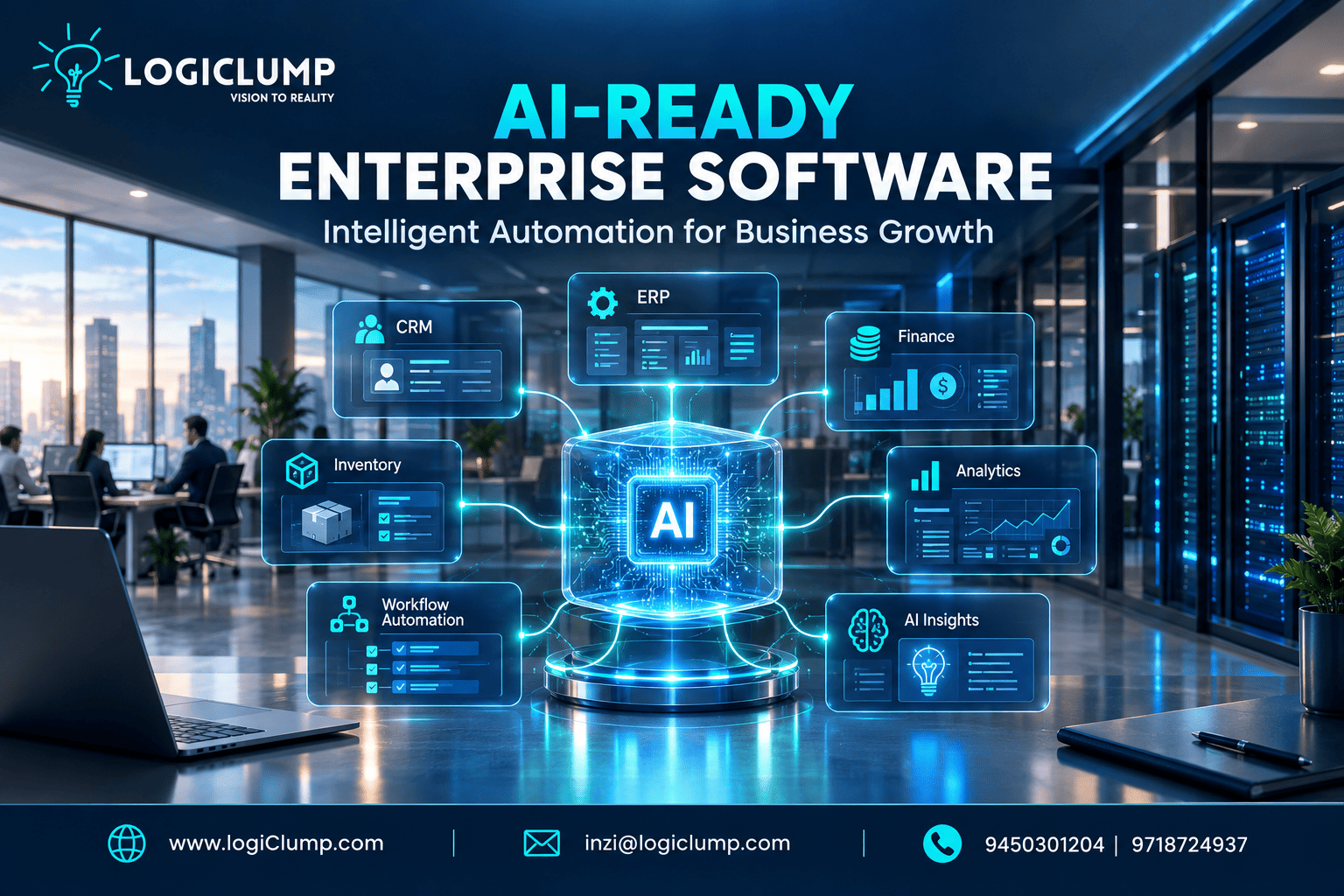
AI-Ready Enterprise Software in 2026
Businesses today rely on software to manage customers, coordinate employees, process transactions, track performance, and support everyday operations. As organizations grow, these responsibilities become more complex, and the software that once worked well may begin to create new challenges.
Different departments may use separate applications. Employees may spend hours transferring information between systems. Management may struggle to get a complete view of business performance. Routine decisions may require unnecessary manual effort.
Artificial intelligence offers new ways to address these challenges. But to benefit from AI, businesses need more than a chatbot or a collection of disconnected tools. They need software that supports their actual operations, connects their business processes, and can evolve as their requirements change.
This is where AI-ready enterprise software becomes important.
For businesses planning their next stage of digital transformation, the opportunity is to combine reliable enterprise software with intelligent capabilities that improve productivity, decision-making, and operational efficiency.
What Is AI-Ready Enterprise Software?
AI-ready enterprise software refers to business applications designed to support modern organizational needs while allowing artificial intelligence to enhance selected workflows and activities.
These solutions can help companies manage complex operations, improve access to business information, reduce repetitive work, and make better use of the data they already possess.
Examples include:
-
Enterprise resource planning and business management systems.
-
Customer relationship management platforms.
-
Financial and transaction management software.
-
Inventory and supply-chain management applications.
-
Enterprise e-commerce platforms.
-
Employee and internal management portals.
-
AI-powered reporting and business intelligence solutions.
-
Custom software tailored to specific business requirements.
For example, a company may already use software to manage customer relationships. An AI-enabled version could help employees summarize customer interactions, identify overdue follow-ups, and highlight potential sales opportunities.
The objective is not simply to add AI to an existing product. It is to create a more effective business system that helps people work better and enables the organization to grow.
Why Enterprise Software Needs to Evolve
Enterprise software plays a central role in how modern organizations operate. However, business requirements rarely remain the same for long.
Companies introduce new products, enter new markets, expand their teams, acquire customers, and adopt additional business processes.
Software must evolve alongside these changes.
1. Disconnected Business Systems
Many organizations rely on separate applications for sales, finance, operations, customer support, and reporting.
When these systems do not work together effectively, employees may need to enter the same information multiple times or search across several platforms to understand a situation.
This creates delays and increases the possibility of inconsistent information.
Custom enterprise software can help businesses create a more connected working environment, allowing teams to access the information they need and coordinate their activities more effectively.
2. Repetitive Manual Processes
Employees often spend valuable time preparing reports, organizing records, reviewing requests, and completing routine administrative activities.
As the organization grows, these tasks can become increasingly difficult to manage.
Business automation and AI-powered applications can help reduce repetitive work while allowing employees to focus on activities that require judgment, communication, and expertise.
3. Limited Business Visibility
Managers need a clear understanding of what is happening across their organization.
When business information is spread across multiple applications, preparing a complete picture of performance can be difficult.
Enterprise dashboards, reporting platforms, and AI-assisted analysis can help bring important information together and make it easier for decision-makers to identify trends, problems, and opportunities.
4. Software That Cannot Keep Up With Growth
An application that supports a small business may not meet the needs of a larger organization.
Growing companies may require more advanced reporting, additional user roles, new business workflows, greater operational visibility, and support for multiple departments.
Enterprise software should be designed around current requirements while allowing room for future growth.
How AI Is Changing Enterprise Software
AI is creating new possibilities for how employees interact with business applications.
Traditionally, software has helped users record information, follow processes, and complete predefined tasks. AI can add another layer by helping users interpret information, prepare recommendations, and manage selected activities more efficiently.
Here are some important applications.
Intelligent Business Reporting
Managers often need to understand revenue, expenses, customer activity, operational performance, and other business indicators.
AI-assisted reporting can help summarize information, highlight unusual changes, and identify areas that deserve further investigation.
For example, a management team could use an AI-enabled reporting solution to identify which products are performing well, where expenses have increased, or which customer segments have become less active.
The information should still be verified before it is used for important business decisions.
Smarter Customer Relationship Management
A CRM system should do more than store customer information.
With appropriate AI capabilities, it can help sales teams summarize customer interactions, identify follow-up opportunities, prepare communication, and understand changes in customer activity.
This can help employees spend less time on administration and more time building customer relationships.
More Efficient Operations
Enterprise applications can help organizations coordinate activities across departments.
AI can assist with tasks such as classifying incoming requests, preparing summaries, identifying potential delays, and highlighting operational issues.
For example, an operations team could receive an early indication that a particular inventory item requires attention based on available stock and sales information.
The business can then investigate the situation and take appropriate action.
Better Employee Experiences
Employees often need to search through policies, reports, internal documents, and business records to find the information required for their work.
An AI-enabled internal business assistant can help locate relevant information and provide summaries based on approved company resources.
This can make internal information easier to access while allowing employees to verify important details.
Enterprise Software Solutions That Support Business Growth
Every organization has different requirements. The most effective enterprise software is designed around the business processes it needs to support.
Several types of solutions can help companies improve their operations.
Custom Enterprise Software
Off-the-shelf software can be useful for standard business activities, but some organizations have specialized requirements that existing products do not fully address.
Custom enterprise software can be designed around a company's particular workflows, reporting needs, internal processes, and operational goals.
For example, a service organization may need a unified platform for managing customer requests, employee assignments, service delivery, and performance reporting.
A custom solution can bring these activities into a more organized environment.
Enterprise CRM Solutions
Customer relationship management software helps businesses organize leads, customer records, sales activities, and customer interactions.
A well-designed CRM solution can improve visibility across the sales process and help teams maintain consistent customer communication.
AI capabilities can further assist with customer summaries, follow-up suggestions, and sales insights.
ERP and Business Management Systems
Enterprise resource planning and business management systems help organizations coordinate activities such as inventory, purchasing, finance, and operations.
For businesses dealing with complex processes, an integrated management platform can reduce fragmented workflows and improve access to operational information.
Financial and Trading Software
Financial organizations and trading businesses require software that supports their specific operational needs.
Depending on the use case, these solutions may include financial dashboards, transaction management applications, trading interfaces, reporting tools, and customer management systems.
Reliability, security, accuracy, and appropriate oversight are especially important when software supports financial activities.
E-Commerce and Digital Commerce Platforms
Growing e-commerce businesses often need more than a basic online store.
They may require product management, order tracking, inventory visibility, customer accounts, sales reporting, and improved customer experiences.
Enterprise-oriented commerce software can help businesses manage these activities as their operations expand.
AI-Powered Business Applications
Some organizations need AI capabilities built around a specific business problem.
Examples include customer-support assistants, document analysis tools, intelligent reporting applications, internal knowledge assistants, and workflow automation solutions.
The right application depends on the business objective, the information available, and the level of reliability required.
Real-World Example: Connecting a Growing Business
Consider a company that has expanded its customer base but still manages sales, support, inventory, and reporting through separate tools.
The sales team may not have a complete view of customer activity. Support employees may lack access to relevant order information. Managers may wait for manually prepared reports before identifying operational problems.
An enterprise software improvement initiative could focus on three priorities.
First, connect important business activities. Give employees a more consistent view of the information relevant to their roles.
Second, simplify repetitive processes. Reduce unnecessary manual work involved in customer follow-ups, routine reporting, and internal coordination.
Third, introduce AI where it adds value. Use AI-assisted summaries, recommendations, and analysis to help employees understand information and identify next steps.
The company does not necessarily need to replace every application. It needs a practical plan for improving the processes that create the greatest difficulties.
This is the kind of business-focused approach that makes enterprise software valuable: solve the operational problem first, then select the appropriate technology.
How AI-Ready Enterprise Software Creates Business Value
The benefits of enterprise software should be measured in terms of business outcomes rather than the number of features it contains.
Improved Productivity
Employees can spend less time searching for information and completing repetitive tasks.
Better Coordination
Departments can work more effectively when they have access to relevant and consistent business information.
Faster Decision-Making
Clearer reporting and AI-assisted analysis can help managers identify issues and evaluate opportunities more efficiently.
Improved Customer Experience
Connected customer information and better-organized workflows can help businesses provide more consistent service.
Greater Operational Visibility
Managers can gain a clearer understanding of business performance, workload, and areas that need attention.
Support for Business Growth
Software that evolves with changing requirements can help organizations manage increasing complexity without continually creating disconnected processes.
These benefits depend on the quality of the solution, employee adoption, reliable information, and effective business processes. AI alone does not guarantee better results.
Should Businesses Replace Their Existing Enterprise Software?
Not always.
Replacing an entire software environment can be expensive, disruptive, and unnecessary.
A business may already have applications that work well for particular activities. The challenge may be that some processes are inefficient, some information is difficult to access, or certain capabilities are missing.
In these situations, businesses can evaluate three approaches.
Improve existing systems: Enhance the applications that still meet the organization's needs.
Introduce complementary solutions: Add new software where current applications cannot adequately support a business requirement.
Modernize selected systems: Replace or substantially improve outdated applications that limit performance, usability, or future growth.
The right choice depends on the company's goals, existing software, operational challenges, and available resources.
A thoughtful assessment helps businesses avoid unnecessary replacement costs while ensuring that important problems are addressed.
Preparing Your Organization for AI Adoption
Successful AI adoption requires more than choosing an AI tool. It also requires a clear understanding of the organization's needs and the people who will use the solution.
Start With Business Priorities
Identify the activities that create the greatest delays, unnecessary costs, or difficulties for employees and customers.
Understand Existing Workflows
Determine how different departments operate, where information is duplicated, and which tasks require the most manual effort.
Choose Practical Use Cases
Begin with a specific opportunity, such as improving customer support, simplifying reporting, or helping sales teams manage follow-ups.
Prepare Employees
Explain how the new solution will support their work, and provide appropriate guidance on its use and limitations.
Protect Business Information
Customer records, financial information, and confidential company data must be handled responsibly. Define who can access information and which activities require additional review.
Measure Business Results
Evaluate outcomes such as time saved, customer satisfaction, reporting effort, process consistency, and operational performance.
Expand Based on Evidence
Once a solution demonstrates measurable value, consider extending the approach to other areas of the organization.
This gradual approach helps businesses adopt AI with realistic expectations and a clearer understanding of its value.
Common Mistakes in Enterprise Software Development
Even a well-intentioned software initiative can fail to deliver the expected results if the business problem is not clearly understood.
Choosing Software Before Defining the Problem
Organizations should identify what needs to improve before deciding which solution to purchase or develop.
Adding Too Many Features
A system with numerous unnecessary features can become difficult to use and maintain.
The focus should be on capabilities that support actual business requirements.
Ignoring Employee Workflows
Software must work for the people who depend on it every day. Employee feedback can help identify practical requirements and usability problems early.
Treating AI as a Complete Replacement for Human Judgment
AI-generated information can be inaccurate or incomplete. Important decisions should have appropriate verification and human oversight.
Overlooking Long-Term Needs
Enterprise software should be evaluated not only for its immediate usefulness but also for its ability to accommodate changing business requirements.
Measuring Activity Instead of Outcomes
The success of a software project should be judged by improvements in business performance, not merely by the number of features delivered.
Choosing the Right Enterprise Software Development Partner
Selecting a software development partner is an important decision because the resulting application may become central to daily business operations.
Businesses should look for a partner that understands their objectives and can translate those objectives into practical digital solutions.
Important considerations include:
-
Business understanding: Can the partner understand the company's operational challenges?
-
Custom development capabilities: Can the solution be tailored to the organization's requirements?
-
Integration experience: Can the proposed solution work alongside the company's existing applications?
-
Security and reliability: Are business information and essential operations treated responsibly?
-
Scalability: Can the solution evolve as the organization grows?
-
Long-term support: Can the software be improved as business needs change?
-
Clear communication: Are project scope, expectations, and responsibilities understood?
The right partner should focus on delivering business value rather than simply building software.
How LogiClump Supports Enterprise Software Development
At LogiClump Technologies, we understand that businesses need software that supports real operational requirements—not just a collection of digital features.
Our focus is on developing custom digital solutions that help organizations improve processes, deliver better customer experiences, and prepare for future growth.
Our services include:
-
Custom enterprise software development
-
Web and mobile application development
-
Business management and CRM solutions
-
E-commerce platforms
-
AI-powered business applications
-
Workflow automation
-
Financial and trading software
-
API and third-party integrations
-
Business dashboards and reporting solutions
Whether a business needs a new enterprise application, an improved customer management system, a specialized digital platform, or AI capabilities within an existing workflow, the solution should begin with its goals and challenges.
LogiClump works toward practical software solutions designed around business needs, with an emphasis on usability, flexibility, and long-term value.
The Future of Enterprise Software in 2026 and Beyond
Enterprise software is evolving from a collection of separate tools toward more connected, intelligent business environments.
Organizations are increasingly exploring how AI can assist employees, make business information easier to understand, and improve selected workflows.
However, the future of enterprise software is not simply about adding more AI features.
It is about building systems that help businesses operate more effectively, adapt to change, and make better use of their information.
Companies that invest in understanding their workflows, choosing suitable software, preparing their employees, and measuring outcomes will be better positioned to benefit from these developments.
Conclusion: Build Enterprise Software Around Your Business Goals
Enterprise software plays an important role in how organizations manage operations, serve customers, and pursue growth.
As business requirements become more complex, companies need solutions that can improve coordination, reduce unnecessary work, and support better decisions.
AI-ready enterprise software offers an opportunity to combine these business foundations with intelligent capabilities where they provide genuine value.
The most effective approach is not to adopt every new technology or replace every existing application. It is to identify what needs to improve, choose the right solution, and build a clear path toward better business performance.
At LogiClump, our focus is on helping businesses turn their requirements into practical, scalable digital solutions.
Let's Discuss Your Enterprise Software Requirements
Looking to develop custom enterprise software, modernize business applications, improve operational workflows, or introduce AI-powered capabilities?
LogiClump Technologies can help you explore a solution aligned with your business goals.
🌐 Website: www.logiclump.com
📧 Email: inzi@logiclump.com
📞 Contact: 9450301204 | 9718724937
Build. Innovate. Empower
Discover how AI-ready enterprise software helps businesses improve operations, connect workflows, support growth, and adopt intelligent automation.
Tom Cruise