
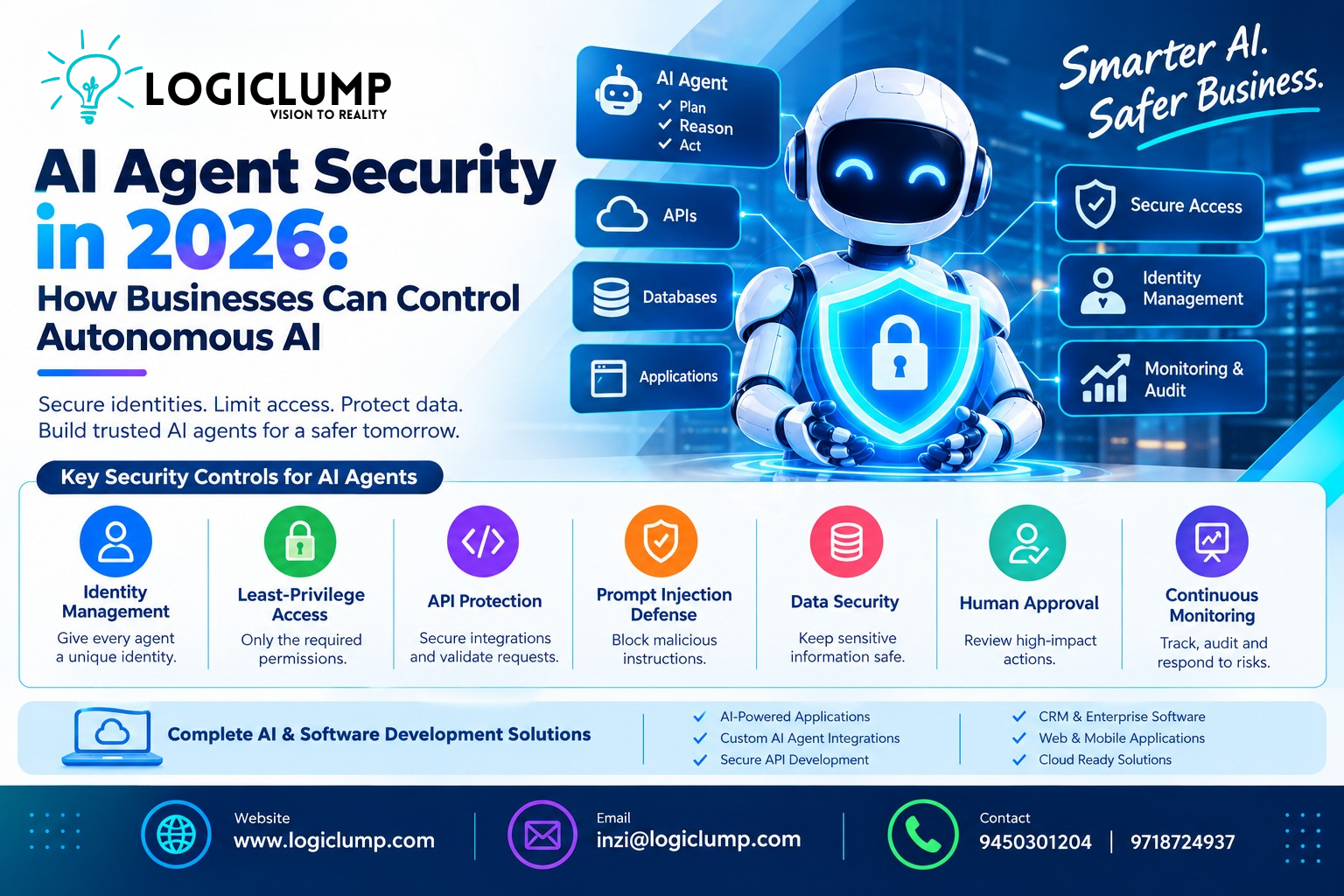
AI Agent Security in 2026: Smarter AI. Safer Business.
Artificial intelligence is changing the way companies manage their daily operations. What started as a technology for answering questions and generating content is now becoming a way to coordinate tasks, interact with business applications, and automate complex workflows.
AI agents are an important part of this transition.
Unlike conventional chatbots, which primarily respond to user requests, AI agents can work through a series of steps to accomplish a defined objective. They can retrieve information, communicate with APIs, use connected tools, and perform selected operations with limited human involvement.
For businesses, this creates opportunities to reduce repetitive work and connect systems that previously operated separately.
However, there is an important difference between allowing AI to provide information and allowing it to take action.
An agent connected to company databases, customer accounts, financial applications, or cloud infrastructure can influence real business operations. If its access is poorly managed, even a routine automation workflow can introduce security problems.
The challenge in 2026 is no longer just building capable AI agents. It is building agents whose capabilities remain within clearly defined security boundaries.
Why Businesses Must Rethink AI Security
Most traditional business applications operate through functions and permissions established during development. Users interact with those functions through predefined interfaces.
AI agents introduce a more dynamic way of working.
An agent may receive a broad objective, determine the steps needed to complete it, choose from available tools, and use the results to decide what happens next.
Consider an agent responsible for processing customer orders. It might:
- Read an incoming customer request.
- Retrieve the relevant order information.
- Check product availability.
- Prepare an update.
- Create a support ticket.
- Notify the appropriate team.
Each step may involve a different application or data source.
This creates a connected security environment in which the agent's identity, instructions, credentials, permissions, and integrations all matter.
A weakness in one component can affect the complete workflow. For example, a secure AI model cannot compensate for an API that allows unauthorized database access.
Businesses therefore need to protect the entire system surrounding an agent, not just the model that powers it.
What Makes an Autonomous Agent Vulnerable?
An AI agent operates through several connected components. Understanding these components helps developers identify where security controls are necessary.
Instructions and External Content
Agents receive instructions from users, developers, and connected information sources. These sources do not all have the same level of trust.
Tools and Functions
Tools give an agent the ability to search databases, send messages, update records, execute code, or communicate with external services.
Identity and Credentials
Agents need a way to authenticate themselves when accessing applications and services.
Data and Memory
Some agents retrieve internal documents or retain information from previous interactions. This information must be protected against unauthorized access.
Runtime Environment
The environment in which an agent executes tasks determines which files, networks, services, and computing resources it can reach.
Security planning should cover all these components before an agent receives access to important business systems.
The Security Risks Behind Agentic AI
Prompt Injection Can Manipulate Agent Behavior
An AI agent may be asked to examine an email, summarize a document, or research a website. That content could contain instructions designed to influence the agent.
For example, an attacker might include misleading text in a document that attempts to persuade an internal AI assistant to reveal confidential information.
This type of manipulation is commonly known as prompt injection.
It is particularly relevant to agents because they may have access to tools that can turn an influenced decision into an actual operation.
Businesses should reduce this exposure by:
- Treating external content as information, not trusted instructions.
- Separating developer-defined instructions from retrieved material.
- Limiting the tools available to each agent.
- Checking proposed operations through independent security controls.
- Testing against adversarial documents and messages.
- Monitoring unexpected tool usage.
There is no single prompt-filtering technique that guarantees protection. Technical access restrictions remain essential even when an agent has strong instructions.
Overprivileged Agents Increase the Impact of Errors
An agent should not receive broad permissions simply because developers want to make implementation easier.
Imagine a reporting assistant that only needs to read sales figures. Giving it permission to modify customer accounts, change financial settings, or delete records creates unnecessary risk.
A safer design gives each agent access according to its specific responsibility.
For example, a reporting agent may be allowed to:
- Read approved sales information.
- Generate performance summaries.
- Export authorized reports.
It should not automatically be able to:
- Change administrator accounts.
- Modify payment information.
- Delete business records.
- Access unrelated employee data.
This approach follows the principle of least privilege: provide only the access necessary to complete an assigned task.
Poorly Protected APIs Can Expose Connected Systems
APIs are the bridges between AI agents and business applications.
An agent may use an API to retrieve customer information, check an order, create a ticket, or update a record.
If an API does not properly verify the requesting identity and the requested operation, an agent integration can become a route to unauthorized access.
Developers should protect these interfaces through:
- Strong authentication.
- Resource-level authorization.
- Input and output validation.
- Rate limiting.
- Encrypted communication.
- Secure credential handling.
- Request monitoring.
- Detailed audit records.
Importantly, API permissions should be checked for every operation. Authentication alone does not establish that an agent is authorized to perform a particular action.
Confidential Information Can Travel Through AI Workflows
An agent may combine information from several sources to complete a task. Without suitable data controls, confidential information could be included in an output, stored in memory, exposed through logs, or transferred to an external service.
Organizations should identify sensitive information before connecting it to AI workflows.
Practical safeguards include data classification, access restrictions, appropriate masking, retention rules, and reviews of external data transfers.
Businesses should also understand how their chosen AI services handle prompts, responses, and interaction histories.
An Incorrect Decision Can Become a Real Operation
AI systems can misunderstand requests or work with incomplete information.
A conventional chatbot might produce an inaccurate answer. An agent with operational permissions might also update a record, send a message, or trigger another workflow based on that misunderstanding.
The solution is to introduce validation between an AI recommendation and the actual execution of an operation.
Business rules should determine whether an action is acceptable. The AI model should not be the only authority deciding whether an operation can proceed.
Establish a Clear Identity for Every Agent
When multiple agents work across an organization, businesses need to know which system is accessing information and performing actions.
Using one shared account for several agents makes accountability difficult.
Instead, important agents should have separate identities associated with their purpose and responsible owner.
A practical identity record could include:
| Identity detail | Example |
|---|---|
| Agent | Inventory Assistant |
| Owner | Operations Department |
| Purpose | Monitor stock and report shortages |
| Data access | Approved inventory records |
| Available tools | Stock lookup and report generation |
| Restrictions | No financial or administrator access |
| Review | Periodic permission assessment |
This makes it easier to investigate activity, update permissions, and disable an agent when it is no longer required.
Agent identities should be managed throughout their lifecycle, just like other non-human identities used by business applications.
Make Every Access Request Prove Its Permission
Being part of an organization's internal environment should not give an AI agent automatic access to its resources.
A useful approach is to apply Zero Trust principles to agent interactions.
Under this approach, the application checks each request before allowing access.
For example, when an agent attempts to retrieve a customer record, the system should establish:
- Which agent is making the request?
- Who is responsible for that agent?
- Is the agent permitted to access this customer?
- Is the requested information necessary for its task?
- Does the operation comply with organizational policy?
The same checks should apply when an agent attempts to modify information or invoke another service.
Permissions should also be reviewed when an agent changes purpose, receives new tools, or moves into a different environment.
Keep Security Decisions Independent of AI Reasoning
An AI model can recommend an action, but it should not be responsible for granting itself permission to perform that action.
This distinction is important.
Suppose an agent identifies an outdated customer record and decides that deleting it would improve the database. The application should not execute the deletion merely because the model believes it is appropriate.
An independent authorization layer should verify whether deletion is permitted, whether the correct record has been selected, and whether additional approval is required.
A secure workflow separates responsibilities:
AI agent: Understands the request and proposes an operation.
Policy engine: Evaluates the operation against business and security rules.
Application: Executes the operation only when authorization succeeds.
Monitoring system: Records what happened.
This separation reduces dependence on model behavior for critical security decisions.
Design Agent Tools With Narrow Responsibilities
The tools available to an agent determine the actions it can attempt.
Developers should avoid exposing unrestricted functions when smaller, purpose-specific operations can accomplish the same task.
For a customer-support assistant, tools might include:
find_orderread_support_articlecreate_ticketdraft_customer_reply
Each function should have a clearly defined purpose and a limited set of permitted inputs.
An operation that modifies important records should have additional authorization and validation.
This design has another benefit: smaller tools are easier to test, document, monitor, and maintain.
If an agent does not need a capability, that capability should not be exposed to it.
Protect the Credentials That Connect Agents to Applications
Autonomous systems often require API tokens, service credentials, or other authentication mechanisms to access external platforms.
These credentials can become a serious weakness if they are exposed in source code, prompts, logs, or configuration files.
A secure implementation should consider:
- Centralized secrets management.
- Short-lived credentials where supported.
- Limited token scopes.
- Credential rotation.
- Secure authentication protocols.
- Session expiration.
- Immediate revocation procedures.
- Monitoring of credential usage.
Credentials should be assigned to specific agents or services rather than shared unnecessarily.
When an agent is retired or its access is no longer required, its credentials and associated sessions should be revoked.
Match Human Approval to the Consequences of an Action
Complete automation is not necessary for every business process.
Some activities are routine and predictable. Others can affect customers, finances, infrastructure, or confidential records.
Businesses should establish different execution rules for different levels of risk.
Routine tasks
Examples include preparing summaries, sorting support requests, and organizing approved information. These may be suitable for automated execution after validation.
Business-sensitive tasks
Examples include updating selected customer records or preparing important external communications. These may require employee review.
High-impact operations
Examples include transferring money, changing privileged access, deleting critical information, or modifying production infrastructure. These should have stronger authorization and explicit approval requirements.
This approach allows businesses to benefit from AI automation without treating every operation as equally safe.
Use Isolated Environments for Agent Execution
Some agents need to run code, access files, or interact with command-line tools. Giving them unrestricted access to the underlying environment can increase the impact of unexpected behavior.
Developers can reduce this exposure by using:
- Sandboxed execution.
- Container-based isolation.
- Restricted network connections.
- Controlled file-system access.
- Separate development and production environments.
- Resource limits.
- Approved command execution.
For example, a coding agent can work in a dedicated development environment, run permitted tests, and prepare proposed changes.
Those changes can then pass through code review and deployment controls before reaching production.
The same principle applies to business agents: provide a controlled environment appropriate to their assigned work.
Build Visibility Into Every Agent Workflow
Security teams need to understand what agents are doing, which resources they are accessing, and whether their activity follows approved policies.
A useful monitoring system can capture:
- Agent identity and owner.
- Model and configuration version.
- Task and workflow identifiers.
- Tools and APIs invoked.
- Resources accessed.
- Operations attempted.
- Authorization failures.
- Approval events.
- Execution results.
- Unexpected errors or activity.
Monitoring should help identify unusual patterns, such as repeated attempts to access restricted information or unexpected increases in API usage.
Audit records should be protected against unauthorized changes and retained according to the organization's requirements.
This visibility is important not only for cybersecurity but also for troubleshooting, compliance reviews, and operational accountability.
Treat Agent Memory as Protected Business Data
Memory and retrieval systems allow agents to use information from previous interactions or internal knowledge sources.
However, information retained for future tasks can become outdated, inaccurate, or sensitive.
A business should define which information an agent is allowed to remember and who can retrieve it.
Important controls include:
- Access restrictions for stored information.
- Retention and deletion policies.
- Protection of sensitive records.
- Procedures for correcting inaccurate information.
- Separation of information between users and departments.
- Permission checks when retrieving documents.
An agent should not gain access to an internal document merely because it is indexed in a knowledge base. The original document's access restrictions should remain effective when information is retrieved through AI.
Evaluate Security Before Expanding Autonomy
Testing an agent only on whether it completes a task is not enough.
Developers should also evaluate what happens when the agent receives unexpected instructions, encounters unavailable services, or attempts an operation outside its permissions.
A thorough evaluation process should cover:
Workflow accuracy: Does the agent complete its assigned task correctly?
Access restrictions: Can it retrieve information outside its approved scope?
Prompt injection: Can untrusted content manipulate its behavior?
Tool selection: Does it use the appropriate function for the requested operation?
Data protection: Does it expose information that should remain private?
Failure handling: Does it respond safely when an API or database becomes unavailable?
Approval enforcement: Are sensitive actions blocked until authorization is received?
Testing should be repeated whenever the model, tools, prompts, integrations, or permissions change.
An agent's security should be treated as an ongoing engineering responsibility rather than a one-time deployment check.
A Practical Architecture for Secure AI Agents
A business application that uses autonomous AI should separate the agent's reasoning process from the controls that authorize and execute operations.
A simplified architecture can contain the following layers:
User or Business Request
↓
AI Agent and Planning Layer
↓
Agent Identity and Authentication
↓
Policy Evaluation and Authorization
↓
Restricted Tools and API Gateway
↓
Business Applications and Databases
↓
Monitoring, Audit and Incident Response
Human approval can be added to the workflow when a requested operation has significant consequences.
This structure allows AI systems to remain flexible while ensuring that access and execution are controlled through independently enforced rules.
It also makes it easier to replace a model or modify an agent without redesigning the organization's entire security framework.
A Deployment Roadmap for Businesses
Organizations can introduce agent security gradually instead of attempting to redesign every application at once.
Step 1: Start With a Clearly Defined Use Case
Select one business workflow and identify exactly what the agent should accomplish.
Step 2: Map the Required Resources
List the databases, documents, APIs, and applications involved. Identify which information is sensitive.
Step 3: Create a Dedicated Agent Identity
Assign a distinct identity and a responsible business owner.
Step 4: Set Access Boundaries
Define which resources the agent can read, modify, or execute operations against.
Step 5: Secure Every Integration
Apply authentication, authorization, validation, encryption, and monitoring to connected services.
Step 6: Establish Approval Rules
Identify operations that require additional review before execution.
Step 7: Test Against Unexpected Conditions
Evaluate security behavior, not just normal task completion.
Step 8: Monitor the Deployed System
Review logs, access patterns, errors, and permission changes.
Step 9: Review and Retire Agents Properly
Remove unused tools, revoke credentials, and disable agents that are no longer needed.
Following this process can help businesses expand AI capabilities while keeping their security responsibilities manageable.
What AI Agent Security Means for Software Development
The growth of autonomous AI is changing the requirements of modern application development.
Software engineers must now consider how AI systems receive instructions, retrieve information, authenticate with other services, and execute operations.
This creates opportunities for several areas of software engineering:
- AI-powered application development.
- Secure API architecture.
- Agent identity and access management.
- Enterprise workflow automation.
- Cloud and backend security.
- AI monitoring and evaluation.
- Permission-aware database integration.
- Controlled tool execution.
- Human-approval workflows.
- Secure web and mobile applications.
Developing these systems requires collaboration between AI engineering, backend development, cybersecurity, cloud architecture, and business process design.
The objective is to build applications in which AI capabilities are useful, measurable, and controlled.
How LogiClump Can Help Businesses Develop Secure AI Solutions
Businesses exploring autonomous AI often need more than an AI model. They need applications, integrations, APIs, databases, and workflows that allow intelligent systems to operate within their existing technology environment.
LogiClump provides software development services involving:
- AI-powered application development.
- Custom AI agent integrations.
- Secure API development.
- Business process automation.
- CRM and enterprise software.
- Web and mobile application development.
- SaaS platform development.
- FinTech and trading software.
- Backend and database development.
- Cloud-ready software architecture.
- Authentication and authorization systems.
- Third-party application integrations.
- Custom dashboards and business tools.
Every business has different requirements for data access, automation, and security. A suitable solution begins with understanding the actual workflow, identifying the necessary integrations, and defining the controls required for each operation.
LogiClump focuses on developing software solutions that bring together practical functionality, secure integration, and scalable architecture.
The Next Phase of Autonomous AI
AI agents are gradually becoming part of the broader enterprise technology environment.
As businesses connect more agents to internal applications and external services, managing their identities, permissions, and activities will become increasingly important.
Organizations will need reliable ways to identify active agents, understand their responsibilities, track their actions, and remove access when it is no longer required.
Security will also need to adapt as models and integrations evolve.
The future of enterprise AI is therefore not simply about making agents more autonomous. It is about creating systems that can operate with clearly defined responsibilities and independently enforced controls.
Businesses that build these foundations early can approach AI adoption with a more structured understanding of both its capabilities and its risks.
Conclusion
Autonomous AI is opening new possibilities for business software, from customer-service automation to internal knowledge management and complex application workflows.
But greater capability also means greater responsibility.
An agent that can access business information and perform operations must have a clear identity, limited permissions, secure credentials, controlled tools, and continuous monitoring.
Organizations should also separate AI-generated decisions from application-level authorization and introduce human approval whenever the potential impact of an action requires it.
The goal is not to restrict AI unnecessarily. It is to give every agent the right capabilities—and no more authority than its task requires.
In 2026, businesses will need to measure AI success not only by speed and productivity, but also by how reliably and securely their autonomous systems operate.
Intelligent automation needs intelligent security.
Discover how businesses can secure autonomous AI agents with identity management, least-privilege access, API protection, data security, human approval, and continuous monitoring.
Tom Cruise