
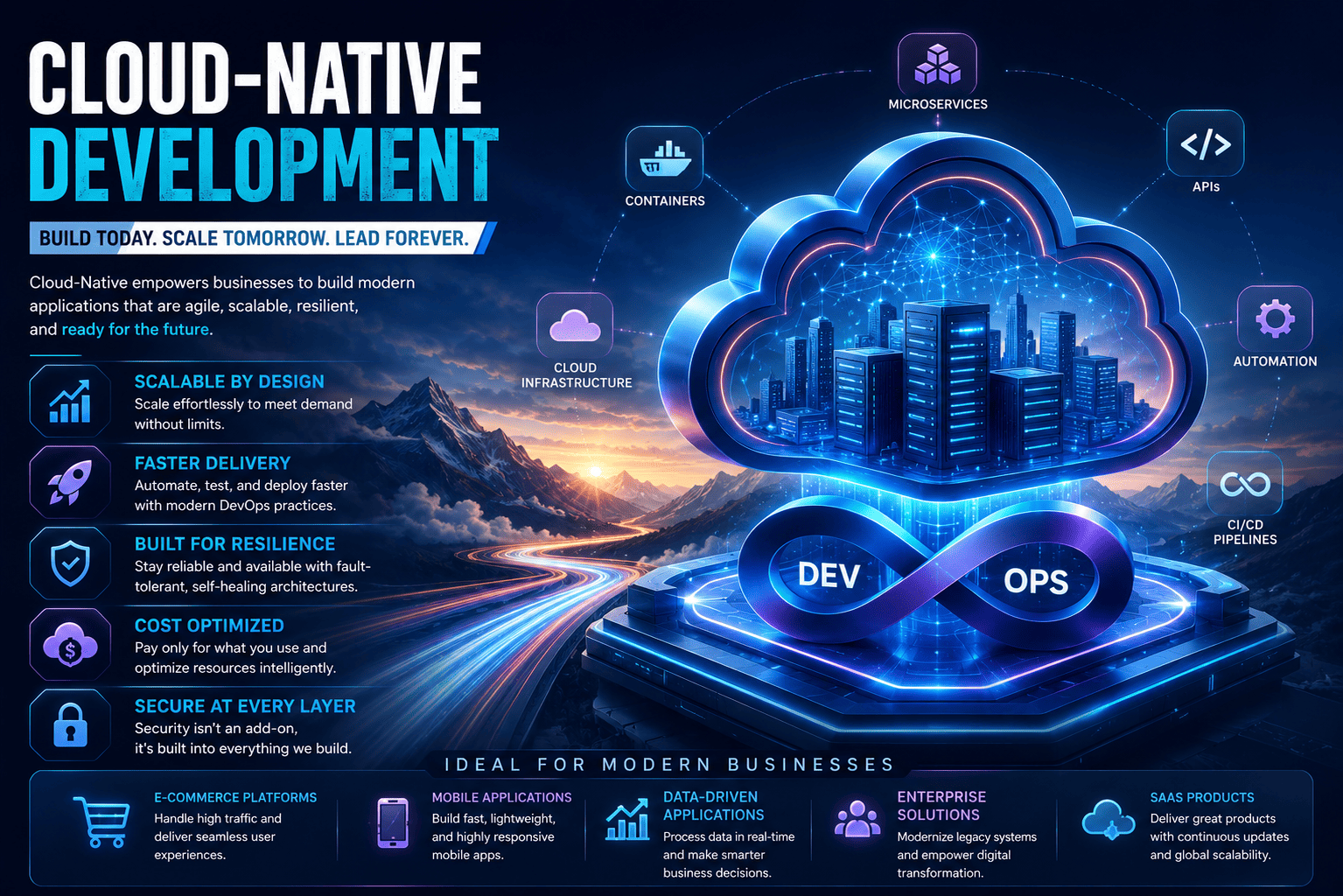
Cloud-Native Development: What Businesses Need to Know
Technology is moving fast, and businesses can no longer depend on software that is difficult to update or scale. As customer expectations grow, companies need digital systems that can handle more users, adapt to change, and continue performing reliably.
This is one of the main reasons cloud-native development has become increasingly important.
Cloud-native development is not simply about moving an application to the cloud. It is about designing software to take advantage of cloud technology from the beginning. The result can be applications that are easier to scale, update, manage, and improve over time.
For businesses building websites, mobile applications, enterprise platforms, or custom software, understanding this approach can help shape better technology decisions.
Understanding Cloud-Native Development
Cloud-native development refers to building and running applications in a way that takes full advantage of modern cloud environments.
These applications are often built using a combination of technologies and practices, including:
- Microservices
- Containers
- Cloud infrastructure
- APIs
- Automation
- CI/CD pipelines
- DevOps practices
Rather than placing every feature inside one large application, a cloud-native system can separate different functions into smaller services.
For example, user authentication, payments, notifications, and reporting can operate as independent parts of a larger system.
This structure can make it easier to update or improve one part of an application without making major changes to everything else.
Why Are Businesses Choosing Cloud-Native Solutions?
Businesses today operate in an environment where change is constant. User traffic can increase unexpectedly, customers expect faster services, and new features may need to be introduced regularly.
Cloud-native development helps businesses respond to these challenges more effectively.
1. Scaling When the Business Grows
A growing business needs technology that can grow with it.
Consider an online store during a major promotional campaign. Thousands of additional visitors may arrive within a short period. With the right cloud architecture, the system can increase resources where demand is highest.
This is more efficient than treating the entire application as a single system that must always use maximum resources.
Cloud-native technology gives businesses greater flexibility in managing growth.
2. Releasing Updates More Quickly
Long software release cycles can slow down a business.
Modern cloud-native development uses automation to make testing and deployment more efficient. Development teams can build processes that help them check code, test changes, and release approved updates with less manual effort.
This can help businesses:
- Introduce new features faster
- Respond to technical issues quickly
- Reduce repetitive deployment tasks
- Improve the software development workflow
Faster delivery can give businesses an important advantage in a competitive market.
3. Building More Reliable Applications
Downtime can affect customer trust and business operations.
Cloud-native applications can be designed to handle failures more effectively. Instead of one small issue affecting the entire system, different services can be managed independently.
The exact level of reliability depends on how the system is designed, but cloud-native architecture provides more options for building resilient applications.
This can lead to a better and more consistent experience for users.
4. More Freedom to Adapt
Every business has different requirements.
A startup may focus on launching quickly, while a larger company may need to connect several internal systems. A flexible cloud architecture can support different stages of business growth.
Companies can develop and expand their technology based on changing requirements rather than being locked into a rigid system.
5. Supporting Modern Business Operations
Businesses are no longer limited to a single office or location.
Teams may work remotely, customers may come from different countries, and services may need to remain accessible around the clock.
Cloud-based systems can support this modern way of working by providing infrastructure that is accessible across locations.
For companies with distributed teams or international customers, this flexibility can be particularly valuable.
The Main Components of Cloud-Native Development
Cloud-native applications are built using several important technologies and development practices.
Microservices
Microservices break an application into smaller services, with each service responsible for a specific task.
A business application, for example, might separate:
- User accounts
- Payment processing
- Notifications
- Customer management
- Analytics
This approach can make large systems easier to develop and manage.
However, microservices are not necessary for every project. Smaller applications may benefit from a simpler architecture.
The best choice depends on the project's size and business requirements.
Containers
Containers help package an application together with the components it needs to run.
This makes it easier to maintain consistency between development, testing, and production environments.
Developers can spend less time dealing with differences between systems and focus more on building the application.
APIs
APIs allow different software systems to communicate with one another.
They are an essential part of many modern applications.
For example, APIs can connect:
Website → Mobile App → Cloud Services → External Platforms
A well-planned API structure helps different systems exchange information efficiently.
Because APIs often handle important data, security must be considered throughout their design and development.
Automation and CI/CD
Automation plays a major role in modern software development.
CI/CD, which stands for Continuous Integration and Continuous Delivery or Deployment, helps teams automate parts of the development process.
Depending on the workflow, automation may support:
- Code testing
- Quality checks
- Build preparation
- Deployment processes
- Software updates
The goal is not to remove developers from the process but to reduce unnecessary manual work and make software delivery more consistent.
What Should Businesses Consider Before Moving to Cloud-Native Development?
Cloud-native technology offers many possibilities, but businesses should have a clear strategy before making major changes.
Start With Business Requirements
Technology should solve a real business problem.
Before selecting a cloud-native architecture, businesses should ask:
- What are we trying to build?
- Who will use the application?
- How quickly do we expect to grow?
- How often will the software need updates?
- Which systems need to connect with each other?
Clear answers to these questions can help avoid unnecessary complexity.
Make Security a Priority
Cloud technology does not automatically guarantee security.
A secure application requires careful planning and ongoing attention.
Important areas may include:
- API security
- User authentication
- Access management
- Data protection
- Encryption
- Security monitoring
- Regular testing
Security works best when it is included throughout the development process rather than added later.
Keep an Eye on Costs
Cloud services offer flexibility, but businesses still need to manage resources carefully.
Unused infrastructure, unnecessary storage, and poorly configured services can increase costs.
Regular monitoring can help businesses understand how resources are being used and where improvements can be made.
A successful cloud strategy should balance performance with cost efficiency.
Avoid Unnecessary Complexity
More technology does not always mean a better solution.
A highly complex architecture may not be necessary for a small or straightforward application.
Businesses should focus on building what they actually need today while keeping future growth in mind.
The right solution is one that is practical, maintainable, and aligned with business goals.
The Future of Cloud-Native Development
Cloud-native development will continue to influence how businesses build digital products.
As artificial intelligence, automation, cybersecurity, and cloud platforms continue to evolve, applications will become increasingly connected and adaptable.
Businesses will need technology that can respond quickly to changing customer needs and market conditions.
For startups, cloud-native technology can provide a flexible foundation for growth. For established companies, it can support the modernization of older systems and the development of new digital services.
The focus is no longer just on building software. It is about building systems that can continue to evolve.
How LogiClump Helps Businesses Build for the Future
At LogiClump, we understand that a successful digital product needs more than an attractive design or a basic set of features.
The technology behind the product must also support performance, security, flexibility, and future growth.
Whether it is a website, mobile application, custom software platform, or business-focused digital solution, choosing the right architecture can make a significant difference.
Our approach focuses on creating modern technology solutions that support:
- Application scalability
- Secure system communication
- API integration
- Flexible development
- Reliable performance
- Future expansion
We help businesses turn ideas into practical digital solutions designed to meet both current needs and future opportunities.
Final Thoughts
Cloud-native development is changing the way modern software is built and managed.
It gives businesses more flexibility to scale, improve applications, automate processes, and respond to change.
At the same time, moving toward cloud-native technology requires careful planning. Businesses need to consider security, costs, architecture, and their actual requirements before choosing a solution.
There is no single cloud-native model that works for every business.
The best approach is the one that fits the product, supports the users, and provides a strong foundation for future growth.
At LogiClump, we build modern digital solutions designed to help businesses innovate, adapt, and grow in a technology-driven world.
Build Smart. Adapt Faster. Grow with Confidence.
Discover how cloud-native development helps businesses scale, improve reliability, automate workflows, enhance security, and build flexible digital solutions for future growth.
Tom Cruise