
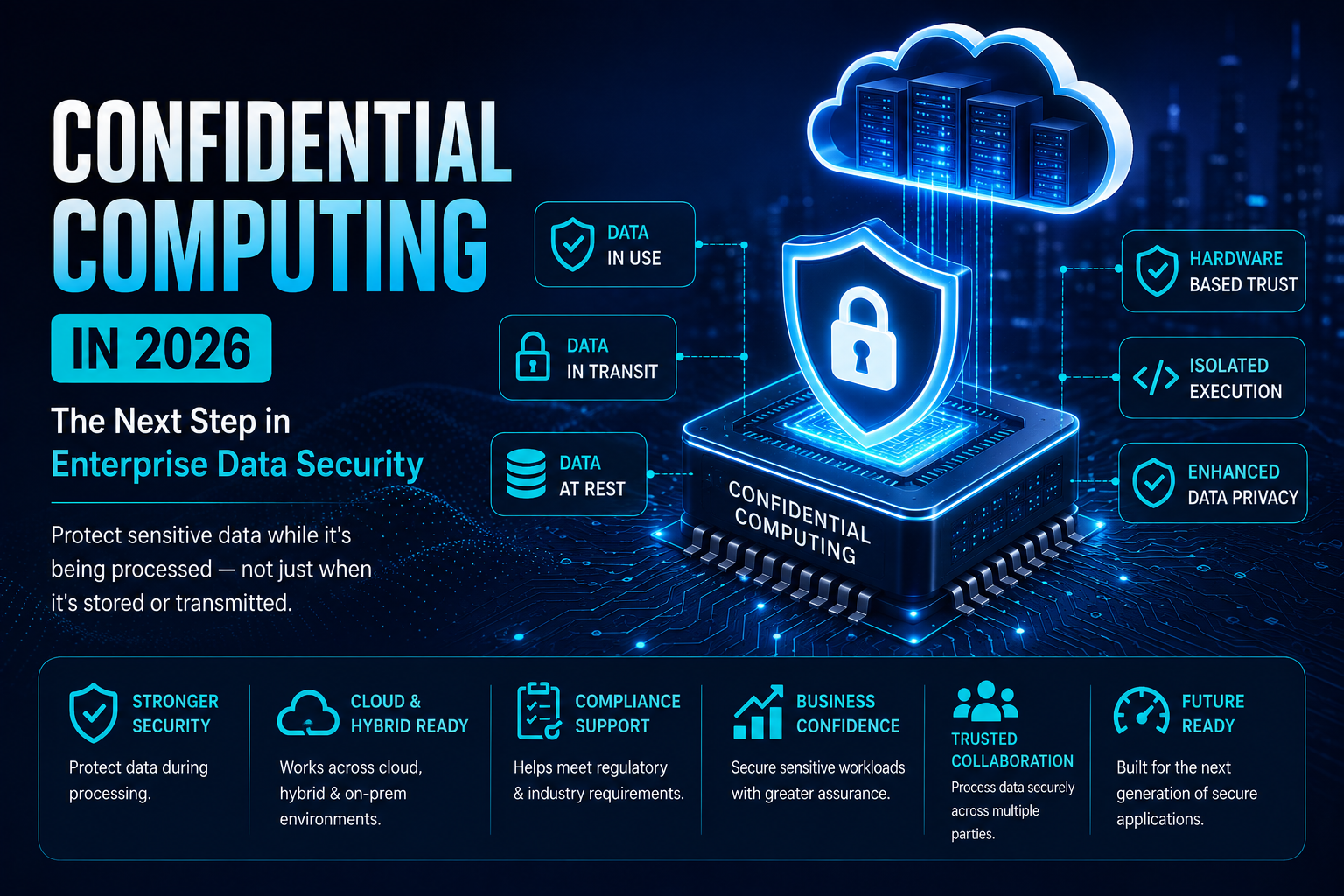
Confidential Computing in 2026: The Future of Enterprise Data Security
As businesses move more applications, databases and workloads into cloud and hybrid environments, protecting sensitive information is becoming more challenging. Traditional encryption protects data while it is stored or transmitted, but organizations increasingly need protection while data is actively being processed.
This is where confidential computing is gaining attention in 2026.
Gartner has included confidential computing among its key strategic technology trends for 2026, highlighting its role in protecting sensitive data while it is being used.
What Is Confidential Computing?
Confidential computing is a security approach designed to protect data while it is being processed.
Traditionally, data security is divided into three stages:
- Data at rest — information stored in databases or servers
- Data in transit — information moving between systems
- Data in use — information being processed by applications
Encryption has become standard for the first two. Confidential computing focuses on strengthening protection for the third.
It uses specialized hardware-based security technologies, commonly known as trusted execution environments (TEEs), to isolate sensitive workloads from unauthorized access.
Why Is Confidential Computing Important in 2026?
Businesses increasingly operate across public cloud, private cloud, on-premises infrastructure and distributed environments. This creates more points where sensitive information can potentially be exposed.
At the same time, organizations are dealing with:
- Customer and financial data
- Intellectual property
- Business-critical databases
- Healthcare information
- Payment information
- Proprietary applications
- Regulatory and compliance requirements
As infrastructure becomes more distributed, security can no longer depend only on network boundaries.
Confidential computing provides another layer of protection by helping secure sensitive workloads during processing.
Confidential Computing and Cloud Security
Cloud computing has changed how businesses build and deploy applications. However, organizations sometimes hesitate to place their most sensitive workloads in shared infrastructure because of concerns around data control and isolation.
Confidential computing can help address part of this challenge.
Instead of relying solely on traditional access controls, confidential workloads can run inside protected execution environments designed to restrict unauthorized access to the data and code being processed.
This can be particularly valuable for organizations handling regulated or highly sensitive information.
From Cloud-First to Security-First Infrastructure
Enterprise IT strategies are also becoming more flexible.
Recent 2026 research shows businesses are reconsidering purely cloud-first approaches and increasingly evaluating combinations of public cloud, private cloud, edge and other infrastructure models based on security, resilience, cost and workload requirements.
This means the future of enterprise infrastructure is unlikely to be about choosing one environment.
Instead, businesses will increasingly choose the right environment for each workload while applying consistent security controls across them.
Where Can Confidential Computing Be Used?
Confidential computing can be relevant across several industries and use cases.
1. Financial Services
Banks, fintech companies and financial platforms process highly sensitive customer and transaction information.
Protected execution environments can add another security layer when sensitive financial workloads are processed.
2. Healthcare
Healthcare organizations manage confidential patient and medical information.
Confidential computing can support secure processing of sensitive healthcare data while reducing exposure risks.
3. E-Commerce
Online businesses handle customer information, payment-related data and transaction records.
Additional workload-level protection can strengthen an organization's overall security architecture.
4. Enterprise Software
Businesses running CRM, ERP, analytics and other enterprise applications can explore confidential computing where sensitive information requires additional protection during processing.
5. Multi-Party Data Processing
Some business collaborations require organizations to work with sensitive information without unnecessarily exposing the underlying data.
Confidential computing can become useful in architectures where multiple parties need controlled access to protected workloads.
Confidential Computing Is Not a Complete Security Solution
It is important to understand that confidential computing does not replace cybersecurity.
It works as one component of a broader security architecture that can include:
- Encryption
- Identity and access management
- Zero-trust security
- Secure APIs
- Network protection
- Vulnerability management
- Monitoring and logging
- Backup and disaster recovery
- Security policies and governance
Organizations should therefore treat confidential computing as an additional security layer rather than a standalone solution.
What Businesses Should Consider Before Adopting It
Before implementing confidential computing, companies should evaluate:
Workload suitability:
Not every application requires confidential execution.
Performance requirements:
Security mechanisms should be evaluated against application performance.
Infrastructure compatibility:
Existing applications may require architectural changes.
Compliance requirements:
Organizations should determine whether the technology supports their specific regulatory objectives.
Cost and complexity:
The security benefits should be balanced against implementation and operational requirements.
The Future of Secure Computing
The enterprise technology landscape is moving toward infrastructure that is distributed, connected and security-conscious.
With businesses using cloud, hybrid environments, edge infrastructure and increasingly sensitive digital applications, protecting data only when it is stored or transmitted may not be enough.
Confidential computing represents an important evolution toward protecting information throughout its lifecycle—including during processing.
For businesses modernizing their technology infrastructure in 2026, it is worth keeping confidential computing on the IT roadmap and evaluating where it can provide meaningful security benefits.
How LogiClump Can Help
At LogiClump Technologies, we develop modern digital solutions including websites, mobile applications, custom software, cloud-ready applications and API-integrated systems.
For businesses planning to modernize their technology infrastructure, the right architecture should balance security, scalability, performance and business requirements.
LogiClump can help businesses turn their technology requirements into practical digital solutions—from initial development to deployment and ongoing support.
Final Thoughts
Confidential computing is becoming an important part of the broader enterprise security conversation in 2026. As organizations process increasingly sensitive information across cloud and distributed environments, protecting data in use can become just as important as protecting data at rest and in transit.
The businesses that approach infrastructure modernization with security built into the architecture—not added as an afterthought—will be better positioned for the next generation of digital operations.
LogiClump Technologies — Vision to Reality.
Discover how confidential computing protects data in use, strengthens cloud and hybrid security, and helps businesses build secure digital infrastructure in 2026.
Tom Cruise