
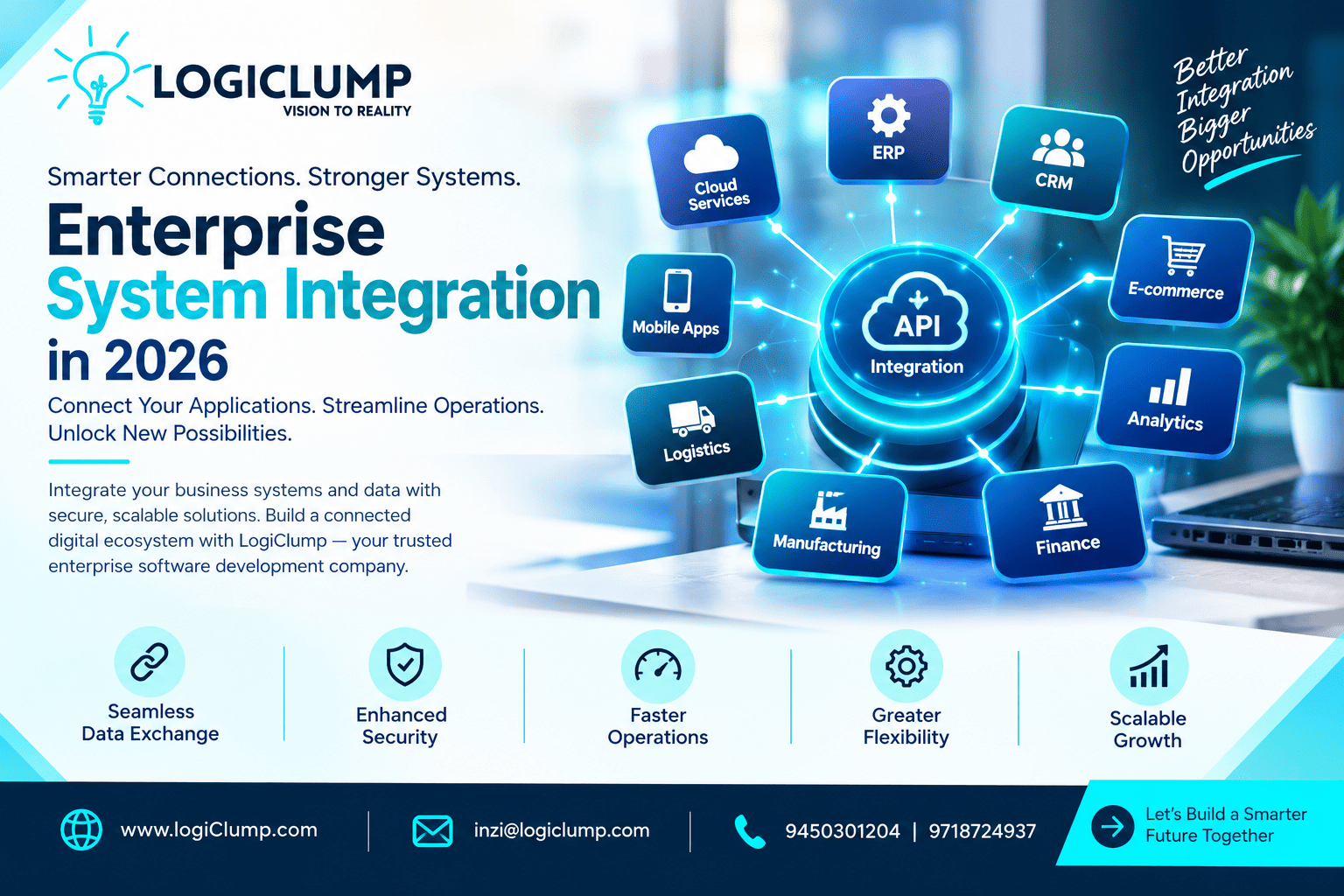
Enterprise System Integration in 2026
Modern enterprises depend on a growing collection of digital tools to manage customers, finances, inventory, employees, and daily operations. While each application may solve a specific problem, the real challenge begins when these systems need to work together.
When business applications operate independently, information can become inconsistent, employees may repeat the same tasks, and important decisions can be delayed. These problems become more difficult to manage as transaction volumes increase and organizations expand into new markets.
Enterprise system integration helps businesses create a connected technology environment in which applications can exchange information and coordinate processes more effectively.
In 2026, integration is increasingly important for organizations investing in cloud platforms, AI-enabled applications, digital customer experiences, and scalable enterprise software. The goal is to make technology work as a coordinated system rather than a collection of disconnected products.
What Is Enterprise System Integration?
Enterprise system integration is the process of connecting business applications, databases, platforms, and services so they can share information or coordinate activities.
Depending on the organization's requirements, integration may involve APIs, event-driven communication, middleware, data pipelines, or other architectural approaches.
For example, a company might connect its sales platform with inventory management and accounting software. When a customer places an order, the connected systems can exchange the information required to process the transaction and update the relevant records.
Common integration projects include:
-
Connecting customer management and enterprise resource planning systems
-
Linking payment services with business applications
-
Sharing information between websites and mobile apps
-
Synchronizing inventory and order records
-
Connecting internal databases with reporting platforms
-
Integrating third-party services into custom software
-
Linking cloud applications with existing enterprise systems
-
Creating secure data connections for business partners
The most effective integration strategy begins with a clear business requirement and a practical understanding of the systems involved.
Why Connected Enterprise Systems Matter
A company's technology infrastructure should support its business processes instead of creating additional administrative work.
Reducing Information Silos
Separate departments may maintain different versions of customer, product, or transaction information. This can lead to conflicting records and time-consuming reconciliation.
Integration can help authorized systems exchange relevant information while establishing clearer rules about which application owns and updates particular data.
Improving Operational Speed
When information must be transferred manually between applications, each handoff introduces additional work and potential delays.
Connected systems can trigger the next stage of a process when the required conditions are met, helping teams complete routine operations more efficiently.
Creating Consistent Customer Experiences
Customers may interact with a business through its website, mobile application, support team, and payment services.
Integration helps these channels use consistent information, making it easier to provide accurate order updates, account details, and service responses.
Supporting Better Business Decisions
Managers often need information from several departments to understand operational performance.
Connecting appropriate data sources can improve reporting and help decision-makers identify trends, delays, and areas that need attention.
Four Approaches to Enterprise Integration
Different business environments require different integration techniques. Selecting the right approach depends on system capabilities, transaction volumes, security needs, and how quickly information must be exchanged.
1. API-Based Integration
APIs allow applications to request information or use specific functions exposed by another system.
For instance, a mobile application might use an API to retrieve a customer's account information from an enterprise backend.
API-based integration is useful when applications need controlled, structured communication without exposing their internal implementation.
2. Event-Driven Integration
Some processes need to respond to events rather than wait for a scheduled data transfer.
A new order, a completed payment, or a stock-level change can generate an event that another service processes.
This approach can support responsive business processes, although systems must be designed to handle duplicate events, delayed messages, and processing failures.
3. Middleware and Integration Platforms
Middleware helps coordinate communication between applications with different interfaces, data formats, or technical requirements.
It can be useful when an organization needs to connect several business systems without building every connection independently.
4. Data Integration
Data integration brings information from different sources into a consistent environment for reporting, analytics, or operational use.
This may involve data transformation, validation, scheduled synchronization, or data pipelines.
The objective is to ensure that information is appropriate for its intended use, with clear handling for inconsistencies and updates.
A Practical Example: Connecting an Enterprise Order System
Consider a business that receives orders through an online store but manages stock, shipping, and financial records in separate applications.
Without integration, employees may need to check each platform manually and update records after every transaction.
A connected system could coordinate the process as follows:
-
The online store records a new order.
-
The order service validates the submitted information.
-
The inventory application receives the necessary stock update.
-
The payment service provides the relevant transaction status.
-
The fulfillment team receives the information needed to prepare the shipment.
-
The customer-facing application displays the appropriate order status.
-
Relevant transaction details are transferred to the accounting system.
Each step requires suitable validation and error handling. For example, the system should not treat an order as successfully paid simply because a payment request was submitted.
This type of integration can reduce manual coordination while making the overall process easier to monitor.
Preparing Enterprise Applications for AI Integration
AI-enabled software often needs access to existing business information and services. Integration provides a controlled way to make those resources available to approved AI applications.
Imagine a support assistant that needs to answer questions about an order. Rather than relying on an outdated copy of order information, the assistant could request the current status from an authorized business service.
Similarly, an internal assistant might retrieve approved documents or summarize information supplied by a reporting platform.
These capabilities require appropriate technical and governance controls, including:
-
Verifying the identity of the requesting user or service
-
Restricting access to authorized information
-
Validating requests and returned data
-
Recording important actions
-
Monitoring unusual usage
-
Requiring confirmation for sensitive operations
AI applications should not receive unrestricted access to enterprise systems. Access should be limited to the information and functions needed for their assigned purpose.
Businesses should also evaluate the accuracy, cost, privacy implications, and reliability of AI-enabled integrations before deploying them at scale.
Security Considerations for Enterprise Integration
Every new connection introduces another relationship that must be managed and protected.
An integration can expose sensitive information if authentication is weak, permissions are excessive, or input validation is inadequate.
A security-focused integration strategy should consider:
Identity and access: Verify users and services, then grant only the permissions they require.
Data protection: Use appropriate encryption and secure credential management.
Input validation: Check incoming requests and data before processing them.
Traffic controls: Apply rate limits and safeguards against abusive or unexpected usage.
Auditability: Maintain useful records of important requests, changes, and failures.
Ongoing monitoring: Track service availability, unusual traffic, and repeated errors.
Lifecycle management: Review integrations regularly, update dependencies, and retire interfaces that are no longer required.
Security requirements should reflect the sensitivity of the information and the potential impact of a compromised system.
Common Enterprise Integration Challenges
Even when the business benefits are clear, integration projects can be difficult if technical dependencies and ownership are not addressed early.
Different Data Structures
Applications may store similar information using different formats or identifiers. Mapping rules and validation are needed to ensure that exchanged data retains its intended meaning.
Older Applications
Some established systems offer limited integration options. Connecting them may require adapters, middleware, supported extensions, or carefully planned changes.
Service Dependencies
A process that depends on several external systems can be affected when one service becomes slow or unavailable.
Timeouts, controlled retries, monitoring, and recovery procedures help prevent failures from spreading unnecessarily.
Changing Interfaces
A third-party provider may change an API or discontinue an older version. Compatibility planning, documentation, and testing help reduce disruption.
Maintenance Responsibilities
Integrations require continuing attention. Businesses should establish who manages credentials, monitors performance, approves changes, and responds to incidents.
Addressing these issues during planning is generally more effective than treating them as problems to solve after deployment.
How to Plan an Enterprise Integration Project
A structured implementation helps businesses control complexity and focus on measurable outcomes.
Step 1: Define the Business Objective
Identify the problem the integration should solve. Examples include reducing duplicate data entry, improving order visibility, or making reporting information available more quickly.
Step 2: Assess Existing Systems
Document the applications, data sources, interfaces, dependencies, and security requirements involved.
Step 3: Establish Data Ownership
Determine which system is authoritative for each important type of information and how conflicting updates should be handled.
Step 4: Choose the Integration Method
Select APIs, event-driven messaging, middleware, or data pipelines according to the actual requirements.
Step 5: Design for Security and Failure
Plan permissions, validation, logging, timeouts, recovery, and error handling before moving into production.
Step 6: Test End-to-End Behavior
Test successful transactions along with invalid requests, duplicate messages, service interruptions, and unauthorized access attempts.
Step 7: Monitor and Maintain
Measure availability, performance, error rates, and business outcomes. Keep documentation current and review integrations as connected applications evolve.
Starting with a focused project gives an organization an opportunity to validate its architecture before expanding integration across additional departments.
Measuring the Value of Connected Systems
Enterprise integration should produce measurable operational improvements.
Useful indicators include:
-
Time required to complete a business transaction
-
Number of manual data transfers eliminated
-
Frequency of inconsistent records
-
Integration availability and response time
-
Failed transaction rates
-
Time needed to introduce new software features
-
Cost of maintaining connected applications
-
Accuracy and timeliness of business reporting
For example, a company may compare how long it takes to process an order before and after connecting its order management and inventory systems.
The evaluation should include development, infrastructure, monitoring, testing, and maintenance expenses. This helps businesses understand whether the integration provides sufficient long-term value.
Choosing an Enterprise Software Development Company
Enterprise integration often requires more than connecting two endpoints. A solution may need custom business logic, database changes, secure backend services, cloud infrastructure, and testing across several applications.
When choosing an enterprise software development company, assess its ability to understand business requirements and work with the technologies already used by your organization.
Important capabilities include:
-
Custom enterprise application development
-
API design and integration
-
Backend and database engineering
-
Cloud architecture and DevOps
-
Application security and quality assurance
-
Third-party service integration
-
Technical documentation and ongoing support
A suitable development partner should explain the trade-offs between available approaches and recommend an architecture that meets business needs without unnecessary complexity.
LogiClump: Enterprise Software Development for Connected Businesses
A connected digital environment helps organizations make better use of their existing technology while creating opportunities for new services and improved operations.
LogiClump is an enterprise software development company that helps businesses turn technology requirements into practical digital solutions.
Its service areas include custom software development, enterprise web applications, mobile app development, AI-powered solutions, FinTech and trading platforms, SaaS products, cloud engineering, and system integration.
Businesses can work with LogiClump to explore projects such as:
-
Connecting existing enterprise applications
-
Developing APIs and backend services
-
Integrating third-party business platforms
-
Building secure web and mobile applications
-
Creating customized enterprise software
-
Connecting AI capabilities with approved business services
-
Developing scalable SaaS and digital platforms
Every organization has different operational priorities, technical constraints, and security requirements. A successful project starts by understanding these factors and selecting an approach that supports both immediate needs and future growth.
If your business wants to connect its software systems or develop a new enterprise application, LogiClump can help you explore a solution aligned with your requirements.
Build Your Connected Digital Future With LogiClump
Looking to improve communication between business applications, simplify data exchange, or develop enterprise software tailored to your organization?
Contact LogiClump to discuss your project requirements and explore the right digital solution for your business.
LogiClump — Vision to Reality
🌐 Website: www.logiclump.com
📧 Email: inzi@logiclump.com
📞 Contact: 9450301204 | 9718724937
Learn how enterprise system integration connects business applications, improves data flow, and supports secure, scalable digital operations.
Tom Cruise