
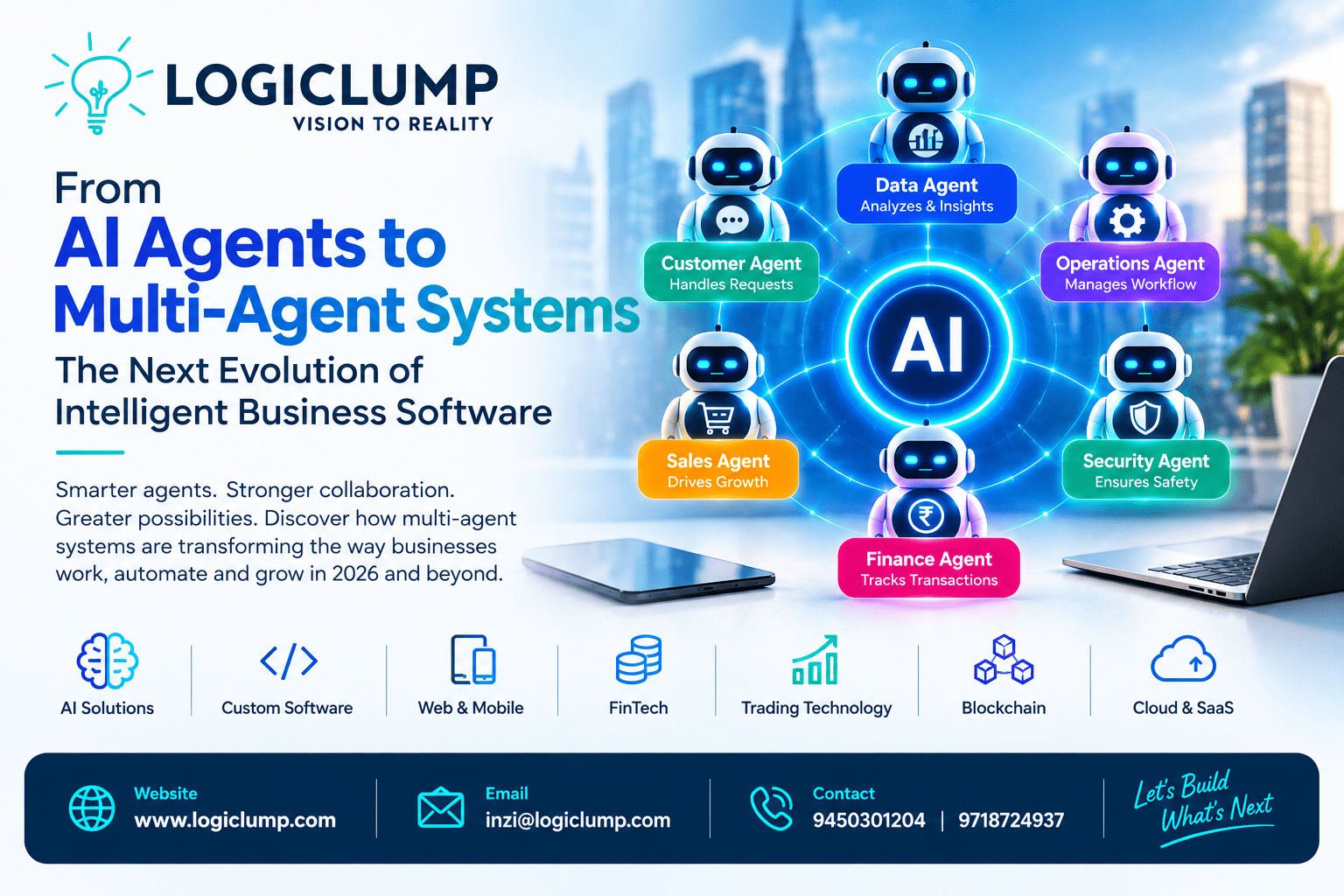
From AI Agents to Multi-Agent Systems: The Next Evolution of Intelligent Software
Artificial Intelligence is entering a new phase.
For years, businesses primarily used AI to analyze information, generate content, answer questions, and automate repetitive tasks. Today, the focus is shifting toward software that can do more than respond—it can understand an objective, decide what needs to happen next, use digital tools, and carry out parts of a workflow.
These systems are commonly known as AI agents.
The next step is even more interesting: instead of relying on one AI agent to manage an entire process, businesses can use multiple specialized agents that work together. This approach is known as a multi-agent system.
Rather than thinking of AI as a single assistant, organizations can begin to think of it as a coordinated digital workforce.
What Makes an AI Agent Different?
A conventional software application normally waits for a predefined instruction.
For example, a user clicks a button, submits a form, or enters a search query, and the application performs the programmed operation.
An AI agent can work differently.
It can receive a broader objective, interpret the available information, determine possible actions, interact with connected tools, and evaluate the result.
For example, consider a customer who reports a problem with an order.
A conventional system may simply display a support form.
An AI agent could potentially:
- Understand the customer's complaint
- Locate the relevant order
- Check the order status
- Review available company policies
- Identify an appropriate resolution
- Update the support system
- Respond to the customer
- Escalate unusual cases to a human employee
The important difference is that the AI is participating in the workflow, rather than simply generating a response.
What Is a Multi-Agent System?
A multi-agent system takes this concept further.
Instead of giving one AI agent every responsibility, different agents can be assigned different jobs.
Think about a business process involving sales, inventory, payments, customer communication, and reporting.
One AI system might become difficult to manage if it is responsible for everything. A multi-agent architecture can divide the work.
For example:
Sales Agent
Understands customer requirements and assists with sales activities.
Inventory Agent
Checks product availability and stock information.
Finance Agent
Handles payment-related information and financial workflows.
Customer Agent
Communicates with customers and manages routine requests.
Analytics Agent
Processes business data and prepares insights.
Coordinator Agent
Determines which agent should handle each part of the workflow.
The agents can exchange relevant information while remaining focused on their individual responsibilities.
This creates a more modular approach to intelligent software.
Why Businesses Are Moving Toward Agentic Software
Modern businesses operate through interconnected systems.
A single customer interaction may involve a CRM, payment gateway, database, inventory platform, communication tool, analytics system, and internal business application.
Traditional automation can connect these systems, but many workflows still require people to interpret information and decide what should happen next.
AI agents introduce an additional layer of intelligence.
They can help interpret unstructured information, determine the next appropriate action, and interact with connected tools.
This creates an opportunity to automate processes that were previously difficult to automate using fixed rules alone.
From Automation to Intelligent Workflows
Traditional automation generally works well when a process follows a predictable path.
For example:
Payment received → Order confirmed → Invoice generated → Customer notified
But real business operations rarely remain this simple.
What happens if:
- The payment is incomplete?
- The requested product is unavailable?
- The customer has a special requirement?
- The order requires additional verification?
- The transaction appears unusual?
A rigid workflow may require several manual interventions.
An AI-powered workflow can potentially interpret these situations and determine which action should happen next.
This does not mean AI should make every decision independently. Instead, AI can handle appropriate parts of the process while predefined rules and human approval remain available for sensitive situations.
Multi-Agent Systems in FinTech
FinTech is particularly suited to intelligent, coordinated software because financial platforms involve large amounts of data and multiple interconnected operations.
A financial technology platform could potentially use different agents for:
- Customer onboarding
- Transaction monitoring
- Financial data analysis
- Risk assessment
- Customer assistance
- Reporting
- Compliance support
- Operational monitoring
For example, when a transaction requires additional review, a monitoring agent could flag it, a risk-focused agent could analyze relevant information, and a reporting agent could prepare the necessary internal information.
A coordinating layer could then determine whether the case should proceed automatically or be sent to a human specialist.
For trading platforms, AI can also support areas such as market-data analysis, alerts, reporting, monitoring, and operational assistance.
However, financial systems require particularly strong controls. AI-generated recommendations should not automatically be treated as financial decisions, and sensitive operations should have appropriate authorization, auditability, compliance controls, and human oversight.
AI Agents in E-Commerce
E-commerce can also benefit from agent-based software.
Imagine a customer saying:
“I need a laptop suitable for development, with good performance and a budget of around $1,000.”
Instead of requiring the customer to manually browse dozens of products, an AI shopping agent could interpret the requirements and identify suitable options.
Behind the scenes, additional agents could potentially:
- Compare product specifications
- Check availability
- Review pricing
- Identify applicable offers
- Check delivery information
- Assist with order-related questions
The customer experiences a simpler interaction, while multiple software components work behind the scenes.
AI-Powered Business Operations
The same concept can be applied to internal business processes.
Consider a new sales lead.
A coordinated AI workflow could assist with:
Lead Collection → Company Research → Lead Qualification → CRM Update → Personalized Outreach → Meeting Scheduling → Follow-Up
Different agents could handle individual stages.
A research agent could collect relevant company information.
A qualification agent could evaluate the lead against predefined criteria.
A communication agent could prepare personalized outreach.
A CRM agent could update the company's records.
A scheduling agent could coordinate available meeting times.
Instead of one large automated workflow containing every function, businesses can build a collection of focused capabilities that work together.
The Importance of an Orchestration Layer
As the number of AI agents increases, coordination becomes critical.
A multi-agent environment needs a mechanism for deciding:
- Which agent receives a task
- What information it should receive
- Which tools it is allowed to access
- When another agent should take over
- Whether the result needs verification
- When a human must approve an action
This is where AI orchestration becomes important.
A simplified architecture could look like:
Business Request
↓
AI Orchestrator
↓
Specialized AI Agents
↓
Business Systems & APIs
↓
Validation / Approval
↓
Action & Result
The architecture can be adapted to the requirements of a particular business rather than forcing every organization into the same AI model.
What Are the Benefits?
A well-designed multi-agent system can provide several potential advantages.
Specialized Capabilities
Different agents can be optimized for different tasks instead of forcing one system to handle every business function.
Greater Workflow Flexibility
Businesses can modify or replace individual components without necessarily redesigning the entire system.
Faster Information Processing
Agents can process large amounts of information and perform routine analysis quickly.
Improved Automation
Processes involving multiple applications and decision points can potentially become more automated.
Easier Expansion
New agents can be introduced as business requirements grow.
For example, a company might initially deploy customer-support agents and later add finance, sales, analytics, or operations agents.
Challenges Businesses Cannot Ignore
The potential of multi-agent technology comes with significant responsibilities.
Security and Access Control
An AI agent should only have access to the systems and information required for its assigned role.
Giving an agent unrestricted access to databases, financial systems, or internal applications can create unnecessary security risks.
Incorrect Decisions
AI systems can misunderstand information or produce incorrect conclusions.
Critical workflows therefore require validation, monitoring, fallback procedures, and appropriate human involvement.
Data Privacy
Businesses must carefully determine what information an agent can access, process, retain, and share.
Operational Costs
Running several AI agents can increase model usage, infrastructure requirements, monitoring needs, and operational expenses.
Businesses need to evaluate the cost of each workflow against its expected value.
Governance
Organizations need clear boundaries around what AI agents are permitted to do.
A useful approach is to classify tasks according to their risk level.
Low-risk activities may be automated.
Higher-risk activities can require verification.
Sensitive decisions can remain under human control.
Multi-Agent Systems Are Not About Removing People
One of the biggest misconceptions about agentic technology is that organizations must completely remove humans from business workflows.
In reality, the strongest implementations are likely to combine AI capabilities with human expertise.
AI can handle repetitive analysis, information gathering, coordination, and routine actions.
People can focus on:
- Strategic decisions
- Complex customer situations
- Creative problem-solving
- Relationship management
- Business judgment
- High-impact approvals
This creates a model where AI increases the capabilities of a team rather than simply attempting to replace it.
How Businesses Can Start
Organizations interested in agentic software do not need to transform their entire technology infrastructure at once.
A practical starting point is to identify one workflow where intelligent automation could deliver measurable value.
1. Find the Right Workflow
Look for repetitive processes involving large amounts of information, multiple systems, or frequent manual coordination.
2. Define the Objective
Clearly establish what the AI system should accomplish and what it should never do.
3. Start Small
Begin with one focused agent and measure its performance before introducing additional agents.
4. Connect the Necessary Systems
Use APIs and controlled integrations to connect the agent with databases, CRM platforms, business applications, or other required tools.
5. Introduce Additional Agents
Once the first workflow is stable, specialized agents can be introduced where they provide a clear advantage.
6. Build Governance From the Beginning
Security, permissions, monitoring, logging, human approvals, and fallback mechanisms should be part of the architecture—not features added at the end.
What the Future of Software Could Look Like
The evolution from traditional applications to AI agents and eventually multi-agent systems represents a fundamental change in software design.
The traditional model has largely been:
User → Application → Result
An intelligent software environment can become:
Goal → AI Reasoning → Collaboration → Tools → Actions → Verification → Result
This does not mean every application will become completely autonomous.
Instead, businesses are likely to combine traditional software, deterministic automation, AI agents, and human decision-making according to the requirements of each workflow.
The result could be software that is not only capable of storing information or executing predefined commands, but also capable of coordinating activities around a business objective.
The Opportunity for Businesses in 2026
AI agents and multi-agent systems are still evolving, which means businesses have an opportunity to experiment and build practical solutions before these technologies become standard components of enterprise software.
Companies can begin with relatively focused applications such as:
- Intelligent customer support
- Sales automation
- Business research
- Data analysis
- Workflow coordination
- FinTech operations
- E-commerce assistance
- Internal knowledge systems
- SaaS automation
Over time, these individual capabilities can become part of a larger intelligent software ecosystem.
Build the Next Generation of Intelligent Software With LogiClump
The future of business software is moving toward systems that can do more than display information and execute fixed commands.
At LogiClump, we build technology solutions across AI, custom software, web and mobile applications, FinTech, trading technology, blockchain, cloud, and SaaS.
Our focus is on creating practical digital solutions that align technology with real business requirements—from intelligent applications and automation to scalable platforms and industry-specific software.
Whether you are exploring your first AI-powered workflow or planning a larger intelligent software ecosystem, the right architecture, integrations, security controls, and development strategy can make the difference between an experimental AI feature and a genuinely useful business solution.
Ready to Build Smarter Software?
LogiClump — Turning Technology Ideas Into Digital Solutions.
🌐 Website: www.logiclump.com
📧 Email: inzi@logiclump.com
📞 Contact: 9450301204 | 9718724937
Discover how AI agents and multi-agent systems are transforming business software through intelligent automation, collaboration, smarter workflows, and scalable digital solutions in 2026.
Tom Cruise