
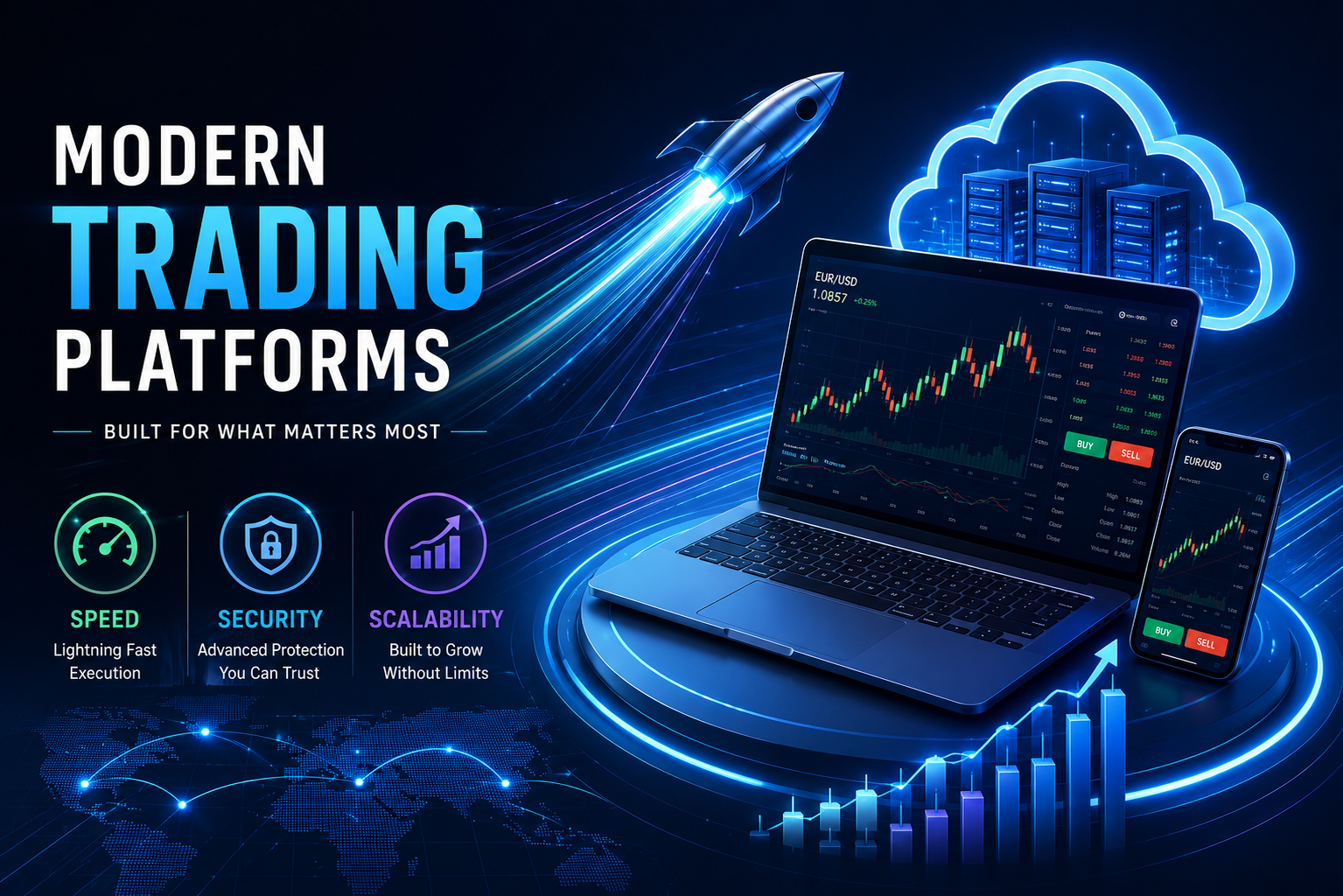
Modern Trading Platforms: Built for Speed, Security & Scale
Financial markets move in milliseconds. A small delay in receiving market data, executing an order, or updating a trading chart can significantly affect a trader's experience.
That is why modern trading platforms are no longer just dashboards with charts and buy/sell buttons. Behind a professional trading platform is a combination of high-performance infrastructure, secure APIs, real-time data processing, reliable architecture, and scalable technology.
For brokers, financial businesses, and fintech companies, building the right technology foundation is essential for delivering a fast and dependable trading experience.
At LogiClump, we focus on developing modern trading technology designed around performance, security, flexibility, and future growth.
Why Speed Matters in Modern Trading
Trading platforms constantly process large amounts of information.
Market prices can change continuously, while thousands of users may simultaneously view charts, place orders, monitor positions, and manage their accounts.
A slow platform can create problems such as:
- Delayed market information
- Slow order processing
- Poor chart performance
- Unresponsive dashboards
- Frustrating user experiences
Modern platforms therefore need architectures capable of processing requests quickly and efficiently.
Real-Time Market Data
A trading platform needs a reliable connection between market data sources and the user's screen.
When a currency pair changes price, the information needs to travel through the system and appear on the trader's interface with minimal delay.
This requires efficient data pipelines, optimized APIs, appropriate caching strategies, and infrastructure designed for real-time workloads.
The Technology Behind Fast Trading Platforms
Performance does not come from a single technology. It comes from how multiple components work together.
1. High-Performance APIs
APIs connect different parts of a trading ecosystem.
They can handle communication between:
Trading Platform → Trading Engine → User Account → Market Data → External Services
Well-designed APIs can reduce unnecessary processing and help applications communicate efficiently.
API performance becomes especially important when a platform needs to support a large number of simultaneous requests.
2. Efficient Database Architecture
Trading platforms generate significant amounts of data, including:
- User accounts
- Orders
- Transactions
- Positions
- Trade history
- Market information
- Reports
A properly designed database architecture helps applications retrieve and store this information efficiently.
The goal is not simply to store more data—it is to make important information available quickly when users need it.
3. Optimized Trading Interfaces
The front end of a trading platform also affects perceived performance.
Charts, dashboards, order panels, watchlists, and portfolio information need to update smoothly without making the application feel heavy.
A modern interface should provide traders with the information they need while avoiding unnecessary visual or processing complexity.
Security: The Foundation of a Trading Platform
Speed is important, but speed without security creates serious risks.
Trading platforms handle valuable financial and personal information, making security a fundamental part of the development process.
Secure Authentication
Users should have secure authentication mechanisms that protect their accounts from unauthorized access.
Depending on the platform, this can include:
- Multi-factor authentication
- Secure session management
- Strong password policies
- Token-based authentication
- Role-based access controls
Security should be integrated into the platform rather than added after development is complete.
Secure API Communication
APIs are essential to modern trading platforms, but they can also become potential attack surfaces.
Secure API development should include practices such as:
- Authentication and authorization
- Input validation
- Rate limiting
- Encryption
- Secure token handling
- API monitoring
- Access control
Every API endpoint should be designed with security in mind.
Data Protection
Trading platforms may process sensitive customer and transaction information.
Encryption, secure storage, access controls, monitoring, and regular security testing can help protect this data.
A secure platform also needs visibility into unusual activity so potential issues can be identified and addressed quickly.
Scalability: Preparing for Growth
A trading platform may begin with a relatively small number of users.
But what happens when thousands or millions of users start accessing the platform?
This is where scalability becomes critical.
A scalable architecture allows a system to increase its capacity as demand grows.
Horizontal Scaling
Instead of relying on a single powerful server, modern architectures can distribute workloads across multiple instances or services.
This can help a platform handle increased traffic without placing excessive pressure on one component.
Microservices Architecture
Microservices can divide a large application into smaller services that perform specific functions.
For example, a trading ecosystem could separate:
- Authentication
- User management
- Market data
- Order processing
- Notifications
- Reporting
- Payments
- Portfolio management
This approach can allow individual services to be developed, updated, and scaled independently when appropriate.
However, microservices are not automatically the best solution for every project. Architecture should be selected according to the platform's actual requirements.
Cloud Infrastructure
Cloud infrastructure can provide businesses with flexible computing resources and deployment options.
As traffic increases, infrastructure can be configured to support additional workloads.
Cloud-based environments can also help businesses build systems with redundancy, monitoring, backups, and disaster-recovery strategies.
High Availability and Reliability
A trading platform should be available when users need it.
Unexpected server failures, infrastructure problems, or software issues can affect the user experience and potentially disrupt trading operations.
Modern trading systems can improve reliability through:
- Load balancing
- Redundant infrastructure
- Health monitoring
- Automated recovery
- Database backups
- Failover mechanisms
- Continuous system monitoring
The objective is to minimize downtime and ensure critical services remain operational.
The Importance of Order Management
A modern trading platform needs more than attractive charts.
Order management is one of its most important components.
The system needs to correctly process actions such as:
Buy → Sell → Modify → Cancel → Monitor → Close
Every request must be handled accurately while maintaining appropriate security and performance controls.
An efficient order-management architecture can help reduce unnecessary delays and provide users with a smoother trading experience.
Mobile and Web Trading
Today's traders expect access from multiple devices.
A modern platform may need to support:
- Web browsers
- Desktop applications
- Android devices
- iOS devices
The challenge is maintaining a consistent experience across different platforms.
Using well-structured APIs and reusable backend services can make it easier to connect multiple interfaces to the same core technology infrastructure.
Monitoring and Performance Optimization
Building a trading platform is not the end of the development process.
Performance needs to be monitored continuously.
Development teams can track:
- API response times
- Server performance
- Database queries
- Error rates
- User activity
- System availability
- Resource utilization
Monitoring helps teams identify bottlenecks before they become major problems.
Performance optimization should therefore be an ongoing process rather than a one-time task.
Building a Trading Platform That Can Evolve
Financial technology continues to change.
Trading platforms may eventually need to integrate new markets, additional payment systems, AI-powered features, analytics, mobile applications, or third-party financial services.
This makes flexibility important.
A platform should be designed so new capabilities can be introduced without rebuilding the entire system from scratch.
A strong technical foundation can make future expansion easier and more cost-effective.
How LogiClump Builds Modern Trading Technology
At LogiClump, we understand that a trading platform needs more than a visually impressive interface.
The technology behind the platform needs to support performance, security, reliability, and scalability.
Our development approach focuses on building solutions with capabilities such as:
- Real-time Forex market data
- Advanced trading interfaces
- Secure API architecture
- Web and mobile connectivity
- Portfolio and order management
- Scalable backend systems
- Reliable cloud-ready infrastructure
- Performance-focused application design
From a broker-focused trading terminal to supporting financial technology infrastructure, the objective is to create systems that can adapt as businesses and user requirements grow.
Final Thoughts
Modern trading platforms are complex technology ecosystems.
Their success depends on how effectively they combine speed, security, reliability, and scalability.
Fast APIs, efficient data processing, secure authentication, resilient infrastructure, scalable architecture, and continuous monitoring all contribute to a better trading experience.
For businesses entering the financial technology space, choosing the right development architecture from the beginning can make a significant difference in long-term performance and growth.
At LogiClump, we believe trading technology should be built not only for today's requirements but also for tomorrow's opportunities.
Build Faster. Trade Smarter. Scale Further.
Discover how modern trading platforms are built for speed, security, scalability, and reliability with LogiClump’s advanced trading technology solutions.
Tom Cruise