
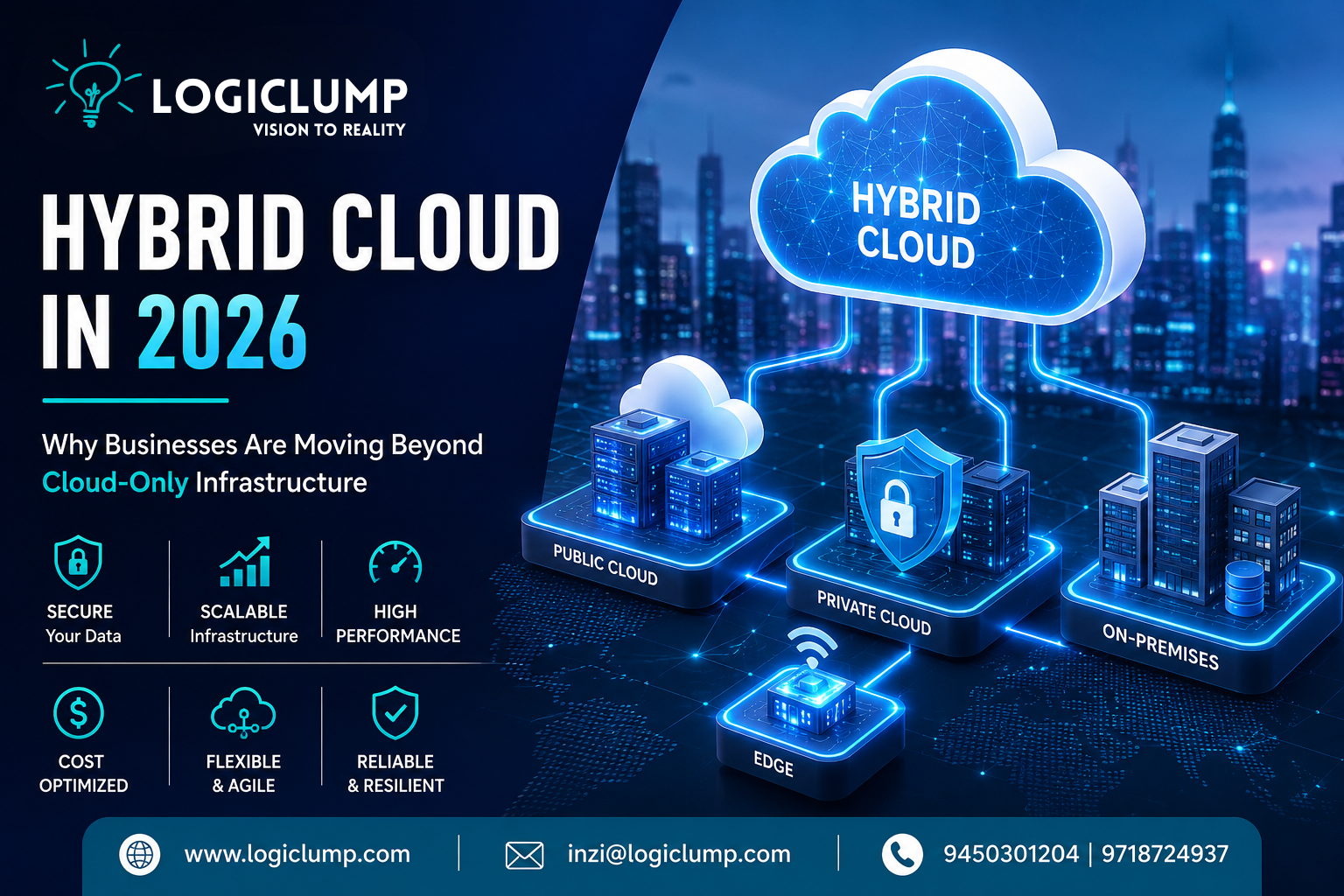
Hybrid Cloud in 2026: The Future Beyond Cloud-Only Infrastructure
For years, businesses were encouraged to follow a cloud-first strategy. Moving applications, data, and infrastructure to public cloud platforms offered scalability, flexibility, and faster deployment.
But in 2026, the conversation is changing.
Organizations are increasingly asking a different question: Does every workload really belong in the public cloud?
The answer for many businesses is no. Instead, companies are adopting hybrid cloud infrastructure, combining public cloud, private cloud, on-premises systems, and in some cases edge environments.
Recent 2026 research shows this shift clearly. Flexera reports that 73% of organizations surveyed operate hybrid cloud environments, while CNCF reports that hybrid cloud has reached 44% adoption among Indian cloud-native developers, making it the most popular deployment model in its India 2026 study.
What Is Hybrid Cloud?
Hybrid cloud is an IT architecture that connects different computing environments so organizations can use each environment for the workloads it handles best.
A typical hybrid setup might combine:
Public Cloud → scalable applications and customer-facing services
Private Cloud → sensitive workloads and controlled environments
On-Premises Infrastructure → existing enterprise systems and critical databases
Edge Computing → applications requiring processing close to users or devices
Instead of moving everything into one environment, businesses can decide where each workload should run based on security, performance, cost, compliance, and business requirements.
Why Are Businesses Rethinking Cloud-Only Strategies?
Public cloud remains extremely important, but businesses have discovered that moving everything to the cloud does not automatically produce the best results.
Several factors are driving the move toward hybrid infrastructure.
1. Cost Optimization
Cloud infrastructure provides flexibility, but unpredictable workloads can make costs difficult to forecast.
As cloud environments become larger and more complex, organizations are paying greater attention to infrastructure utilization, operational expenses, and workload placement.
Flexera's 2026 State of the Cloud research reports that wasted IaaS and PaaS spending increased to 29%, highlighting the continuing challenge of controlling cloud costs.
A hybrid approach can allow businesses to keep predictable or specialized workloads in private infrastructure while using public cloud resources when elasticity is valuable.
2. Data Security and Compliance
Not every type of business data can be handled in exactly the same way.
Financial information, healthcare records, government data, intellectual property, and other sensitive information may require additional controls around access, storage, location, and governance.
Hybrid infrastructure allows organizations to keep certain workloads in controlled environments while still using public cloud services for appropriate applications.
This can be particularly important for industries where data sovereignty and regulatory requirements influence infrastructure decisions.
A 2026 ISG report notes that enterprises are increasingly balancing public cloud with private, colocation, edge, and sovereign environments to address resilience, governance, and regulatory requirements.
3. Existing IT Infrastructure Can't Simply Disappear
Many companies have invested heavily in servers, databases, enterprise applications, and private infrastructure over the years.
Replacing everything at once can be expensive and disruptive.
Hybrid cloud provides a more gradual path.
Businesses can:
Keep → Modernize → Integrate → Migrate
Instead of replacing an entire IT environment immediately, organizations can modernize applications progressively while connecting existing systems with newer cloud services.
This approach can reduce disruption and allow businesses to continue operating critical systems during modernization.
4. Performance Matters
Not every application benefits from being hosted far away in a public cloud region.
Some workloads require:
- Low latency
- Consistent performance
- Local processing
- High-speed data access
- Specialized hardware
This is one reason hybrid strategies increasingly include edge computing.
For example, an organization operating connected devices may process time-sensitive information closer to where the data is generated while sending selected information to the cloud for storage and analysis.
The result can be a more flexible architecture where workloads are positioned according to their technical requirements.
5. Cloud Strategy Is Becoming “Workload-First”
One of the biggest changes in IT thinking is the move away from asking:
“Should we move everything to the cloud?”
toward:
“Where should this particular workload run?”
A customer-facing web application may benefit from public cloud scalability.
A sensitive database may require a private environment.
An older enterprise application may remain on-premises while being gradually modernized.
An edge application may need local processing.
This workload-first approach allows businesses to choose infrastructure based on actual requirements rather than following a single deployment model.
Hybrid Cloud Is Growing in India
Hybrid cloud is particularly relevant to India's rapidly expanding cloud-native ecosystem.
According to the CNCF and SlashData State of Cloud Native Development in India 2026 report, India has approximately 2.25 million cloud-native developers, and hybrid cloud adoption among Indian developers has reached 44%.
This growth reflects the increasing need for Indian businesses to balance:
- Digital transformation
- Data protection
- Scalability
- Cost management
- Existing infrastructure
- Cloud adoption
- Application modernization
For businesses expanding their digital operations, hybrid architecture can provide a practical bridge between existing systems and new cloud-native applications.
Hybrid Cloud and Modern Software Development
Hybrid infrastructure also changes how software is developed.
Modern applications increasingly need to work across different environments.
Developers may need to build:
- Cloud-connected applications
- API-driven platforms
- Containerized services
- Distributed applications
- Secure authentication systems
- Cross-platform applications
- Cloud and on-premise integrations
This makes architecture and integration extremely important.
A well-designed application should be able to communicate securely with the systems it needs without creating unnecessary dependencies on a single infrastructure environment.
Security Must Be Consistent Across Environments
Hybrid cloud can provide flexibility, but it also introduces additional complexity.
When applications and data exist across multiple environments, organizations need consistent security policies.
Important areas include:
Identity & Access Management
Only authorized users and systems should have access to specific resources.
API Security
Applications communicating across cloud and on-premises environments need secure APIs.
Encryption
Sensitive information should be protected both during transmission and while stored.
Monitoring
Organizations need visibility across different infrastructure environments.
Backup & Disaster Recovery
Critical applications should have reliable recovery strategies.
Zero-Trust Architecture
Access should be continuously verified rather than automatically trusted based on network location.
The goal is to make security consistent across the entire infrastructure, rather than securing each environment separately.
Hybrid Cloud Is Not the Same as Multi-Cloud
These concepts are often confused.
Hybrid Cloud combines different infrastructure environments, such as public cloud and on-premises or private cloud.
Multi-Cloud means using services from multiple cloud providers.
A business can use both at the same time.
For example:
Private Infrastructure + AWS + Microsoft Azure + Google Cloud
would represent a hybrid and multi-cloud environment.
The important thing is not how many platforms a company uses, but whether the architecture is properly governed and managed.
The Challenges of Hybrid Cloud
Hybrid cloud isn't automatically easier.
It introduces its own challenges, including:
- Infrastructure complexity
- Multiple management systems
- Security coordination
- Network configuration
- Data synchronization
- Monitoring
- Skills requirements
- Cost management
- Application compatibility
Research from HashiCorp found that hybrid cloud complexity is already a major infrastructure-management challenge for many organizations.
This means businesses should not adopt hybrid cloud simply because it is trending.
They need a clear architecture and management strategy.
How Businesses Can Prepare for Hybrid Cloud
A successful hybrid strategy should start with business requirements.
Step 1: Identify Your Workloads
Understand which applications, databases, and services the organization operates.
Step 2: Classify Your Data
Determine which information requires additional security, compliance, or residency controls.
Step 3: Evaluate Performance
Identify workloads that require high availability, low latency, or specialized infrastructure.
Step 4: Analyze Costs
Compare infrastructure and operational costs across public, private, and on-premises environments.
Step 5: Design Secure Integrations
Use secure APIs, identity management, encryption, and monitoring to connect different environments.
Step 6: Modernize Gradually
Instead of replacing everything at once, prioritize applications based on business value and technical requirements.
What Does the Future of Hybrid Cloud Look Like?
Hybrid cloud is becoming less of a temporary transition between on-premises infrastructure and public cloud.
It is increasingly becoming an operating model in its own right.
2026 industry research shows organizations are moving toward balanced infrastructure strategies that combine public cloud, private infrastructure, edge, colocation, and other environments according to workload requirements.
The future is therefore unlikely to be completely cloud-only or completely on-premises.
Instead, successful businesses will increasingly use the right infrastructure for the right workload.
Final Thoughts
The cloud is not going away. Instead, the way businesses use the cloud is becoming more strategic.
In 2026, organizations are moving beyond the idea that every application must live in the public cloud.
Hybrid cloud gives businesses the flexibility to combine cloud scalability, private control, existing infrastructure, edge performance, and modern software architecture.
The real advantage isn't simply having multiple environments.
It's having the ability to choose where applications and data should run based on business requirements.
For companies planning digital transformation, application modernization, or new software platforms, hybrid architecture can provide the flexibility needed to grow without completely abandoning existing technology investments.
Build Scalable Digital Solutions with LogiClump
At LogiClump Technologies, we help businesses build and modernize digital solutions with a focus on scalability, security, performance, and long-term growth.
Our services include:
- 🌐 Website Development
- 📱 Mobile App Development
- ⚙️ Custom Software Development
- ☁️ Cloud-Based Applications
- 🔗 API & System Integration
- 🏢 CRM & ERP Solutions
- 🛒 E-Commerce Platforms
- 💻 Enterprise Software Solutions
LogiClump Technologies — Vision to Reality
🌐 www.logiclump.com
📧 inzi@logiclump.com
📞 9450301204 | 9718724937
Discover why businesses are adopting hybrid cloud in 2026 to achieve greater flexibility, scalability, security, performance, and cost efficiency beyond cloud-only infrastructure with LogiClump.
Tom Cruise