
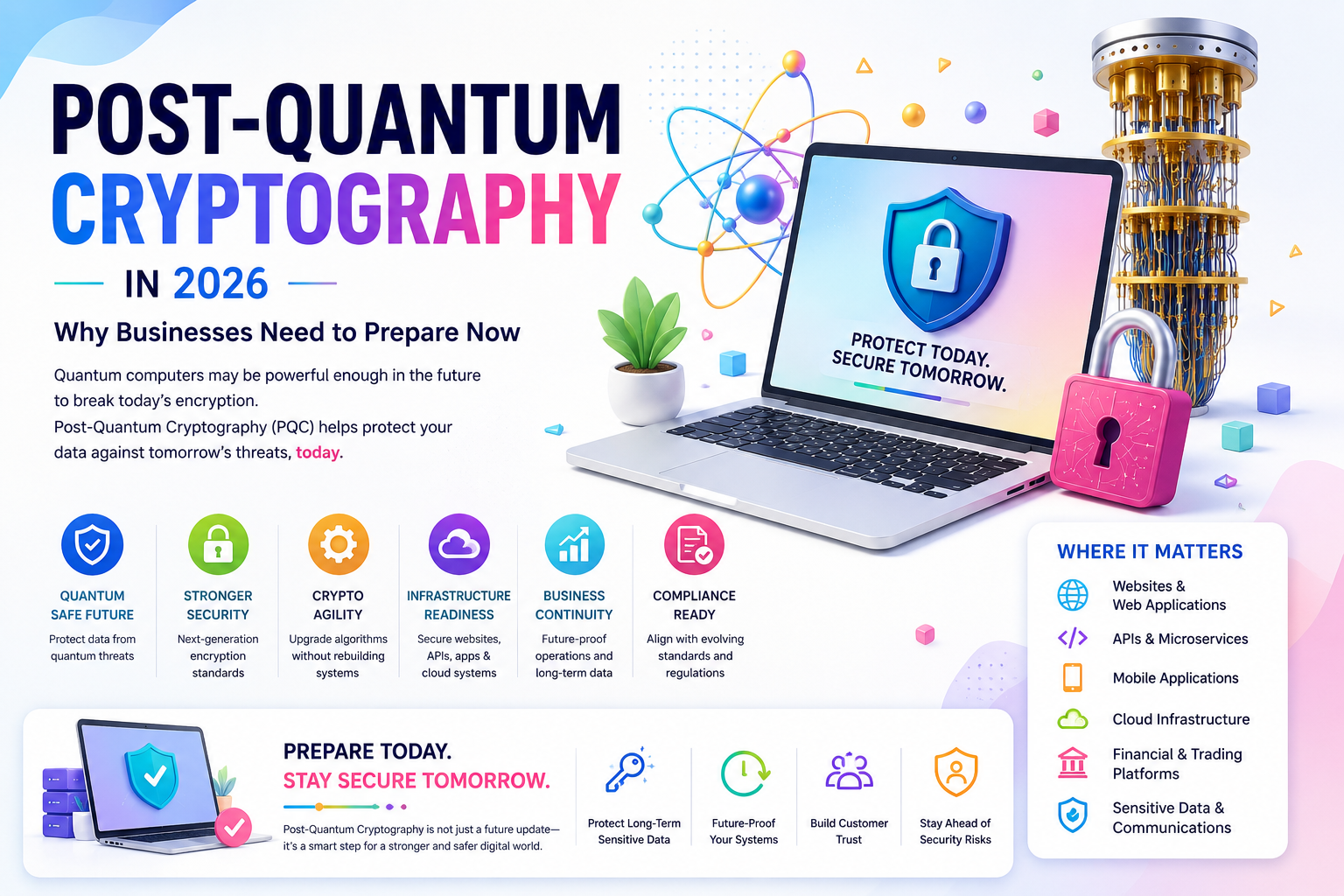
POST-QUANTUM CRYPTOGRAPHY IN 2026
The way businesses protect digital information is entering a new phase.
For years, organizations have relied on established public-key cryptography to secure websites, applications, APIs, communications and sensitive information. These technologies remain essential today, but advances in quantum computing are creating a new security consideration: some existing cryptographic algorithms may eventually become vulnerable to sufficiently powerful quantum computers.
This is why Post-Quantum Cryptography (PQC) has become an increasingly important topic for IT leaders in 2026.
Rather than waiting for quantum computers to become capable of breaking current encryption, businesses can begin preparing their systems for cryptographic technologies designed to withstand quantum attacks.
What Is Post-Quantum Cryptography?
Post-Quantum Cryptography refers to cryptographic algorithms designed to remain secure against attacks from both conventional and quantum computers.
The objective is not to build a quantum computer.
Instead, PQC focuses on developing and deploying new encryption and digital-signature techniques that can operate on today's computing infrastructure while providing stronger protection against future quantum threats.
This makes PQC particularly relevant to software developers, cloud architects, cybersecurity teams and organizations responsible for protecting long-lived digital information.
Why Is PQC Becoming Important in 2026?
Quantum computing is still developing, but organizations cannot assume that quantum-related security risks are decades away.
The World Economic Forum's 2026 Global Cybersecurity Outlook notes that quantum technologies are increasingly being viewed as a cybersecurity concern and that organizations need to consider migration toward post-quantum cryptography.
HPE similarly describes post-quantum cryptography as an infrastructure-planning issue and highlights the importance of crypto-agility—the ability to change cryptographic technologies without rebuilding entire systems.
For businesses, this creates an important question:
Are your applications and infrastructure ready to replace their cryptographic components when necessary?
The "Harvest Now, Decrypt Later" Problem
One reason organizations are preparing early is the possibility of a "harvest now, decrypt later" strategy.
In this scenario, attackers collect encrypted information today and store it. If sufficiently capable quantum computing becomes available in the future, that stored information could potentially become easier to decrypt.
This is particularly concerning for information that needs to remain confidential for many years.
Examples include:
- Financial records
- Customer information
- Intellectual property
- Government-related data
- Healthcare information
- Business contracts
- Authentication credentials
- Long-term confidential communications
Therefore, organizations should consider not only today's security requirements but also the expected lifetime of the information they protect.
Which Business Systems Could Be Affected?
Post-quantum migration isn't limited to one application or server.
Cryptography can exist throughout a modern IT environment.
Websites and Web Applications
Secure websites rely on encryption to protect communication between users and servers. Organizations should monitor developments in post-quantum support across their web infrastructure and security stack.
APIs
Modern applications frequently communicate through APIs. Authentication, certificates, secure connections and data exchange mechanisms can all involve cryptographic technologies.
Mobile Applications
Mobile applications may rely on encrypted communication, authentication mechanisms and certificates. Long-lived applications should be included in future cryptographic migration planning.
Cloud Infrastructure
Cloud environments contain numerous services, certificates, keys and encrypted workloads. Organizations using multiple cloud providers should understand where cryptography is being used and how easily it can be upgraded.
Financial and Trading Platforms
Financial systems are particularly sensitive to security and data integrity.
Trading applications, payment systems, broker platforms and financial APIs can contain valuable information that requires long-term protection.
For such systems, cryptographic agility should become part of broader security and infrastructure planning.
What Is Cryptographic Agility?
One of the most important concepts associated with post-quantum readiness is crypto-agility.
Crypto-agility means designing systems so cryptographic algorithms, certificates and related security components can be replaced without requiring a complete redesign of the application.
A rigid architecture may make cryptographic migration expensive and complicated.
A flexible architecture can make future upgrades significantly easier.
For developers, this means avoiding unnecessary hard-coding of cryptographic assumptions throughout an application.
Instead, security components should be designed with future migration in mind.
How Businesses Can Prepare
Organizations do not necessarily need to replace every encryption system immediately.
A better approach is to start with visibility and planning.
1. Create a Cryptographic Inventory
First, identify where cryptography is being used.
Organizations should look at:
- Websites
- APIs
- Databases
- Mobile applications
- Cloud services
- VPNs
- Certificates
- Authentication systems
- Internal applications
- Third-party software
Without knowing where cryptography exists, migration planning becomes difficult.
2. Identify High-Value Information
Not all information has the same security lifetime.
Organizations should identify data that must remain confidential for many years and prioritize protection for those assets.
3. Evaluate Third-Party Dependencies
Modern applications depend on frameworks, libraries, cloud services and external platforms.
Businesses should understand whether their technology providers have a roadmap for post-quantum readiness.
4. Build Crypto-Agility
Applications should be designed so that cryptographic components can be upgraded with minimal disruption.
This is particularly important for systems expected to operate for many years.
5. Monitor Industry Standards
Post-quantum cryptography is an evolving field. Organizations should monitor standards, security guidance and vendor support rather than adopting untested technologies simply because they are marketed as "quantum-safe."
PQC Doesn't Replace Existing Cybersecurity
Post-quantum cryptography should not be viewed as a replacement for conventional cybersecurity.
Businesses still need:
- Strong identity management
- Secure software development
- Encryption
- Multi-factor authentication
- Vulnerability management
- API security
- Network security
- Monitoring and logging
- Backup and disaster recovery
- Regular security testing
PQC is another layer in a broader security strategy.
Why Software Architecture Matters
Preparing for post-quantum security isn't only a cybersecurity responsibility.
It is also a software architecture challenge.
Applications built with modular components, clear security boundaries and flexible infrastructure are generally easier to upgrade when technologies change.
This is why organizations modernizing legacy applications should consider long-term security requirements alongside performance, scalability and functionality.
A modernization project can provide an opportunity to identify outdated cryptographic dependencies and introduce more flexible security architecture.
What This Means for Businesses in 2026
The biggest lesson isn't that every organization needs to immediately deploy a completely new encryption system.
The lesson is that waiting until quantum computing becomes an immediate threat could make migration much harder.
Businesses should begin by understanding their current cryptographic footprint, identifying long-lived sensitive data and evaluating whether their applications and infrastructure can adapt to future security standards.
Post-quantum readiness is ultimately about reducing future disruption.
How LogiClump Can Help
At LogiClump Technologies, we develop modern digital solutions including websites, mobile applications, custom software, cloud-ready applications and API-integrated systems.
When developing or modernizing business applications, factors such as security, scalability, reliability and maintainability are important parts of the technology architecture.
For businesses planning long-term digital transformation, building flexible systems today can make it easier to adapt to emerging technologies and evolving security requirements tomorrow.
Final Thoughts
Post-quantum cryptography may sound like a technology for the distant future, but preparation is already becoming part of enterprise security planning.
The organizations that begin mapping their cryptographic dependencies, evaluating their technology stack and building crypto-agile architectures today can reduce the complexity of future migration.
The quantum era may still be developing, but quantum-ready IT planning can start now.
LogiClump Technologies — Vision to Reality.
Explore Post-Quantum Cryptography in 2026 and learn how businesses can prepare websites, apps, APIs, cloud infrastructure, and sensitive data for future quantum security threats.
Tom Cruise