
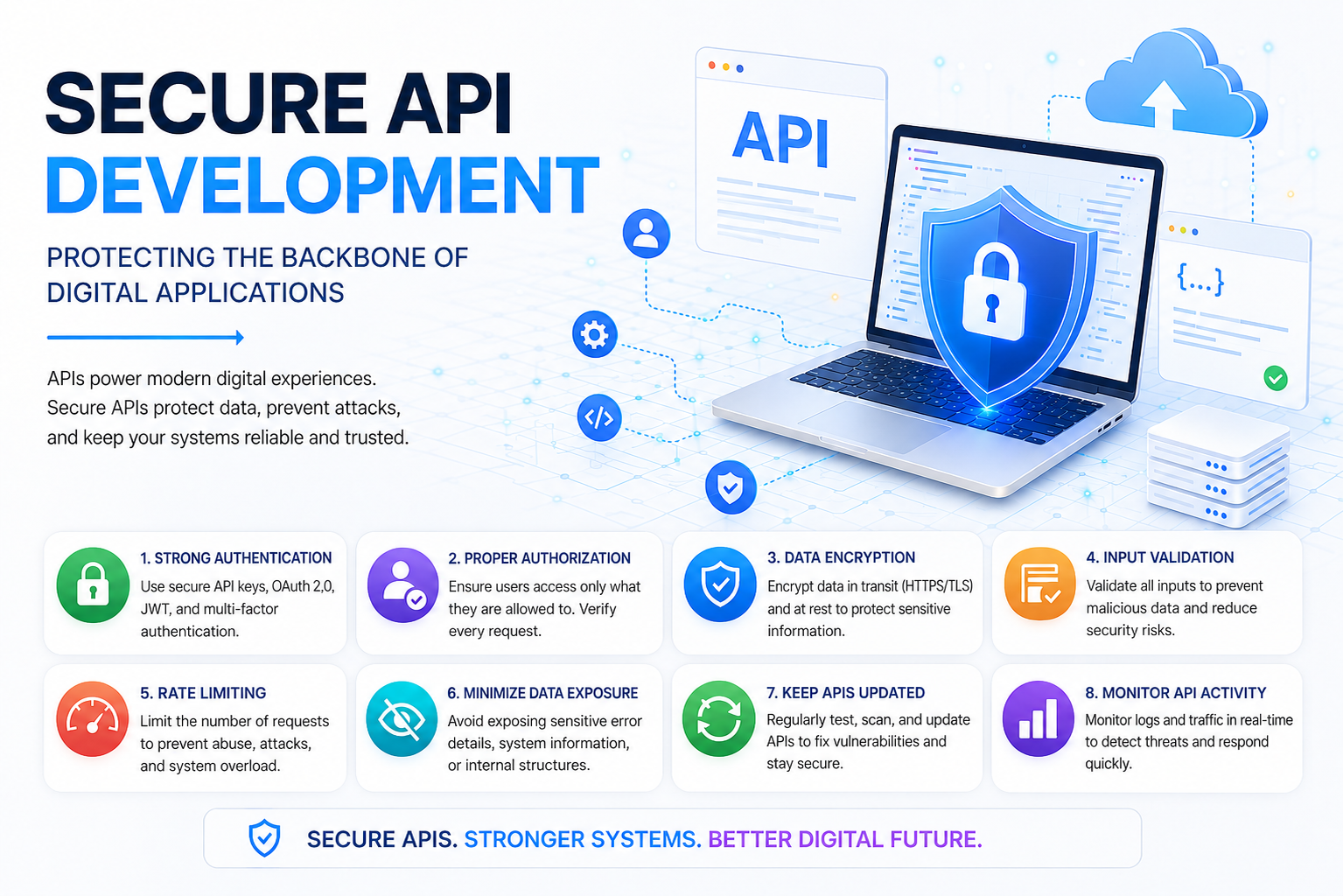
Secure API Development: Protecting the Backbone of Digital Applications
In today's connected digital world, applications rarely work alone. Mobile apps, websites, payment systems, cloud platforms, and third-party services constantly exchange information behind the scenes. The technology making much of this communication possible is the API (Application Programming Interface).
APIs are the backbone of modern digital applications. However, as businesses become more connected, APIs have also become an important target for cyberattacks.
A single insecure API can expose sensitive customer information, financial data, business systems, and other critical resources. This is why secure API development is no longer optional—it is an essential part of building reliable digital products.
What Is an API?
An API allows different software applications to communicate with each other.
For example, when you:
- Log in to a mobile application
- Make an online payment
- Check live market data
- Connect a website with a third-party service
- Access information from a cloud platform
An API may be working in the background.
Because APIs often handle valuable data and important business operations, security must be considered from the very beginning of development.
Why API Security Matters
Modern businesses depend on APIs more than ever. As digital platforms grow, APIs can connect multiple systems, users, databases, and external services.
If an API is not properly secured, attackers may attempt to:
- Access sensitive information
- Steal user credentials
- Manipulate application data
- Perform unauthorized transactions
- Overload services with excessive requests
- Exploit weaknesses in authentication or authorization
The impact can go far beyond technical problems. A security incident can damage customer trust, interrupt business operations, and create financial losses.
1. Use Strong Authentication
Authentication helps verify the identity of a user or application trying to access an API.
Strong authentication methods may include:
- Secure API keys
- OAuth 2.0
- JSON Web Tokens (JWT)
- Multi-factor authentication where appropriate
However, authentication alone is not enough. Developers should also carefully manage how tokens and credentials are created, stored, and renewed.
Sensitive credentials should never be exposed directly in public code or unsecured applications.
2. Implement Proper Authorization
Authentication answers the question:
“Who are you?”
Authorization answers:
“What are you allowed to do?”
A user may successfully log in but should not automatically have access to every resource in the system.
For example, an ordinary user should not be able to access administrator-level data simply by changing an ID in an API request.
Proper authorization ensures that every request is checked before sensitive data or actions are made available.
3. Always Encrypt Data
Data should be protected while it moves between users, applications, and servers.
Using HTTPS and modern TLS encryption helps protect information from being intercepted during transmission.
Sensitive information stored by the application should also be protected using appropriate encryption and security practices.
Encryption is especially important for platforms handling:
- Financial information
- Personal data
- Login credentials
- Business records
- Transaction details
4. Validate Every Input
APIs should never blindly trust data received from users or external systems.
Input validation helps prevent malicious or unexpected information from entering the application.
Developers should verify:
- Data type
- Format
- Length
- Required fields
- Allowed values
Proper validation can help reduce the risk of common attacks and application errors.
5. Apply Rate Limiting
An API can receive thousands or even millions of requests. Without proper controls, attackers may try to overwhelm the system with excessive traffic.
Rate limiting controls how many requests a user or application can make within a certain period.
This helps protect APIs against:
- Brute-force attacks
- Automated abuse
- Excessive traffic
- Resource exhaustion
Rate limiting also helps maintain a better experience for legitimate users.
6. Avoid Exposing Sensitive Information
Error messages can sometimes reveal too much information.
For example, a detailed error message might expose:
- Database structure
- Server details
- Internal application paths
- Security configurations
While detailed information can help developers during testing, production APIs should return controlled and secure error responses.
The goal is to provide useful information without helping potential attackers understand the internal system.
7. Keep APIs Updated and Tested
Security is not a one-time task.
New vulnerabilities and attack methods continue to emerge. APIs should be regularly reviewed, updated, and tested.
A strong API security process may include:
- Regular security testing
- Code reviews
- Dependency updates
- Vulnerability scanning
- Penetration testing
- API monitoring
Continuous improvement helps businesses identify potential risks before they become serious problems.
8. Monitor API Activity
Real-time monitoring can help detect unusual activity.
For example, businesses may want to identify:
- Repeated failed login attempts
- Unusual request patterns
- Unexpected access attempts
- Sudden spikes in API traffic
Logs and monitoring tools provide valuable visibility into how APIs are being used.
When suspicious activity is detected early, teams can respond faster and reduce potential damage.
API Security and Modern Application Development
As applications become more complex, APIs are connecting an increasing number of services.
A modern digital ecosystem may include:
Mobile Apps → APIs → Cloud Services → Databases → Third-Party Platforms
Every connection creates a potential security consideration.
This is why security should be integrated into the complete development lifecycle instead of being added at the end.
The best approach is to design APIs with security in mind from the beginning.
How LogiClump Approaches Secure Digital Development
At LogiClump, we understand that modern digital solutions need more than attractive designs and advanced features. Security, performance, and reliability are equally important.
Whether developing a website, mobile application, custom software solution, trading platform, or other digital system, secure APIs play a vital role in connecting services safely and efficiently.
A well-developed API architecture can help businesses build solutions that are:
- Secure
- Scalable
- Reliable
- High-performing
- Ready for future growth
By following modern development and security practices, businesses can create stronger digital foundations for long-term success.
Final Thoughts
APIs are one of the most important components of modern software development. They connect applications, power digital services, and enable businesses to deliver seamless experiences.
But with greater connectivity comes greater responsibility.
Secure authentication, proper authorization, encryption, input validation, rate limiting, regular testing, and continuous monitoring are all essential parts of a strong API security strategy.
As digital transformation continues to accelerate, businesses that prioritize secure API development will be better prepared to protect their systems, users, and data.
At LogiClump, we believe strong technology starts with a strong foundation—and secure APIs are a key part of building it.
Build Secure. Build Smart. Build for the Future.
Contact us:
🌐 www.logiclump.com
📧 inzi@logiclump.com
📞 9450301204 | 9718724937
Learn how secure API development protects data, prevents cyberattacks, and builds secure, scalable, and reliable digital applications with modern API security practices.
Tom Cruise