
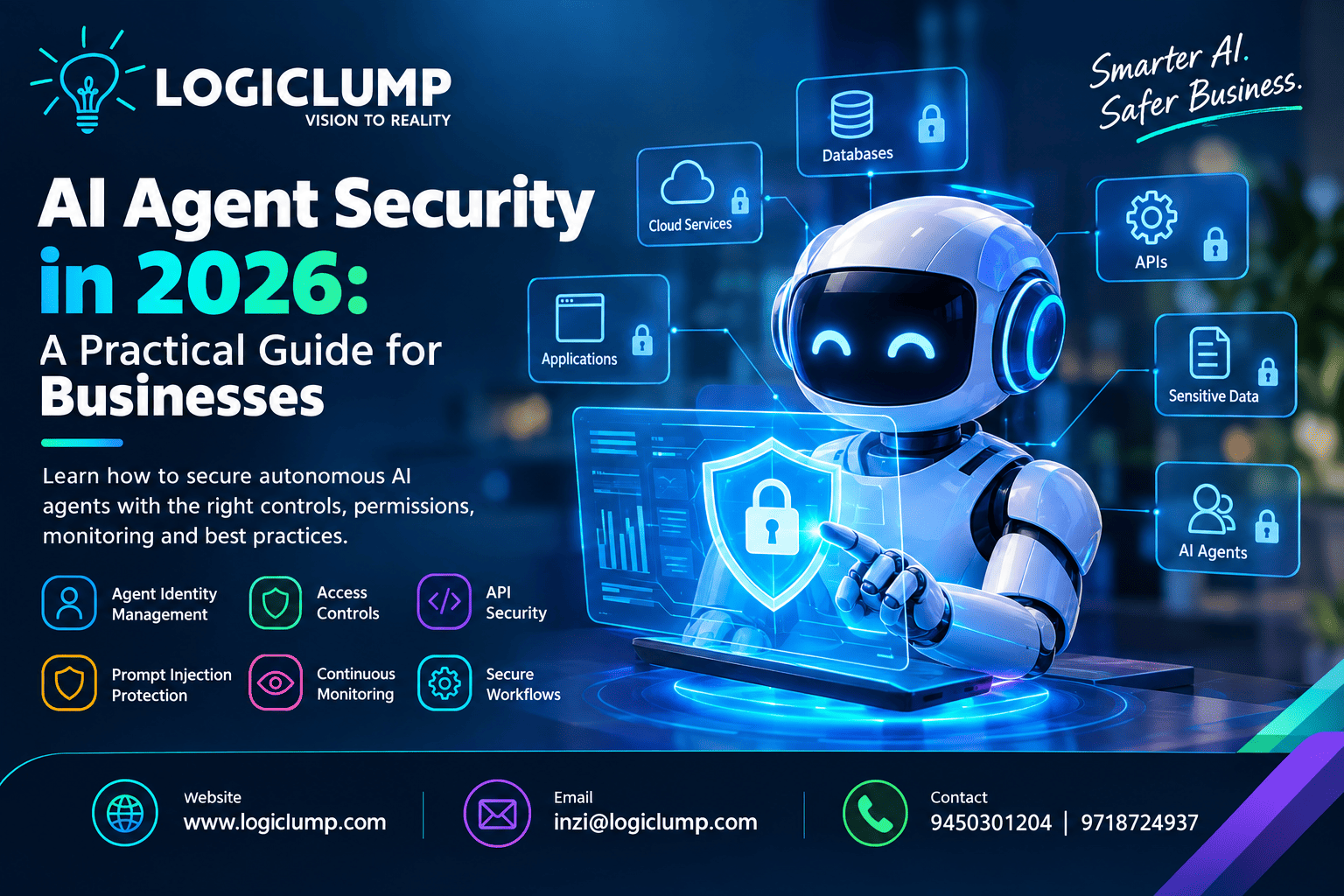
AI Agent Security in 2026
Artificial intelligence is becoming an active part of business operations.
Companies are experimenting with AI systems that can investigate customer requests, retrieve internal information, communicate with applications, prepare reports, and coordinate tasks across different departments.
These systems are changing the way organizations approach automation.
Unlike traditional software that follows a fixed sequence of instructions, an AI agent can interpret a goal, evaluate available information, select suitable tools, and attempt to complete a task.
This flexibility makes AI agents useful, but it also creates a difficult question for businesses:
How can an organization allow AI to perform real work without giving it uncontrolled access to company systems?
An AI agent connected to a CRM, database, payment service, or cloud environment can potentially affect important business operations. A mistake involving permissions or an improperly secured integration may have consequences beyond an incorrect AI response.
Consequently, AI security must extend beyond protecting models and training data. Organizations also need to secure the actions, connections, identities, and information surrounding every deployed agent.
This is the foundation of AI agent security.
Why AI Agents Need a Different Security Approach
Traditional applications generally operate through functionality defined by developers. Their permissions and available operations are established through application logic and access-control systems.
AI agents introduce a layer of flexible decision-making.
An agent may decide which tool to use based on the information it receives. It may retrieve data from one application, process that information, and then initiate an operation in another system.
Consider a business assistant responsible for managing customer requests.
It might need to:
- Read customer messages.
- Retrieve order information.
- Search internal documentation.
- Prepare a response.
- Update a support record.
- Notify an employee.
Each capability connects the agent to another part of the organization's technology environment.
If these connections are not properly restricted, the agent could access information or perform operations outside its intended responsibilities.
The security model must therefore account for both the agent's reasoning capabilities and the technical authority granted to it.
Understanding the AI Agent Attack Surface
The attack surface of an autonomous agent includes much more than the AI model.
It can involve several interconnected components:
Model: The system interpreting instructions and producing decisions.
Instructions: The prompts, system rules, and operational guidance provided to the agent.
Tools: The functions available for retrieving information or performing tasks.
APIs: The interfaces connecting the agent to other applications.
Data sources: The databases, documents, and external information the agent can access.
Identity: The credentials and permissions associated with the agent.
Memory: Information retained between interactions.
Runtime environment: The infrastructure in which the agent operates.
A weakness in any of these components can affect the security of the entire workflow.
For example, a well-protected AI model may still be part of an insecure application if its API credentials are exposed or its database permissions are excessive.
This is why agent security requires an end-to-end approach.
Important Threats Businesses Need to Understand
Prompt Injection: When External Content Influences an Agent
AI agents often process information that originates outside the organization.
This might include customer emails, uploaded documents, websites, support messages, or third-party data.
An attacker may place misleading instructions inside such content, attempting to influence the agent into revealing information or performing an unintended operation.
This is known as prompt injection.
For example, an AI research agent may be asked to summarize a document. The document could contain instructions attempting to make the agent send confidential information to an external destination.
The agent should not automatically treat everything it reads as an authorized instruction.
Protective measures:
- Separate trusted instructions from external content.
- Treat retrieved documents as untrusted information.
- Restrict the tools available to the agent.
- Validate sensitive actions through independent policies.
- Test against malicious and unexpected inputs.
- Monitor attempts to access restricted information.
The important point is that prompt filtering alone cannot provide complete protection. The agent's technical permissions must also limit what it can actually do.
Excessive Access to Business Systems
An agent may receive broad permissions because developers want to make integrations easier.
This can create unnecessary exposure.
Imagine an AI assistant designed to prepare customer reports. It needs access to selected customer records, but it is also given permission to modify account settings and delete records.
Those additional permissions serve no necessary purpose.
If the agent makes an incorrect decision or its credentials are compromised, the consequences could be more serious.
Protective measures:
Give agents only the access required for their assigned functions. Separate permissions for reading information, modifying records, and performing administrative operations.
API Exploitation
APIs provide the communication channels through which agents interact with software.
An agent may use several endpoints during a single task. If an endpoint lacks proper authorization or input validation, it could become a security weakness.
Businesses should pay attention to:
- Authentication requirements
- Endpoint-level permissions
- Request validation
- Rate limits
- Secure credential storage
- Encryption
- API activity monitoring
- Error handling
A successful connection should never be treated as automatic permission to perform every operation offered by the connected application.
Data Leakage Through AI Workflows
An agent may process information from multiple sources.
Without appropriate boundaries, sensitive data could appear in generated responses, logs, memory, or external integrations.
This is particularly important when applications handle personal information, financial records, employee details, or proprietary business documents.
Protective measures:
- Classify sensitive information.
- Restrict access by role and purpose.
- Remove unnecessary personal data from prompts.
- Apply appropriate masking.
- Review external data-sharing behavior.
- Define retention and deletion policies.
Incorrect or Unintended Actions
AI agents can misunderstand instructions, work with incomplete information, or select an inappropriate tool.
A minor error in a low-risk workflow may be manageable. The same problem in a financial or administrative process could have much greater consequences.
Businesses should not assume that an agent will always interpret a request correctly.
Important operations should have independent validation and approval mechanisms.
Give Every AI Agent a Separate Identity
One of the most important foundations of agent security is identity management.
When multiple autonomous systems operate within an organization, each important agent should have an identifiable identity and accountable owner.
For example:
Agent: Inventory Monitoring Assistant
Owner: Operations Department
Purpose: Monitor product availability and report inventory exceptions.
Approved capabilities:
- Read inventory levels.
- Review selected order information.
- Generate stock reports.
- Notify operations employees.
Restricted capabilities:
- Change administrator accounts.
- Access payroll records.
- Delete product databases.
- Modify financial permissions.
A separate identity makes it easier to track activity, investigate incidents, and revoke access.
It also prevents organizations from relying on shared credentials that make it difficult to determine which agent performed a particular operation.
Make Least-Privilege Access a Default Rule
The principle of least privilege is straightforward: an identity should receive only the permissions necessary to perform its assigned work.
For AI agents, this principle should apply to every connected resource.
A marketing agent may need access to campaign analytics and approved content libraries.
It should not automatically receive access to customer payment information.
A software-development agent may need access to a development repository and testing environment.
It should not automatically receive production administrator credentials.
Permissions should be designed around the agent's actual responsibilities.
They should also be reviewed when its purpose changes.
Keep Authorization Outside the AI Model
An AI model can decide that an operation appears useful.
That does not mean the operation should be permitted.
For example, an agent might determine that changing a customer's account information would help complete a support request.
Before the application executes the change, a separate authorization system should check:
- Which agent made the request?
- Is the agent authenticated?
- Does it have access to this customer?
- Is this particular modification permitted?
- Does the operation require human approval?
- Does the request comply with business policy?
The application should enforce the result independently of the AI model's recommendation.
This separation is fundamental to secure agentic architecture.
AI provides the proposed action. The authorization system controls execution.
Secure Credentials and Agent Sessions
AI agents frequently need credentials to access external services.
These credentials should be managed carefully.
Storing permanent API keys directly in prompts, source code, or configuration files creates unnecessary exposure.
Businesses should consider:
- Centralized secrets management
- Credential rotation
- Short-lived access tokens
- Scoped credentials
- Secure authentication protocols
- Session expiration
- Revocation procedures
- Authentication activity monitoring
Where supported, temporary credentials are particularly useful for agents that perform short-lived tasks.
An agent should not retain access indefinitely simply because it once needed to complete a workflow.
Control What Agents Can Do With Tools
Tool access determines the practical authority of an AI agent.
A customer-service agent might have several available functions:
get_order_statusread_customer_profilecreate_support_ticketprepare_customer_response
These functions provide useful capabilities without necessarily giving the agent permission to make every possible change.
The design becomes safer when tools are narrow, clearly defined, and independently authorized.
Avoid creating a single unrestricted tool that gives an agent broad access to an entire application.
The smaller and more specific the available operations, the easier they are to test and govern.
Human Approval Should Depend on Risk
Autonomous execution is useful, but not every action should happen without review.
Organizations can assign approval requirements according to the potential impact of an operation.
Routine operations
Examples:
- Organizing support requests
- Preparing internal summaries
- Generating reports
These may be suitable for automatic execution after validation.
Business-sensitive operations
Examples:
- Sending important customer communications
- Modifying selected business records
- Updating contractual information
These may require employee review.
High-impact operations
Examples:
- Executing financial transfers
- Changing privileged permissions
- Removing critical records
- Modifying production infrastructure
These should have stronger authorization and explicit approval requirements.
This allows businesses to automate appropriate tasks while preserving human responsibility for consequential decisions.
Isolate Agents From Critical Infrastructure
An AI agent should not automatically have access to the entire environment in which it runs.
Isolation can reduce the potential impact of an unexpected action.
Depending on the application, developers may use:
- Sandboxed execution
- Container isolation
- Restricted network access
- Separate development and production environments
- File-system restrictions
- Resource limits
- Controlled command execution
For example, an AI coding agent can work inside a development environment, run approved tests, and submit proposed changes for review.
This is different from allowing it to execute unrestricted commands on production servers.
Monitor Agent Behavior Continuously
Deploying an AI agent is not the end of the security process.
Its behavior may change as models, instructions, integrations, data sources, and permissions evolve.
Organizations need to maintain visibility into what their agents are doing.
Useful monitoring information includes:
- Agent identity and owner
- Active model and version
- API requests
- Tools invoked
- Data accessed
- Operations completed
- Failed permission checks
- Unusual activity
- Human approval events
- Errors and exceptions
This information supports security investigations and helps developers understand why an agent behaved in a particular way.
It also provides evidence for operational reviews and governance.
Protect Agent Memory and Retrieved Information
Memory can make AI agents more useful by allowing them to retain relevant information between tasks.
However, memory should not be treated as an unrestricted storage area.
A business agent may remember customer preferences, previous conversations, or workflow details. Some of that information could be sensitive or no longer accurate.
Organizations should define clear rules for:
- Which information may be stored
- Which agents can access it
- How information is updated
- How long it is retained
- Whether sensitive data must be removed
- How incorrect information is corrected
- When memory should be deleted
Retrieved information should also be checked for relevance and access permissions before being used.
Secure the Entire Agent Lifecycle
Security needs to be included from the first design decision through retirement.
A practical lifecycle can be divided into six stages.
Design
Define the agent's purpose, owner, data requirements, tools, and risk level.
Development
Implement authentication, authorization, secure integrations, input validation, and restricted tool access.
Evaluation
Test normal workflows as well as malicious inputs, unexpected situations, and attempts to exceed permissions.
Deployment
Configure credentials, access policies, monitoring, and approval mechanisms.
Operation
Review agent activity, investigate unusual behavior, update permissions, and evaluate reliability.
Retirement
Disable unused agents, revoke their credentials, remove unnecessary integrations, and retain required audit records.
This approach helps prevent autonomous software from becoming an unmanaged part of the enterprise environment.
Build a Secure Architecture for Autonomous AI
A secure agentic application should separate the AI's decision-making capabilities from the systems that control access and execution.
A simplified architecture could include:
Business Request
↓
AI Agent and Reasoning Layer
↓
Agent Identity Verification
↓
Policy and Authorization Engine
↓
Restricted Tool and API Layer
↓
Business Applications and Databases
↓
Monitoring, Audit and Security Response
Human approval can be introduced between the authorization layer and execution for operations requiring additional control.
The benefit of this design is that the AI model does not become the sole authority over business operations.
Each important action passes through independently enforced controls.
A Practical AI Agent Security Checklist
Before deploying an autonomous agent, businesses should be able to answer the following questions.
| Security area | Important question |
|---|---|
| Ownership | Is a responsible owner assigned? |
| Identity | Does the agent have a distinct identity? |
| Permissions | Are its privileges limited? |
| Data | Can it access only approved information? |
| APIs | Are its integrations authenticated and authorized? |
| Credentials | Are secrets securely stored and managed? |
| Tools | Are available operations restricted? |
| Testing | Has the agent been tested against malicious inputs? |
| Approval | Are sensitive actions reviewed? |
| Monitoring | Can its activities be investigated? |
| Retirement | Can its access be revoked completely? |
This checklist can help organizations identify gaps before expanding AI autonomy.
Common Mistakes in AI Agent Deployment
Some security problems arise not because an organization lacks sophisticated technology, but because basic controls are overlooked.
Treating Every Agent Like a Trusted Employee
An AI agent should not inherit broad employee permissions simply because it works on behalf of a department.
Its access must be defined separately.
Relying on Prompts to Prevent Security Incidents
Instructions can guide model behavior, but they cannot replace technical restrictions.
Using Shared Credentials
When multiple agents use the same credentials, tracking individual actions becomes difficult.
Ignoring Connected Applications
An agent may create risk through the tools and external services it can access, even if the model itself is properly protected.
Enabling Full Autonomy Too Early
Businesses should validate reliability and security before allowing an agent to perform consequential actions.
Failing to Review Deployed Agents
An agent that was appropriately configured initially may become overprivileged as its responsibilities change.
Regular reviews are essential.
What AI Agent Security Means for Software Development
The rise of autonomous software is changing development requirements.
Developers now need to consider not only application functionality but also how AI systems interact with the application.
This creates demand for:
- Secure AI integrations
- Agent identity management
- Permission-aware APIs
- Workflow orchestration
- Controlled tool execution
- AI evaluation systems
- Runtime monitoring
- Audit mechanisms
- Human-approval workflows
- Secure cloud infrastructure
Building an agentic application therefore requires coordination between AI engineering, backend development, API architecture, cybersecurity, and business process design.
The goal is to create systems where autonomous capabilities are useful without becoming uncontrolled.
How LogiClump Can Help
As businesses explore AI-driven automation, they increasingly need software that connects intelligent systems with reliable applications and secure infrastructure.
LogiClump provides software development services involving:
- AI-powered applications
- Custom AI agent integrations
- Secure API development
- Business workflow automation
- CRM and enterprise software
- Web and mobile applications
- SaaS platforms
- FinTech solutions
- Trading software
- Cloud-ready applications
- Backend development
- Third-party integrations
- Authentication and authorization systems
Every business has different operational requirements. The right solution begins by understanding the workflow, identifying where AI can contribute, and defining the security controls required before implementation.
LogiClump focuses on building technology solutions around real business requirements, with attention to integration, scalability, and secure software architecture.
Conclusion
Autonomous AI is expanding the capabilities of business software.
Agents can now participate in workflows that involve multiple applications, information sources, and operational tasks. This creates opportunities for businesses to improve efficiency and reduce repetitive work.
But allowing AI to perform tasks also means allowing software to exercise authority.
That authority needs clear limits.
Organizations should establish separate agent identities, restrict permissions, secure APIs, protect credentials, validate tool usage, monitor activity, and retain human approval for sensitive operations.
The aim is not to remove autonomy from AI.
It is to make autonomy predictable, accountable, and appropriate for the task.
Secure the identity. Restrict the access. Validate the action. Monitor the outcome.
These principles will help businesses build AI-enabled software that can perform meaningful work without compromising the systems and information it depends on.
As autonomous AI becomes more deeply integrated into enterprise operations, security will be one of the foundations that determines how confidently businesses can use it.
Contact Us:
🌐 Website: www.logiClump.com
📧 Email: inzi@logiclump.com
📞 Contact: 9450301204 | 9718724937
Explore AI agent security in 2026, including agent identities, access controls, API protection, prompt injection, monitoring, and secure autonomous workflows.
Tom Cruise