
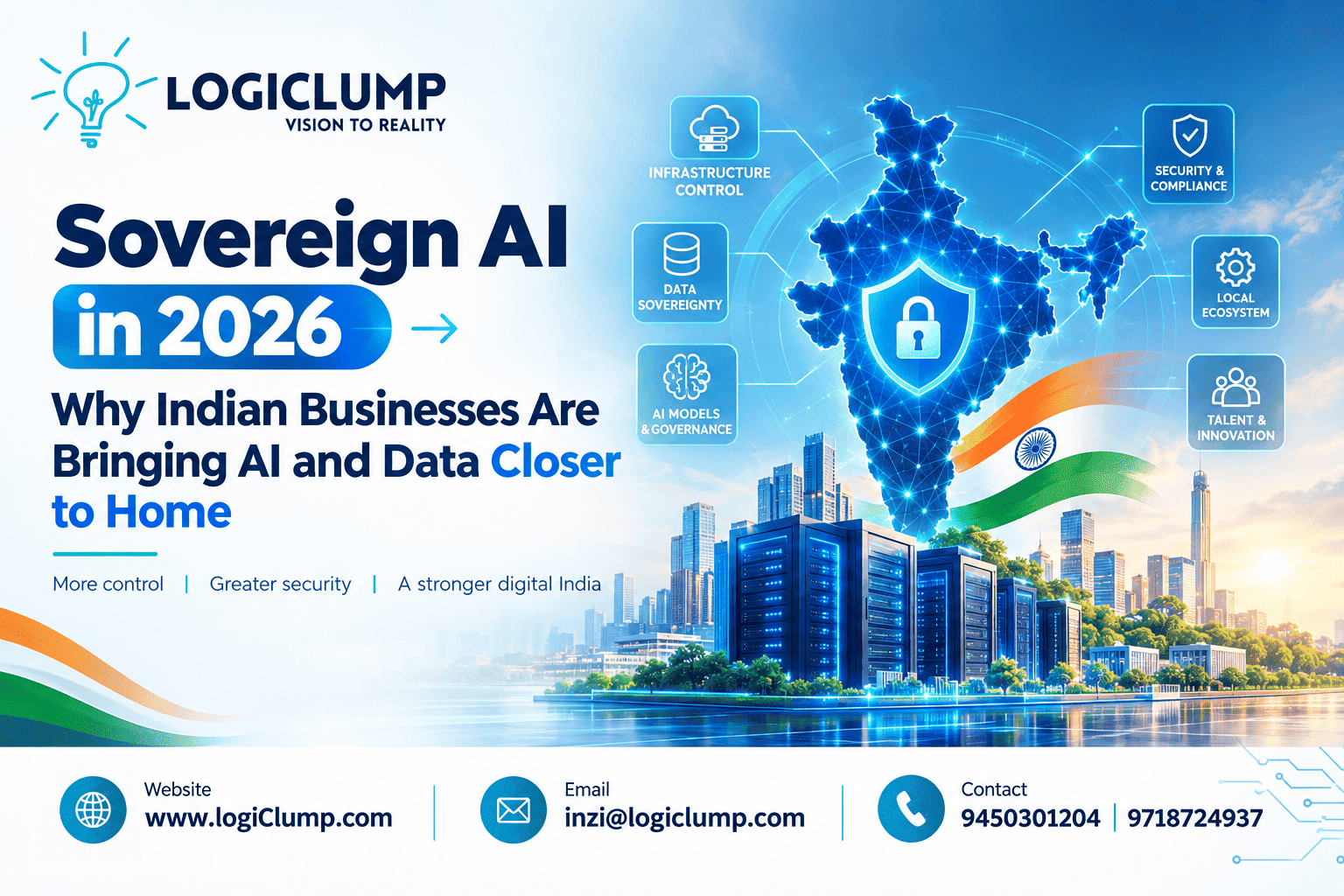
Sovereign AI in 2026
Artificial intelligence is moving from experimentation into everyday business operations. Organizations now use AI to analyze information, automate repetitive work, support customers, develop software, and assist with decision-making.
As these systems become connected to more business processes, a practical question is becoming harder to ignore:
Where is the AI running, who has control over the technology behind it, and what happens to the information sent into the system?
For Indian businesses, the issue can be particularly important because AI applications may handle customer records, financial information, internal documents, employee details, intellectual property, and other confidential material. Depending on the architecture, that information may be stored or processed across infrastructure operated in different locations and by different providers.
This is one reason interest in Sovereign AI is growing. The idea focuses on giving an organization or country greater control over the infrastructure, data, models, security, and governance that support AI workloads.
In 2026, Sovereign AI is increasingly appearing in conversations about India's digital infrastructure and enterprise technology. The goal is not necessarily to move every AI workload into a domestic data centre. Instead, organizations need to identify where local control matters and then choose an architecture that matches their security, operational, commercial, and regulatory needs.
What Is Sovereign AI?
Sovereign AI describes an approach in which an organization or country has meaningful control over the technology and processes used to develop, deploy, operate, and govern AI systems.
That control can extend across several layers, including:
-
Computing resources and GPUs
-
Data centres and cloud platforms
-
AI models and model-development processes
-
Business datasets and information
-
Applications and software integrations
-
Identity and security controls
-
Governance and operational processes
-
Developers, engineers, researchers, and other technical specialists
The concept therefore goes beyond simply deciding where a database is stored.
For example, a company could keep its primary customer database in India while sending selected records or prompts to an AI service operated elsewhere. The database itself would remain local, but part of the processing chain would still take place outside the organization's preferred environment.
A sovereign AI strategy looks at that complete information path. It considers storage, processing, model access, application integration, security, administration, and day-to-day operation.
The appropriate level of control will vary. Industry, risk exposure, contractual commitments, technical requirements, and the sensitivity of the information involved all influence how much sovereignty an organization actually needs.
Why Sovereign AI Is Becoming Important in India
India has a large digital economy spanning financial services, healthcare, manufacturing, retail, education, logistics, telecommunications, and public services. Each sector handles information differently and therefore has different requirements for AI deployment.
A financial organization may need tight controls over customer and transaction information. A healthcare provider may have to protect patient-related records. A manufacturer may want sensitive production data and proprietary operational knowledge to remain inside a controlled environment.
When such organizations introduce AI, they need visibility into how information is collected, transferred, processed, stored, and accessed.
At the same time, India is developing its domestic AI capabilities. The Government of India's IndiaAI Mission focuses on areas such as computing access, indigenous AI development, datasets, talent, and safe and trusted AI adoption.
Government updates reported that the IndiaAI Mission had expanded shared computing capacity to more than 45,000 GPUs by June 2026. Government-reported initiatives also include support for indigenous foundation models and responsible AI projects.
These developments indicate a wider effort to strengthen capabilities across different parts of the AI technology stack.
Source: Government of India – IndiaAI Mission infrastructure update.
Sovereign AI vs. Data Residency
Data residency and Sovereign AI are connected concepts, but they address different questions.
Data residency is primarily concerned with where information is stored or processed geographically, subject to the relevant service arrangements and requirements.
Sovereign AI takes a broader view. It can include questions about infrastructure ownership or control, administrative access, model selection, data governance, security, operational responsibility, and the rules under which the AI environment is managed.
Consider a business that keeps its application and database in India but uses an external AI provider. The business may have local data storage while still sending prompts, documents, or other selected information to an external processing environment.
The organization should therefore examine questions such as:
-
Where are AI requests processed?
-
What information leaves the primary environment?
-
Are prompts and outputs retained by a provider?
-
Who can administer the underlying infrastructure?
-
What contractual and legal terms govern the service?
-
How are models updated and maintained?
-
Which parties can access the system?
A server located in India does not, by itself, establish complete AI sovereignty. Organizations need to assess the full architecture and the actual technical and contractual controls behind it.
The Main Building Blocks of Sovereign AI
Sovereign AI is not a single software package. It is a combination of infrastructure, models, data, security, applications, and people working together.
1. Domestic AI Computing Infrastructure
Training and running AI systems can require substantial computing capacity, particularly when large datasets, model development, or high-volume inference workloads are involved.
GPUs and other specialized processors provide much of the computing power needed for these workloads. Domestic infrastructure can give Indian organizations another option for running selected AI applications in environments governed locally.
However, the challenge extends beyond purchasing processors. Reliable electricity, cooling, networking, hardware availability, physical facilities, maintenance, and technical expertise are also required.
2. Sovereign Cloud Environments
Cloud platforms provide organizations with computing, storage, networking, and application services without requiring every business to build and operate a private data centre.
A sovereign cloud arrangement may introduce stronger controls around data location, infrastructure management, administrative access, governance, and operational responsibilities.
Businesses evaluating such environments should examine:
-
Where data is stored and processed
-
Who has administrative access
-
How encryption and keys are managed
-
How backups are handled
-
What disaster-recovery arrangements exist
-
How identities and permissions are controlled
-
What audit information is available
-
Which responsibilities remain with the provider
The phrase "sovereign cloud" can describe different arrangements. Organizations should therefore examine the actual technical and contractual safeguards instead of relying on the label alone.
3. Indigenous AI Models
India's linguistic diversity, regional requirements, and sector-specific business processes create opportunities for AI models designed or adapted for Indian use cases.
Potential applications include:
-
Customer support in Indian languages
-
Regional-language document processing
-
Agricultural information services
-
Government service assistance
-
Financial-document analysis
-
Industry-specific automation
Locally developed models can also give organizations and developers more choices around model adaptation, hosting, maintenance, and deployment.
That does not mean a domestic model will automatically be more accurate or secure. Every model still needs testing with relevant datasets and real-world workloads before it is used in important business processes.
4. Data Governance and Quality
AI performance depends heavily on the quality and handling of the data supplied to it. Poor, incomplete, outdated, or improperly managed information can lead to unreliable results regardless of where the model is hosted.
Organizations exploring Sovereign AI should define clear practices for:
-
Data collection
-
Classification of information
-
Data ownership
-
Access permissions
-
Retention periods
-
Data sharing
-
Dataset quality
-
Handling of sensitive information
Strong governance helps businesses determine which information can be used by AI systems, how it may be used, and who is allowed to access it.
5. Local Talent and Technical Expertise
Infrastructure alone cannot create a sovereign AI capability. Organizations also need people who can design, secure, operate, and improve the environment.
Relevant skills can include software development, data engineering, cloud architecture, cybersecurity, AI research, machine learning engineering, and systems administration.
Developing these capabilities locally can give organizations greater ability to maintain their systems and adapt them to Indian business requirements.
How Sovereign AI Can Benefit Indian Businesses
The value of Sovereign AI depends on the organization's specific problem. For businesses handling sensitive information or requiring greater control over their technology stack, a carefully designed architecture can provide several practical advantages.
More Control Over Sensitive Information
Businesses often handle information that should only be available to approved employees, applications, and service providers.
A sovereign environment can help organizations define where information is stored, which systems process it, and which identities are permitted to access it.
This can be especially relevant to financial services, healthcare, insurance, and enterprise software environments.
Greater Operational Control
Some organizations want more influence over deployment choices, infrastructure dependencies, model updates, maintenance schedules, and technical policies.
Depending on the design, locally controlled infrastructure can provide additional flexibility over how AI workloads are operated and maintained.
Industry-Specific AI Applications
General-purpose AI systems are not designed around every company's internal processes. Organizations can instead build or adapt applications around their own documents, terminology, workflows, and domain knowledge.
For example, a manufacturing company could create an AI assistant that searches technical manuals, reviews maintenance records, and helps employees locate operational information.
Support for Indian and Regional Languages
India's linguistic diversity creates opportunities for AI services that understand local languages and communication patterns.
Businesses can explore regional-language customer support, voice interfaces, document processing, and digital-assistance applications.
Less Dependence on a Single Technology Provider
A flexible architecture can make it possible to use different models, cloud environments, or computing providers when business requirements change.
This can reduce unnecessary dependence on one vendor, although portability is not automatic. Software must be designed around manageable dependencies, compatible interfaces, and practical data formats if workloads are expected to move between environments.
Sovereign AI Use Cases Across Major Industries
Banking and Financial Services
Financial institutions work with customer information, transaction records, risk-related data, and internal financial documents.
Possible AI applications include:
-
Document processing
-
Customer-service assistance
-
Fraud-analysis support
-
Internal knowledge search
-
Risk-report preparation
-
Compliance workflow assistance
Systems involved in financial operations still require strong access controls, audit trails, testing, and appropriate human oversight when AI contributes to consequential decisions.
Healthcare
Healthcare organizations handle patient records, reports, appointments, and other sensitive information.
AI can support activities such as:
-
Organizing medical documents
-
Appointment administration
-
Clinical information retrieval
-
Administrative workflows
-
Healthcare analytics
-
Patient communication
These applications require appropriate privacy, security, and clinical safeguards. AI-generated information should not replace qualified medical judgment.
Manufacturing
Manufacturers can connect AI with production information, maintenance histories, quality records, and operational systems.
Potential applications include:
-
Predictive maintenance
-
Equipment monitoring
-
Production analytics
-
Quality-inspection assistance
-
Technical-document search
-
Supply-chain analysis
Local infrastructure can be useful when industrial information is sensitive or when systems need to operate within a controlled environment.
Retail and E-Commerce
Retail organizations collect information about products, customers, orders, inventory, and interactions.
AI can be used for:
-
Product discovery
-
Customer-support automation
-
Inventory forecasting
-
Recommendations
-
Sales analysis
-
Product-content creation
The appropriate deployment model depends on the sensitivity of the information, workload characteristics, integration requirements, and cost considerations.
Government and Public Services
Public-sector systems can involve citizen information, government records, public-service workflows, and important infrastructure.
Sovereign AI may be relevant where authorities require stronger control over data handling, system access, infrastructure, and operational governance.
Sovereign AI Does Not Mean Building Everything Yourself
A common assumption is that achieving AI sovereignty requires an organization to create its own foundation model, build a data centre, and independently operate every part of the technology stack.
That is only one possible approach. Organizations can choose different levels of control according to their requirements.
Managed AI services: Organizations can use AI capabilities while leaving much of the underlying infrastructure management to a service provider.
Locally hosted models: Businesses can host models in an environment they control more directly when they need greater influence over deployment and processing.
Private-cloud AI: Dedicated environments can provide more specific infrastructure and operational controls.
Hybrid AI: Local infrastructure and external services can be combined so that different workloads use different environments.
Custom AI infrastructure: Organizations can take direct responsibility for selected parts of the stack when the additional investment and technical expertise are justified.
The appropriate model depends on factors such as security, performance, cost, available skills, infrastructure, and operational responsibility.
The Role of APIs in Sovereign AI
APIs connect AI capabilities with the applications businesses already use.
A CRM system may need an AI service to retrieve approved customer information. A financial application may need to analyze selected transaction records. A document platform may need to communicate with an internal database.
The API layer enables these systems to exchange information, but it also becomes an important security boundary.
For Sovereign AI applications, API architecture should include suitable controls such as:
-
Strong authentication
-
Role-based authorization
-
Encryption
-
Input validation
-
Rate limiting
-
Secure credential management
-
Audit logging
-
Data-access restrictions
-
API monitoring
Hosting an AI model locally does not eliminate application-level security risks. A poorly protected API can still expose sensitive information or allow unauthorized actions.
The security of the complete application therefore matters as much as the location of its servers.
Security and Governance Must Be Part of the Architecture
Keeping AI infrastructure closer to home does not automatically make an AI system secure.
Organizations still need protection against unauthorized access, stolen credentials, malicious instructions, information leakage, software vulnerabilities, and misuse of connected systems.
A robust sovereign AI environment should address several areas:
Identity management: Users, applications, services, and AI agents should have identifiable identities with appropriate permissions.
Least-privilege access: Each application or agent should receive only the permissions needed to perform its assigned work.
Encryption: Sensitive information should be protected while being transmitted and stored, supported by suitable key-management practices.
Network controls: Communication between AI services, databases, applications, and external systems should be restricted and monitored.
Auditability: Significant access events, model operations, configuration changes, and other important activities should be recorded.
AI governance: Organizations should establish responsibility for approving deployments, evaluating model behavior, and responding to incidents.
Human oversight: AI-assisted processes involving sensitive or consequential business decisions should include suitable review and approval mechanisms.
These measures help make AI systems more accountable, traceable, and manageable.
India's Sovereign AI Ecosystem Is Expanding
India's AI ecosystem is developing across computing infrastructure, indigenous models, datasets, research, applications, and technical talent.
The IndiaAI Mission is a significant part of this broader development effort.
Government updates in 2026 have described progress involving shared GPU infrastructure, selected indigenous foundation-model proposals, AI datasets, and responsible AI initiatives.
The private sector is also developing infrastructure and services for organizations operating in India.
For example, IBM and Yotta announced the general availability of a Sovereign Agentic AI Platform for Indian organizations in September 2026. The initiative combines enterprise AI capabilities with locally operated cloud infrastructure and emphasizes data, operational, and governance control within India.
This example shows how the discussion around sovereign AI is expanding from infrastructure alone toward practical enterprise deployments.
Sources: IndiaAI Mission – Government of India | IBM and Yotta sovereign AI platform announcement.
Challenges Businesses Should Consider
Sovereign AI can create new options for organizations, but it also introduces practical considerations.
Infrastructure Investment
AI hardware, data-centre capacity, networking, power, cooling, and maintenance can require substantial capital and operating expenditure.
Businesses should evaluate total cost of ownership rather than considering only the purchase price of servers or GPUs.
Specialized Hardware Availability
Advanced AI processors and related components are part of international supply chains. Operating infrastructure locally does not necessarily mean every hardware component is manufactured domestically.
Shortage of Specialized Skills
AI environments require expertise across machine learning, cloud infrastructure, software engineering, cybersecurity, and data management. Recruiting and retaining people with these skills can be a significant consideration.
Model Performance
A locally hosted or locally developed model may not deliver the same results for every workload as another available model.
Organizations should compare accuracy, latency, reliability, language support, security requirements, and operating cost using representative workloads.
Integration With Existing Technology
Businesses commonly depend on SaaS products, cloud services, databases, and third-party applications. Moving selected AI workloads into a more controlled environment requires careful planning of integrations and information flows.
Governance and Compliance
Organizations must identify the legal, contractual, industry-specific, and internal rules that apply to their data and AI workloads.
Data residency alone should not be treated as a complete compliance strategy.
How Businesses Can Prepare for Sovereign AI
Organizations do not necessarily need to redesign their entire technology stack at once. A staged approach can help identify where greater control will create meaningful value.
Step 1: Classify Sensitive Information
Identify information that is confidential, regulated, commercially sensitive, or subject to specific handling requirements.
Step 2: Map AI Data Flows
Document which AI services receive business information, where requests are processed, what data is transferred, and which third-party systems are involved.
Step 3: Define the Actual Business Requirement
Determine whether the priority is data residency, operational control, local-language capability, provider flexibility, security, or a combination of these requirements.
Step 4: Choose a Deployment Pattern
Compare managed services, private cloud, local model hosting, and hybrid architectures against the organization's workload and control requirements.
Step 5: Secure the Integrations
Protect AI-to-application connections with strong authentication, limited permissions, encryption, monitoring, and appropriate API controls.
Step 6: Run a Controlled Pilot
Before expanding a solution, test model quality, security, reliability, cost, latency, and integration behavior using a realistic workload.
Step 7: Establish Ownership and Governance
Assign responsibility for the AI system, define approval procedures, review access rights, and create processes for responding to security or operational incidents.
Step 8: Scale in Stages
After the pilot meets its technical and business requirements, extend the approach to additional departments, applications, or workflows where appropriate.
What Sovereign AI Means for Software Development
The expansion of Sovereign AI is also changing what businesses need from software engineering teams.
Applications may need to connect AI models with secure cloud environments, internal databases, enterprise platforms, and existing business systems. Building this type of software involves much more than adding a single AI API to a website.
Modern AI-enabled applications may require:
-
Modular backend architecture
-
Secure API gateways
-
Model-integration layers
-
Database access controls
-
Cloud and hybrid deployment capabilities
-
Identity and authentication systems
-
AI monitoring and evaluation
-
Workflow automation
-
Data-governance controls
-
Scalable web and mobile interfaces
Portability is another important consideration. When software uses flexible interfaces and well-managed dependencies, businesses have more freedom to change models or infrastructure providers as requirements evolve.
A well-architected application should make it possible to decide where individual AI workloads run without requiring the entire product to be rebuilt every time the infrastructure strategy changes.
How LogiClump Can Help Businesses Build AI-Ready Software
As Indian organizations explore Sovereign AI, many will need custom applications, integrations, and backend systems that connect AI capabilities with their existing technology.
LogiClump provides software development services including:
-
AI-powered web applications
-
Custom AI integrations
-
Secure API development
-
Business process automation
-
CRM and enterprise software
-
Web and mobile application development
-
SaaS platforms
-
FinTech and trading software
-
Cloud-ready applications
-
Backend and database development
-
Third-party system integrations
-
Custom dashboards and business tools
Whether the requirement involves an AI-powered business application, a controlled AI workflow, or an integration with existing enterprise systems, the development process should begin by understanding the organization's data, infrastructure, security, and operational requirements.
The objective is to create software that lets businesses adopt AI while maintaining the level of control that their use case requires.
The Future of Sovereign AI in India
India's AI ecosystem is developing across computing infrastructure, models, applications, research, software engineering, and technical talent. As these capabilities mature, businesses will have more choices regarding where AI workloads are deployed and how they are managed.
Some organizations may continue to use global AI services for general-purpose workloads. Others may choose local infrastructure for sensitive applications. Many may combine local and external environments through hybrid architectures.
There is unlikely to be one deployment pattern that fits every business.
Instead, organizations will need to determine which data and AI workloads genuinely require stronger local control and which can safely use external services under appropriate safeguards.
The development of Sovereign AI will also depend on continued progress in hardware, energy, connectivity, research, software engineering, cybersecurity, and technical education.
For Indian technology companies, this creates opportunities to develop software that addresses local business requirements while remaining flexible enough to work with rapidly changing global AI technologies.
Conclusion
Sovereign AI is becoming an important topic in India's technology landscape because AI is moving beyond experimentation and becoming part of real business applications, information systems, and operational processes.
For organizations that manage sensitive data or operate under specific governance requirements, understanding where AI workloads run, how information moves, and who controls the supporting infrastructure is increasingly important.
At the same time, sovereignty is not achieved simply by placing a database or server inside India. A broader strategy can involve computing resources, model management, secure integrations, data governance, operational accountability, identity controls, and skilled technical teams.
Businesses can approach the transition gradually: classify their data, map AI-related data flows, define their control requirements, compare deployment options, secure integrations, test practical use cases, and establish governance before scaling.
The next stage of AI in India will depend not only on model capability, but also on how effectively organizations can control, secure, integrate, and apply that capability.
For businesses planning their next generation of digital products, Sovereign AI can provide an opportunity to build AI-enabled systems that are adaptable to changing technology while maintaining appropriate control over business information and infrastructure.
Build Intelligent Systems. Maintain Control. Create What's Next.
Contact Us:
🌐 Website: www.logiClump.com
📧 Email: inzi@logiclump.com
📞 Contact: 9450301204 | 9718724937
Explore Sovereign AI in India in 2026, including data control, secure AI infrastructure, local models, governance, use cases, challenges, and how businesses can prepare.
Tom Cruise