
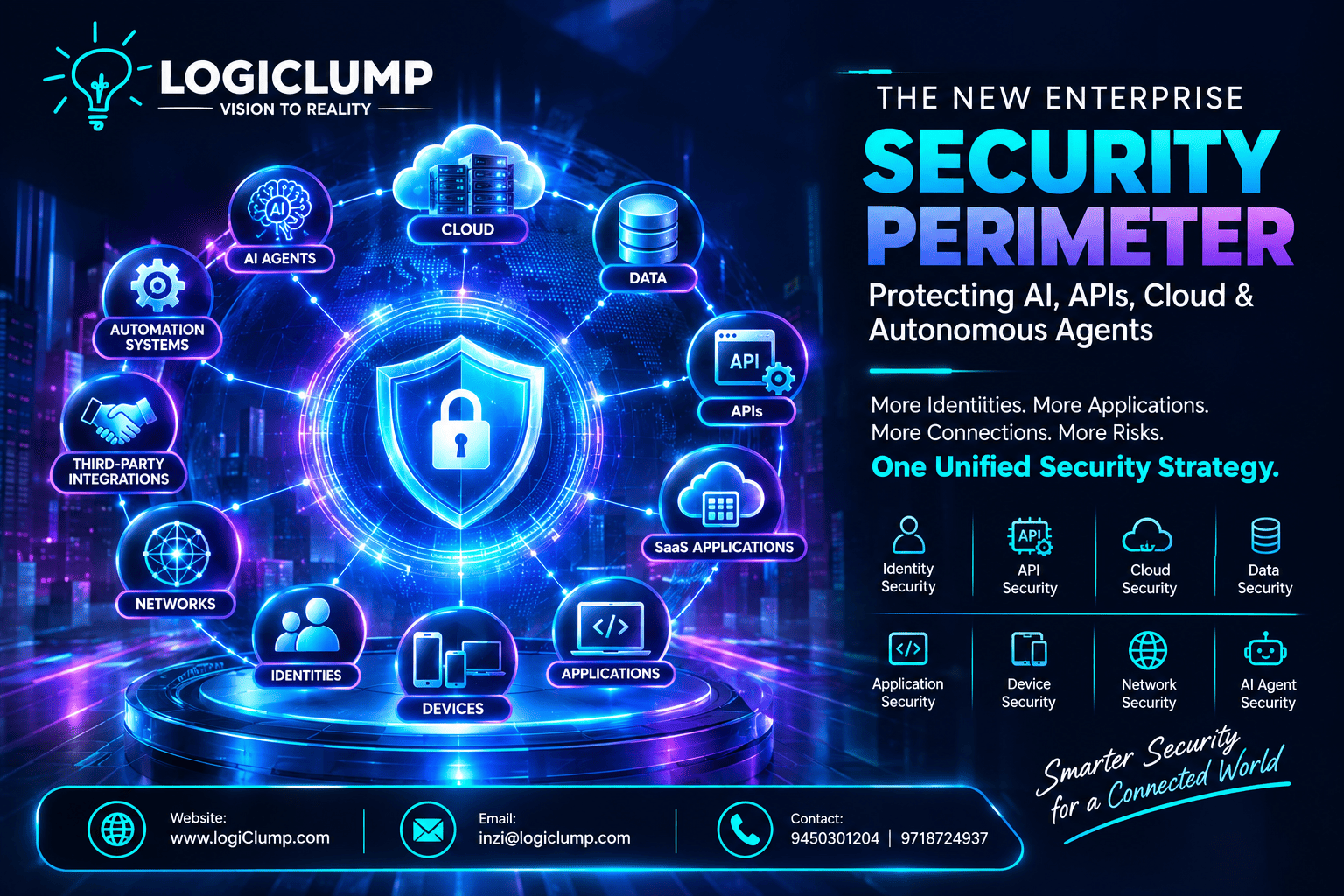
The New Enterprise Security Perimeter
Enterprise security used to have a relatively simple idea of a perimeter.
Organizations protected their offices, servers, internal networks, firewalls, and data centers. Employees connected from inside the corporate network, applications were hosted in controlled environments, and security teams focused heavily on keeping unauthorized users outside.
Modern software has changed that model.
Businesses now operate across cloud platforms, SaaS applications, APIs, mobile devices, remote networks, third-party services, AI systems, and autonomous software agents.
The result is a new security reality:
The enterprise perimeter is no longer a single network boundary.
It is an interconnected ecosystem of identities, applications, APIs, data, workloads, devices, and increasingly autonomous AI systems.
As AI agents begin to interact with business applications and perform tasks on behalf of employees, protecting this environment requires more than traditional firewalls and endpoint security.
Organizations need to understand who or what is accessing a system, what it is allowed to do, which data it can reach, and what happens when something behaves unexpectedly.
This is creating what can be described as the new enterprise security perimeter.
What Is the New Enterprise Security Perimeter?
The modern security perimeter is the collection of controls that protect an organization's digital environment.
It includes:
- Human identities
- AI-agent identities
- APIs
- Cloud workloads
- SaaS applications
- Databases
- Devices
- Applications
- Data
- Network connections
- Third-party integrations
- Automation systems
Instead of protecting only the boundary around a corporate network, organizations increasingly need to protect the relationships between these components.
For example:
Employee → AI Assistant → API → Cloud Application → Database
Every connection in this chain can become a security boundary.
A compromised identity, overly permissive API, vulnerable application, or poorly controlled AI agent can potentially become a path into sensitive business systems.
That means enterprise security must increasingly operate at the identity, application, API, data, and runtime levels.
Why the Traditional Perimeter Is Changing
The traditional enterprise network assumed that location mattered.
A user inside the corporate network was often treated differently from someone outside it.
Modern cloud environments make that assumption much harder to maintain.
Employees may work from home, offices, airports, or customer locations.
Applications may run across multiple cloud providers.
Data may move between SaaS platforms and internal systems.
Developers may deploy services through automated CI/CD pipelines.
AI agents may access tools and APIs without a human manually performing every action.
As a result, simply asking:
“Is this request coming from inside the network?”
is no longer enough.
Security needs to ask:
“Who is making this request, what is it trying to access, why does it need access, and is the requested action permitted?”
This is closely aligned with the identity-centric approach of modern Zero Trust architectures. NIST's cloud-native Zero Trust guidance emphasizes application and service identities, API gateways, and granular authorization rather than relying primarily on network location.
AI Is Creating a New Security Boundary
Generative AI originally entered businesses primarily as an assistant.
Users asked questions, generated content, summarized information, or wrote code.
AI agents are different.
An agent can potentially:
- Read business information
- Call APIs
- Search databases
- Send messages
- Create tickets
- Modify records
- Run software tools
- Trigger workflows
- Coordinate with other agents
This creates a fundamental security challenge.
An AI system that can take actions becomes part of the organization's operational environment.
The security team therefore needs to know:
- Which agents exist?
- Who created them?
- Who owns them?
- Which applications can they access?
- Which APIs can they call?
- Which data can they read?
- Which actions can they perform?
- How long should their permissions remain active?
- How can their access be revoked?
NIST has specifically highlighted the need for appropriate identification and authorization controls for AI agents because they may receive access to diverse data, tools, and applications.
AI Agents Need Their Own Identity
One of the biggest architectural changes introduced by agentic software is the rise of non-human identities.
A traditional employee might authenticate using an identity provider and receive permissions based on their role.
An AI agent needs a similar concept.
Instead of treating an agent as an anonymous process or simply giving it a permanent API key, organizations can assign it a distinct identity.
For example:
Sales Research Agent
Identity:
agent-sales-research
Allowed:
- Read approved CRM information
- Search public company information
- Generate research reports
Not allowed:
- Delete customer records
- Change account permissions
- Transfer money
This creates a much clearer security boundary.
If the agent behaves unexpectedly, its access can be investigated or revoked without affecting unrelated users and systems.
Least Privilege Becomes Even More Important
The principle of least privilege is not new.
But AI agents make it more important because they can potentially make decisions and execute multiple actions automatically.
Giving an agent broad permissions simply because it might need them creates unnecessary risk.
Instead, organizations should provide the smallest permission set required for the task.
For example, a customer-support agent may need permission to:
- Read customer tickets
- Read order status
- Create support notes
It may not need permission to:
- Delete accounts
- Change billing information
- Modify administrator roles
- Export the entire customer database
Permissions should be based on the agent's specific business responsibility.
APIs Are Becoming Security Boundaries
APIs connect modern enterprise software.
They allow applications to communicate with:
- CRMs
- Payment systems
- Databases
- Cloud platforms
- Mobile applications
- Analytics systems
- AI services
- Internal microservices
- Third-party platforms
When AI agents begin using these APIs, API security becomes even more important.
NIST's 2026 API protection guidance emphasizes identifying API risks across development and runtime and applying appropriate controls throughout the API lifecycle.
A secure API strategy should consider:
- Strong authentication
- Fine-grained authorization
- Input validation
- Rate limiting
- Schema validation
- Encryption
- API gateways
- Logging
- Monitoring
- Secret management
- Anomaly detection
An API should not assume that a request is trustworthy simply because it came from an approved application.
The requester's identity, permissions, context, and intended action should matter.
Cloud Has Become Part of the Perimeter
Cloud computing has expanded the enterprise attack surface.
Applications can now operate across:
- Public cloud
- Private cloud
- Hybrid infrastructure
- Multiple cloud providers
- SaaS platforms
- Serverless environments
- Containers
- Kubernetes clusters
- Edge environments
This creates a distributed security environment.
A business may have one application running across several services, each with its own identities, permissions, APIs, secrets, logs, and configuration.
Multi-cloud environments can make centralized security particularly challenging around identity, telemetry, configuration, data protection, and compliance. NIST's 2026 multi-cloud work identifies these areas as major architectural concerns.
Therefore, cloud security should not simply mean protecting the cloud account.
It should mean protecting the entire chain of identities, workloads, applications, APIs, data, and configurations operating within it.
Protecting Data Across the New Perimeter
Data remains one of the most valuable assets in an enterprise.
Modern systems may expose the same data through multiple paths:
Employee → SaaS → API → AI Agent → Database
Each path needs appropriate controls.
Organizations should understand:
- Where sensitive data is stored
- Which applications can access it
- Which APIs expose it
- Which AI systems can process it
- Which agents can retrieve it
- Where copies are created
- How long information is retained
Data protection should therefore be connected to identity and authorization.
Instead of asking only:
“Is this data encrypted?”
organizations also need to ask:
“Who can access this data, through which system, under what conditions, and for what purpose?”
Prompt Injection Is Also an Enterprise Security Problem
AI agents introduce security risks that traditional applications do not experience in exactly the same way.
One example is prompt injection.
An attacker may attempt to place malicious instructions inside content that an AI agent processes.
For example, an agent may read:
- An email
- A web page
- A document
- A support ticket
- A database record
The content could contain instructions designed to manipulate the agent into performing an unintended action.
OWASP identifies prompt injection, tool abuse, privilege escalation, data exfiltration, and memory poisoning among important AI-agent security concerns.
This demonstrates why an AI agent should not be trusted simply because its underlying model is considered reliable.
The security architecture around the model matters just as much.
Don't Let the AI Model Become the Security Boundary
One common mistake is expecting an AI model to enforce all security decisions.
An AI model can interpret information and make decisions, but critical security controls should exist outside the model wherever possible.
For example, an AI agent might decide:
“I need to access the customer database.”
The system should still verify:
- Does this agent have database access?
- Is this specific database allowed?
- Is this operation permitted?
- Is the requested data within its scope?
- Is the action consistent with policy?
The authorization layer—not the model's own reasoning—should enforce the final permission.
This creates an important principle:
AI can recommend an action. Security controls decide whether the action is allowed.
Runtime Monitoring Is Becoming Essential
Traditional security monitoring focuses heavily on users, endpoints, servers, applications, and network traffic.
Agentic environments add another dimension:
What is the AI system doing right now?
Security teams may need visibility into:
- Agent identity
- Tool usage
- API calls
- Data access
- Actions performed
- Permission changes
- Agent-to-agent communication
- Unusual behavior
- Failed authorization attempts
- Execution chains
OWASP's 2026 Agent Control Standard emphasizes that enterprise agents should be inspectable, traceable, instrumentable, and controllable at runtime.
This means observability is becoming part of AI security rather than merely an operational feature.
Authentication Is Not Enough
Authentication answers:
“Who are you?”
Authorization answers:
“What are you allowed to do?”
Modern enterprise security needs both.
An AI agent may successfully authenticate with a business application and still be prohibited from performing certain actions.
For example:
Authenticated agent: Sales Assistant
Allowed: Read lead information
Not allowed: Delete leads
Requires approval: Change customer contract information
This separation becomes especially important when agents act on behalf of human users.
NIST's recent guidance on tokens and assertions also emphasizes secure token verification, key management, lifecycle controls, and protection against forgery, theft, and misuse across identity and API access scenarios.
Short-Lived Credentials Can Reduce Risk
Permanent credentials create long-term exposure.
If an API key or access token remains valid indefinitely, an attacker who obtains it may have an extended opportunity to misuse it.
Modern architectures can instead use:
- Short-lived tokens
- Dynamic credentials
- Scoped permissions
- Automatic expiration
- Continuous authorization
- Credential rotation
This becomes particularly useful for autonomous agents.
An agent performing a temporary task should not necessarily receive permanent access to a sensitive system.
Human Approval Still Matters
Not every action should be fully autonomous.
Organizations can classify actions according to their risk.
Low-risk actions
An agent can act automatically.
Examples:
- Categorizing support tickets
- Generating internal summaries
- Creating draft reports
- Organizing non-sensitive information
Medium-risk actions
The agent prepares the action, but a human approves it.
Examples:
- Sending important customer communications
- Changing selected business records
- Creating external-facing content
High-risk actions
A human should remain directly involved.
Examples:
- Financial transfers
- Privilege changes
- Deleting critical records
- Production infrastructure changes
- High-value transactions
This approach allows businesses to gain automation benefits without treating every AI action as equally trustworthy.
Security Must Follow the Entire Workflow
A modern enterprise workflow may look like this:
Employee
↓
AI Agent
↓
Identity Provider
↓
Authorization Layer
↓
API Gateway
↓
Cloud Application
↓
Database
↓
Business Action
Security cannot stop at one layer.
Each stage needs appropriate controls.
For example:
Identity
Who is requesting the action?
Authorization
Is the action permitted?
API Security
Is the request valid?
Data Security
Can the requested information be accessed?
Runtime Security
Is the behavior normal?
Audit
Can the organization determine what happened?
This layered approach creates a much stronger security architecture.
The New Enterprise Security Architecture
A modern security architecture can be visualized as several connected layers.
1. Identity Layer
Protect users, services, workloads, and AI agents.
2. Access Layer
Apply authentication, authorization, least privilege, and policy enforcement.
3. API Layer
Secure communication between applications and services.
4. Application Layer
Protect business applications, SaaS platforms, microservices, and AI applications.
5. Data Layer
Control access to sensitive information and monitor data movement.
6. Cloud & Infrastructure Layer
Protect cloud resources, containers, workloads, networks, and configurations.
7. AI Security Layer
Protect models, agents, prompts, tools, memory, and AI workflows.
8. Observability Layer
Record activity and identify abnormal behavior.
9. Governance Layer
Define policies, ownership, approval requirements, compliance, and accountability.
Together, these layers create a security perimeter that is distributed rather than centralized.
Zero Trust Becomes the Foundation
The changing perimeter makes Zero Trust increasingly relevant.
The central idea is simple:
Never assume trust. Continuously verify.
In an AI-enabled enterprise, that principle can apply to:
- Users
- Devices
- Applications
- APIs
- Cloud workloads
- Service identities
- AI agents
- Data access
An authenticated identity should not automatically receive unlimited access.
Every important request should be evaluated according to identity, permissions, context, and policy.
Security Teams Need Agent Visibility
You cannot effectively secure what you cannot see.
As organizations deploy more AI tools, security teams need an inventory of:
- AI models
- AI applications
- Autonomous agents
- Agent owners
- Agent permissions
- Connected tools
- API integrations
- Data sources
- External services
This is especially important because AI agents may be introduced through business applications and SaaS platforms rather than traditional IT deployment processes.
The enterprise security team therefore needs visibility across both centrally developed AI systems and AI capabilities embedded inside third-party software.
AI Agent Security Requires Lifecycle Management
An AI agent should not simply be created and forgotten.
Organizations should manage an agent throughout its lifecycle:
Create → Register → Approve → Deploy → Monitor → Update → Review → Disable
Each stage creates security responsibilities.
For example:
Before deployment
- Define the agent's purpose
- Assign an owner
- Define permissions
- Identify connected systems
- Test behavior
During operation
- Monitor activity
- Review access
- Detect abnormal behavior
- Track API usage
- Maintain audit logs
When no longer needed
- Revoke credentials
- Remove integrations
- Disable the agent
- Preserve necessary audit information
This turns AI agents into managed enterprise assets rather than unmanaged software processes.
Building a Secure Enterprise Perimeter: A Practical Roadmap
Organizations do not need to transform their entire security architecture overnight.
A practical approach can begin with several steps.
Step 1: Map the Digital Environment
Identify users, applications, APIs, cloud workloads, data stores, AI systems, and agents.
Step 2: Build an Identity Inventory
Create clear identities for people, services, applications, and AI agents.
Step 3: Review Permissions
Determine what every identity can access and remove unnecessary privileges.
Step 4: Strengthen APIs
Implement authentication, authorization, validation, rate limiting, logging, and runtime monitoring.
Step 5: Protect AI Workflows
Evaluate agents for prompt injection, tool abuse, data leakage, excessive permissions, and unsafe actions.
Step 6: Introduce Runtime Monitoring
Track important activities across users, applications, APIs, cloud workloads, and agents.
Step 7: Add Human Approval
Require human authorization for sensitive or irreversible operations.
Step 8: Continuously Test
Use security testing, red teaming, vulnerability scanning, and controlled simulations to identify weaknesses.
OWASP's 2026 agentic security work emphasizes lifecycle-wide testing and defensive validation for risks such as prompt injection, privilege escalation, tool misuse, and other agent-specific threats.
What Businesses Should Avoid
Building a modern security architecture does not mean adding every available security product.
Organizations should avoid:
Giving AI agents excessive permissions
More access means more potential impact when something goes wrong.
Relying only on network security
Network controls remain important, but identity, application, API, and data controls are equally important in modern environments.
Using permanent API credentials everywhere
Credentials should be appropriately scoped, protected, rotated, and preferably short-lived where practical.
Treating AI output as trusted instructions
AI-generated actions should pass through policy and authorization controls.
Ignoring third-party AI
AI capabilities embedded in SaaS applications can also interact with sensitive enterprise data and systems.
Collecting logs without using them
Security telemetry is valuable only when organizations can analyze it and respond to meaningful signals.
The Future of Enterprise Security
The enterprise security perimeter is likely to become increasingly dynamic.
Instead of defining security around a fixed corporate network, organizations will increasingly define it around:
Identity + Authorization + APIs + Data + Applications + AI + Runtime Controls
This does not mean firewalls, endpoint security, or network segmentation are becoming irrelevant.
They remain important.
But they are becoming components of a much broader security architecture.
AI agents make this transformation particularly visible because software is beginning to act with greater autonomy.
The security question is no longer only:
“Can someone enter the network?”
It is also:
“What can this identity do after it enters the system?”
And increasingly:
“What can this autonomous software do after it receives permission?”
How LogiClump Can Help
Modern businesses need software architectures that are secure from the beginning—not security controls added after the application is built.
LogiClump can help businesses design and develop technology solutions involving:
- AI-powered applications
- AI agent integrations
- Secure APIs
- Cloud-based applications
- Enterprise dashboards
- CRM and business automation
- SaaS platforms
- FinTech applications
- Trading systems
- Web and mobile applications
- Third-party integrations
- Authentication and authorization systems
- Secure backend architectures
The goal should not simply be to connect more systems.
It should be to connect them securely, intelligently, and with clear control over who—or what—can access them.
Conclusion
Enterprise security is entering a new phase.
The traditional network perimeter is no longer sufficient to describe where an organization's digital assets begin and end.
Cloud applications, APIs, SaaS platforms, distributed data, remote users, automated workflows, and autonomous AI agents have created a much larger and more interconnected environment.
That environment requires a broader security strategy.
Organizations need to protect:
People.
Applications.
APIs.
Cloud workloads.
Data.
AI systems.
Autonomous agents.
And they need to understand how all of these components interact.
The new enterprise security perimeter is therefore not a wall around a network.
It is a system of identities, permissions, policies, APIs, applications, data controls, and continuous monitoring.
As AI agents become more capable of performing real business tasks, security will increasingly depend on controlling not just who can access a system, but what autonomous software is allowed to do once it gets there.
For modern businesses, the future of cybersecurity is becoming clear:
Verify every identity.
Control every connection.
Limit every permission.
Monitor every important action.
And never assume that autonomy means unlimited trust.
Contact Us:
🌐 Website: www.logiClump.com
📧 Email: inzi@logiclump.com
📞 Contact: 9450301204 | 9718724937
Explore the new enterprise security perimeter and learn how businesses can protect AI agents, APIs, cloud systems, data, identities, and autonomous software.
Tom Cruise