
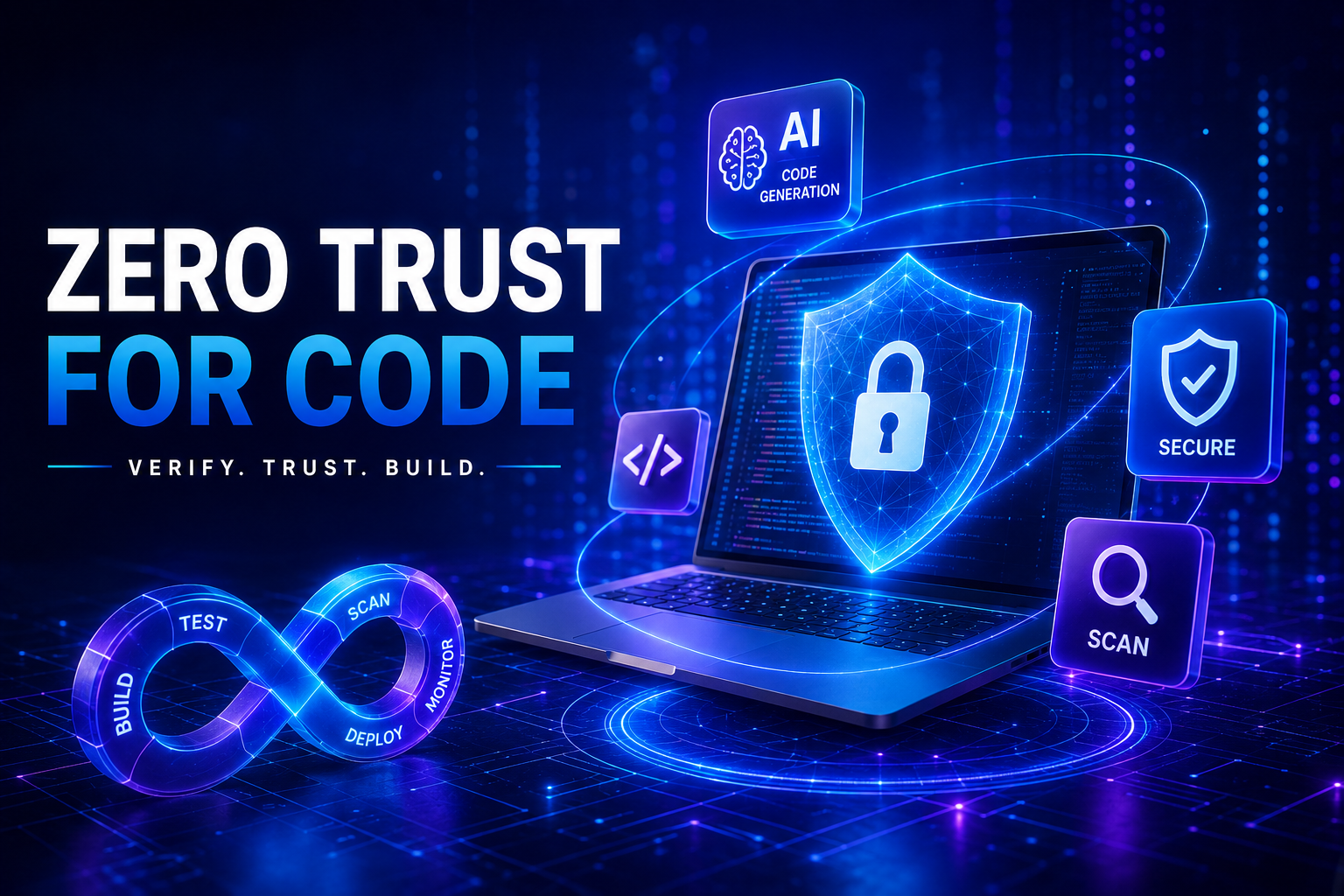
Trust Nothing. Secure Everything.
Artificial intelligence is changing the way software is built.
Developers can now describe a feature in plain language, ask an AI coding assistant to create the implementation, generate tests, fix errors, refactor existing code, and even automate parts of the development workflow. What once required hours of manual programming can sometimes be completed in minutes.
But faster development introduces a new question:
Can organizations trust code simply because it was generated by an AI system?
The answer should be no.
This is where the idea of “Zero Trust for Code” is gaining importance. The concept applies the familiar zero-trust security principle—never automatically trust, always verify—to the software development process itself.
Instead of assuming that code is safe because it came from an experienced developer, an AI assistant, an approved repository, or a popular framework, every significant code change should pass through appropriate verification before it becomes part of a production system.
What Is Zero Trust for Code?
Traditional zero-trust security assumes that no user, device, application, or network connection should receive automatic trust.
Zero Trust for Code applies a similar philosophy to software.
The basic principle is:
No code should be trusted until it has been reviewed, tested, validated, and proven safe for its intended environment.
This does not mean developers should stop using AI.
Quite the opposite.
AI can remain an extremely valuable development assistant. The difference is that AI-generated code should be treated as untrusted input until automated controls and human expertise establish that it is safe.
This approach becomes particularly important as AI coding tools move beyond simple autocomplete. Modern AI-assisted development can involve generating complete functions, modifying multiple files, installing dependencies, running commands, and interacting with development environments.
The more authority an AI tool receives, the greater the importance of verification.
Why AI-Generated Code Changes the Security Equation
Human developers make mistakes, and AI systems can make mistakes too. However, AI introduces some characteristics that make software security more complicated.
1. AI Can Generate Code That Looks Correct
One of the biggest dangers is not obviously broken code.
AI can produce code that is clean, readable, and functional while still containing a security weakness.
For example, generated code might:
- Use weak input validation
- Handle authentication incorrectly
- Expose sensitive information through logs
- Introduce insecure API behavior
- Use outdated dependencies
- Mishandle permissions
- Create unsafe database queries
- Implement cryptography incorrectly
The application may pass normal functional tests while the underlying security problem remains unnoticed.
OWASP has specifically identified inappropriate trust in AI-generated code as an emerging application-security concern.
2. AI May Recommend Outdated Dependencies
Software depends heavily on third-party packages.
An AI assistant may recommend a library or version that appears appropriate but contains a known vulnerability or is no longer the preferred implementation.
This is why dependency verification should not depend on the AI's recommendation alone.
Organizations should combine AI-assisted development with tools such as:
- Software Composition Analysis
- Dependency vulnerability scanning
- SBOM management
- Automated security updates
- Package integrity verification
- Continuous vulnerability monitoring
OWASP's current secure-coding guidance for AI-assisted development recommends auditing AI-suggested dependencies rather than accepting them automatically.
3. AI Coding Agents Can Have Too Much Access
The risk becomes considerably higher when AI tools are allowed to perform actions instead of merely suggesting code.
Imagine an AI development agent that can:
- Read the repository
- Modify source files
- Install packages
- Execute shell commands
- Access internal services
- Run tests
- Create pull requests
- Push changes
If that agent receives excessive permissions, a compromised instruction, malicious repository content, or an unsafe action could potentially affect much more than a single source file.
This creates an important security principle:
The permissions granted to an AI coding system should be no greater than the permissions necessary for its task.
In other words, AI development environments need their own form of least privilege.
From “Trust the Developer” to “Verify Every Change”
Traditional development workflows often rely heavily on developer experience.
An experienced engineer reviews the code, tests it, and approves the pull request.
That model still matters, but AI-assisted development adds another layer.
A developer may now review code that they did not personally write line by line.
Therefore, organizations need stronger mechanisms for proving what happened during development.
A modern workflow could record:
- Who requested the change
- Which AI tool was used
- Which model generated the code
- What files were modified
- Which dependencies were introduced
- Which security checks were performed
- Who reviewed the change
- Which tests passed
- When the code was approved
This creates accountability without preventing developers from benefiting from AI.
What a Zero Trust for Code Pipeline Could Look Like
A practical implementation can be built into the existing software development lifecycle.
Step 1: Generate
Developers use AI to create or modify code.
At this stage, the generated output is considered untrusted.
Step 2: Inspect
The change is reviewed for:
- Security vulnerabilities
- Unexpected functionality
- Sensitive-data exposure
- Permission changes
- Dependency modifications
- Configuration changes
Step 3: Scan
Automated security tools analyze the code.
A pipeline can include:
SAST → SCA → Secrets Scanning → Container Scanning → IaC Scanning → Tests
No single scanner is perfect, so multiple layers provide better coverage.
Step 4: Test
Functional tests verify that the software behaves correctly.
Security tests should independently examine authentication, authorization, input validation, encryption, API behavior, and other critical controls.
This distinction is important because passing a functional test does not automatically prove that an implementation is secure.
Step 5: Review
A human developer remains accountable for important changes.
The objective isn't to make humans review every character manually. Instead, human attention should focus on high-risk changes and decisions that require engineering judgment.
Step 6: Deploy With Controls
Only validated code should move toward production.
CI/CD pipelines can enforce policies such as:
- No critical vulnerabilities
- No exposed secrets
- Approved dependencies only
- Required code review
- Successful security tests
- Verified build artifacts
Step 7: Monitor Continuously
Security doesn't end when software is deployed.
New vulnerabilities can appear in dependencies. Configuration can change. Attack techniques evolve.
Therefore, production applications need continuous monitoring and periodic reassessment.
NIST's secure-development work similarly emphasizes integrating security throughout development and maintaining continuous improvement rather than treating security as a final checkpoint.
Zero Trust for Code Is More Than AI Security
Although AI is accelerating the need for this approach, the idea has applications beyond AI-generated software.
Developers already work with:
- Open-source packages
- External APIs
- Code repositories
- Cloud services
- Infrastructure-as-code
- Container images
- CI/CD pipelines
- Third-party SDKs
Each introduces potential risk.
Zero Trust for Code therefore represents a broader shift from trust-based development toward evidence-based development.
Instead of asking:
“Where did this code come from?”
organizations should increasingly ask:
“What evidence do we have that this code is safe?”
That is a much stronger security question.
The Role of Developers Is Changing
AI is unlikely to eliminate the need for software engineers.
It is changing what engineers spend their time doing.
Developers may spend less time writing repetitive code and more time on:
- Architecture
- System design
- Security decisions
- Code review
- Testing
- Performance
- Integration
- Reliability
- Business logic
- Risk management
This makes software engineering judgment even more valuable.
An AI system can generate thousands of lines of code quickly, but someone still needs to determine whether those lines belong in a production system.
Building a Practical Zero Trust Culture
Organizations don't need to completely redesign their development environments overnight.
A gradual approach can start with a few principles:
Treat AI output as untrusted
Never merge AI-generated code simply because it looks correct.
Apply least privilege
Give AI development tools only the permissions they actually need.
Automate security checks
Make security scanning part of CI/CD instead of relying exclusively on manual reviews.
Track provenance
Maintain visibility into where important code and dependencies originated.
Require human ownership
Every production change should have an accountable human owner.
Monitor after deployment
Security verification should continue after software reaches production.
These practices align with broader secure software development guidance from NIST and emerging OWASP recommendations for AI-assisted development.
The Future of Secure AI-Assisted Development
AI-assisted programming is not a temporary experiment. It is becoming another layer in the software development toolkit.
The organizations that benefit most will not necessarily be those that generate the most code.
They will be the organizations that can generate code quickly while maintaining confidence in its security, quality, and maintainability.
That requires a new mindset.
AI should be treated as a powerful development accelerator—not as an authority.
The future development pipeline may therefore look less like:
Prompt → Code → Production
and more like:
Prompt → Generate → Inspect → Test → Scan → Review → Approve → Deploy → Monitor
That additional verification may seem slower than blindly accepting AI output.
In reality, it can make development more sustainable by reducing the chance that speed today creates expensive security problems tomorrow.
Conclusion
The rise of AI-generated software is changing the definition of software development.
As machines become capable of writing, modifying, testing, and deploying increasingly complex applications, organizations need stronger ways to establish trust in the resulting code.
Zero Trust for Code offers a useful philosophy:
Don't trust code because it was written by a human.
Don't trust it because it was generated by AI.
Trust it only after appropriate evidence shows that it is secure, tested, reviewed, and fit for purpose.
For companies adopting AI-assisted development, this approach can provide the balance they need: the speed of AI with the discipline of secure engineering.
The future of software development may not be about choosing between humans and AI.
It may be about building development systems where AI creates faster—and security controls make sure nothing is trusted blindly.
Discover how Zero Trust for Code secures AI-generated software by verifying every change, scanning for vulnerabilities, and protecting code from development to deployment.
Tom Cruise